 Back
BackPhysics Homework Guidance: Interference, Sound, and Electrostatics
Study Guide - Smart Notes
 Tailored notes based on your materials, expanded with key definitions, examples, and context.
Q1. Interference of Circular Wave Fronts (P16.42)
Background
Topic: Wave Interference (Sound or Water Waves)
This question tests your understanding of constructive and destructive interference from two in-phase sources. You are asked to analyze the path length differences at points P, Q, and R and determine the type of interference at each point.
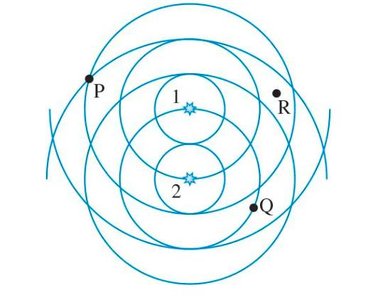
Key Terms and Formulas:
Path length difference (): The difference in distance from each source to a given point.
Constructive interference: Occurs when (where is an integer, is wavelength).
Destructive interference: Occurs when .
Step-by-Step Guidance
For each point (P, Q, R), determine the distance from each source to the point in terms of (as shown in the diagram or problem statement).
Calculate the path length difference for each point.
Compare to the criteria for constructive and destructive interference:
If is a whole number multiple of , the interference is constructive.
If is a half-integer multiple of , the interference is destructive.
Fill in the table with , , , and indicate C (constructive) or D (destructive) for each point.
Try solving on your own before revealing the answer!
Q2. Interference from Two Loudspeakers (P16.43)
Background
Topic: Sound Interference
This question asks you to determine the type of interference (constructive, destructive, or in-between) at a specific point due to two in-phase loudspeakers emitting sound waves.
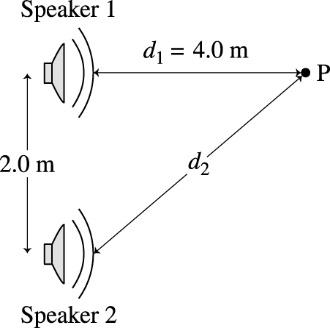
Key Terms and Formulas:
Wavelength (): , where is the speed of sound and is the frequency.
Path length difference (): .
Constructive interference:
Destructive interference:
Step-by-Step Guidance
Calculate the wavelength using , where m/s and Hz.
Find the distance from Speaker 1 to point P ( m) and from Speaker 2 to point P (). Use the Pythagorean theorem: .
Compute the path length difference: .
Express as a multiple of to determine if it matches the condition for constructive or destructive interference.
Try solving on your own before revealing the answer!
Q3. Charge States of Suspended Balls (Q20.1)
Background
Topic: Electrostatics – Charging and Charge Interactions
This question tests your understanding of how objects interact based on their charge states (positive, negative, or neutral) and the concept of charge polarization.
Key Terms and Concepts:
Like charges repel, unlike charges attract.
Neutral objects can be attracted to charged objects due to polarization.
Plastic rod rubbed with wool: Becomes negatively charged.
Step-by-Step Guidance
Recall that ball A is touched by a negatively charged rod, so it becomes negatively charged.
Since balls B, C, and D are attracted to A, they must be either neutral or positively charged.
B and D have no effect on each other, which means both are neutral (if either were charged, there would be attraction or repulsion).
B is attracted to C, so C must be charged (since B is neutral, this is due to polarization).
Since C is attracted to A (which is negative), C must be positive.
Try solving on your own before revealing the answer!
Q4. Behavior of Charged Balls (Q20.26)
Background
Topic: Electrostatics – Forces Between Charged Objects
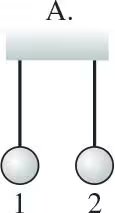
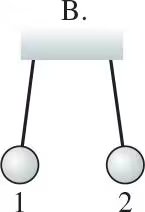
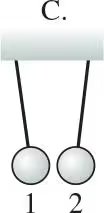
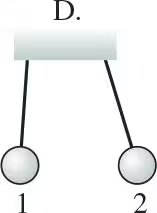
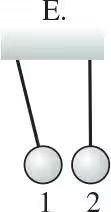
This question asks you to predict how two lightweight, conducting balls will behave after being touched by charged rods in various scenarios. You must choose the correct diagram for each case.
Key Terms and Concepts:
Like charges repel, opposite charges attract.
Neutral objects are attracted to charged objects due to polarization.
Newton's Third Law: Forces between two objects are equal in magnitude and opposite in direction.
Step-by-Step Guidance
For each scenario (a–d), determine the charge on each ball after the described action.
Predict whether the balls will repel, attract, or remain unaffected based on their charges.
Match the behavior to the correct diagram (A–E) based on the direction the balls move.
Remember that like charges repel (move apart), opposite charges attract (move together), and a charged and neutral ball will attract due to polarization.
Try solving on your own before revealing the answer!
Q5. Electric Force on a Charge (P20.17)
Background
Topic: Coulomb's Law – Electric Forces Between Point Charges
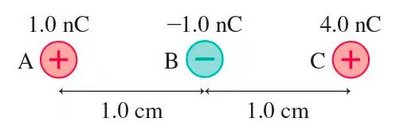
This question asks you to calculate the magnitude and direction of the electric force on charge A due to charges B and C, and then find the net force.
Key Terms and Formulas:
Coulomb's Law:
N·m/C
Forces are vectors; direction matters (attraction or repulsion).
Step-by-Step Guidance
Calculate the force on A due to B using Coulomb's law. Note the sign and direction (attraction or repulsion).
Calculate the force on A due to C using Coulomb's law. Again, note the sign and direction.
Add the forces vectorially (since all charges are in a straight line, you can use signs to indicate direction).
Express the net force in terms of magnitude and direction, but stop before the final calculation.
Try solving on your own before revealing the answer!
Q6. Charge on Accelerating Spheres (P20.51)
Background
Topic: Coulomb's Law and Newton's Second Law
This question asks you to find the magnitude of the charge on each of two identical spheres, given their mass, separation, and acceleration when released.
Key Terms and Formulas:
Coulomb's Law: (since both charges are equal)
Newton's Second Law:
Step-by-Step Guidance
Set the electric force equal to the mass times acceleration: .
Rearrange to solve for : .
Take the square root to solve for .
Plug in the given values (mass, acceleration, separation, and ), but stop before the final calculation.
Try solving on your own before revealing the answer!
