 Back
BackPhysics I: Kinematics, Dynamics, and Motion Study Guide
Study Guide - Smart Notes
 Tailored notes based on your materials, expanded with key definitions, examples, and context.
Problem 1: Kinematic Plots
Q1a. What was Marty’s average acceleration after the entire 20 seconds?
Background
Topic: Kinematics – Average Acceleration
This question tests your understanding of how to calculate average acceleration from a velocity vs. time graph.
Key Terms and Formulas
Average acceleration (): The change in velocity divided by the change in time.
Step-by-Step Guidance
Identify the initial velocity () at seconds from the graph.
Identify the final velocity () at seconds from the graph.
Calculate the change in velocity: .
Calculate the change in time: seconds.
Try solving on your own before revealing the answer!
Q1b. What was Marty’s acceleration at seconds?
Background
Topic: Instantaneous Acceleration
This question tests your ability to determine the instantaneous acceleration from a velocity vs. time graph, which is the slope at a specific point.
Key Terms and Formulas
Instantaneous acceleration: The slope of the velocity vs. time graph at a specific time.
Step-by-Step Guidance
Locate seconds on the time axis of the graph.
Estimate the slope of the velocity curve at this point (rise over run).
Use two nearby points to calculate around s.
Try solving on your own before revealing the answer!
Q1c. What was Marty’s acceleration at seconds?
Background
Topic: Instantaneous Acceleration
This is similar to part (b), but at a different time. You are again finding the slope of the velocity vs. time graph at s.
Key Terms and Formulas
Instantaneous acceleration:
Step-by-Step Guidance
Find seconds on the graph.
Determine the slope of the velocity curve at this point (use two points close to s).
Calculate for those points.
Try solving on your own before revealing the answer!
Q1d. At what time does Marty stop and turn around?
Background
Topic: Kinematics – Turning Point
This question tests your ability to interpret a velocity vs. time graph to find when the object changes direction (velocity crosses zero).
Key Terms and Formulas
Turning point: When velocity and changes sign.
Step-by-Step Guidance
Look for the point on the graph where the velocity curve crosses the time axis ().
Read the corresponding time value from the graph.
Try solving on your own before revealing the answer!
Q1e. Sketch the position versus time graph for Marty’s motion.
Background
Topic: Position-Time Graphs from Velocity-Time Graphs
This question tests your ability to qualitatively sketch a position vs. time graph based on the shape of a velocity vs. time graph.
Key Concepts
When velocity is positive, position increases; when velocity is negative, position decreases.
The slope of the position vs. time graph at any point is the velocity at that time.
Where velocity crosses zero, the position graph has a maximum or minimum (turning point).
Step-by-Step Guidance
Identify intervals where velocity is positive, negative, or zero.
Sketch a curve that increases when velocity is positive and decreases when velocity is negative.
Mark the turning point where velocity crosses zero.
Label your axes: position (y-axis), time (x-axis).
Try sketching the graph before checking the answer!
Problem 2: 1-D Motion
Q2a. If car #1 starts at the origin (), at what position do the two cars run into each other?
Background
Topic: Kinematics – Relative Motion with Constant Acceleration
This question tests your ability to set up and solve equations for two objects moving toward each other with constant acceleration.
Key Terms and Formulas
Position with constant acceleration:
Step-by-Step Guidance
Write the position equation for car #1:
Write the position equation for car #2, starting at m and moving toward car #1:
Set to find the time when they meet.
Solve for using the given accelerations.
Plug back into either position equation to find the meeting position.
Try solving on your own before revealing the answer!
Q2b. If , what would the position equation for car #3 look like?
Background
Topic: Kinematics – Non-Constant Acceleration
This question tests your ability to integrate acceleration as a function of time to find velocity and position.
Key Terms and Formulas
Acceleration:
Velocity:
Position:
Step-by-Step Guidance
Integrate with respect to to find .
Integrate with respect to to find .
Include constants of integration if initial velocity or position are not zero.
Try solving on your own before revealing the answer!
Problem 3: Circular Motion and Newton’s 2nd Law
Q3a. If mass #1 is experiencing 12 g’s of acceleration, how fast is it travelling?
Background
Topic: Circular Motion – Centripetal Acceleration
This question tests your understanding of centripetal acceleration and how to relate it to speed in circular motion.
Key Terms and Formulas
Centripetal acceleration:
Given: , m/s, m
Step-by-Step Guidance
Calculate the total centripetal acceleration: m/s.
Set and solve for .
Plug in the values for and to find .
Try solving on your own before revealing the answer!
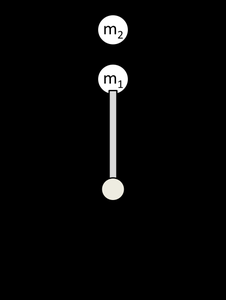
Q3b. How fast is mass #2 travelling?
Background
Topic: Circular Motion – Linear Speed at Different Radii
This question tests your understanding that objects at different radii in circular motion have different linear speeds if they complete a revolution in the same time.
Key Terms and Formulas
Linear speed:
Angular velocity () is the same for both masses.
Step-by-Step Guidance
Find the angular velocity using and from part (a): .
Calculate , where m (8 m + 2 m rod).
Try solving on your own before revealing the answer!
Q3c. How many times does mass 2 travel a full circle in one minute?
Background
Topic: Circular Motion – Frequency and Period
This question tests your ability to relate linear speed, circumference, and time to find the number of revolutions per minute.
Key Terms and Formulas
Circumference:
Number of revolutions:
Step-by-Step Guidance
Calculate the circumference for mass 2: .
Use the speed from part (b) and s to find the number of revolutions: .
Try solving on your own before revealing the answer!
Problem 4: Relative Velocity
Q4a. Draw a diagram depicting this problem.
Background
Topic: Relative Velocity in Two Dimensions
This question tests your ability to visualize and represent velocity vectors for objects moving in different directions.
Key Concepts
Draw vectors for the boat, river, and car, labeling their directions and magnitudes.
Step-by-Step Guidance
Draw an x-y coordinate system.
Draw the boat's velocity vector: m/s.
Draw the river's velocity vector: m/s.
Draw the car's velocity vector: m/s.
Try sketching the diagram before checking the answer!
Q4b. What would the velocity of the boat be if the river were calm?
Background
Topic: Relative Velocity – Reference Frames
This question tests your understanding of how to subtract the river's velocity to find the boat's velocity relative to the water.
Key Terms and Formulas
Relative velocity:
Step-by-Step Guidance
Write the observed velocity of the boat: m/s.
Write the river's velocity: m/s.
Subtract the river's velocity from the boat's observed velocity to get the boat's velocity in a calm river.
Try solving on your own before revealing the answer!
Q4c. What would the magnitude of the boat’s velocity in a calm river and what is the angle that would be measured from the x-axis?
Background
Topic: Vector Magnitude and Direction
This question tests your ability to calculate the magnitude and direction (angle) of a vector from its components.
Key Terms and Formulas
Magnitude:
Angle:
Step-by-Step Guidance
Use the x and y components of the boat's velocity in a calm river from part (b).
Calculate the magnitude using the Pythagorean theorem.
Calculate the angle from the x-axis using the arctangent formula.
Try solving on your own before revealing the answer!
Problem 5: Projectile Motion
Q5a. Draw a diagram depicting the situation.
Background
Topic: Projectile Motion
This question tests your ability to visualize projectile motion, including the launch angle and range.
Key Concepts
Draw the cannon at the origin, the projectile's parabolic path, and label the launch angle () and range (60 m).
Step-by-Step Guidance
Draw an x-y coordinate system with the cannon at the origin.
Draw the projectile's path as a parabola, landing at m.
Label the launch angle from the x-axis.
Try sketching the diagram before checking the answer!
Q5b. What speed did the projectile leave the cannon at?
Background
Topic: Projectile Motion – Range Equation
This question tests your ability to use the range equation for projectile motion to solve for the initial speed.
Key Terms and Formulas
Range equation:
Given: m, , m/s
Step-by-Step Guidance
Write the range equation for projectile motion: .
Plug in the known values for , , and .
Rearrange the equation to solve for .
Calculate for .
Try solving on your own before revealing the answer!
