 Back
BackPhysics I: Mechanics – Energy and Work Study Guidance
Study Guide - Smart Notes
 Tailored notes based on your materials, expanded with key definitions, examples, and context.
Q1. A 5.0 kg cannonball is fired straight up at 35 m/s. What is its speed after rising 45 m?
Background
Topic: Conservation of Energy / Work-Energy Theorem
This question tests your understanding of how kinetic and potential energy change as an object moves vertically under gravity, and how to use the work-energy theorem to relate these changes to the object's speed.
Key Terms and Formulas
Kinetic Energy:
Gravitational Potential Energy:
Work-Energy Theorem:
Conservation of Energy:
Step-by-Step Guidance
Identify the initial and final energies: The cannonball starts with an initial kinetic energy and zero additional potential energy (if you set at the starting point).
As the cannonball rises, it gains gravitational potential energy and loses kinetic energy. The work done by gravity is negative, as it opposes the motion.
Set up the energy conservation equation: or
Plug in the known values: kg, m/s, m, m/s2.

Try solving on your own before revealing the answer!
Final Answer: 18 m/s
The speed decreases as the cannonball rises, converting kinetic energy to potential energy.
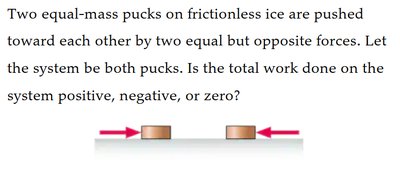
Q2. Two equal-mass pucks on frictionless ice are pushed toward each other by two equal but opposite forces. Let the system be both pucks. Is the total work done on the system positive, negative, or zero?
Background
Topic: Work and Systems
This question tests your understanding of how work is calculated for a system, especially when forces are internal and equal/opposite.
Key Terms and Formulas
Work:
Internal Forces: Forces that act within the system and do not change the total energy of the system.
Step-by-Step Guidance
Recognize that the forces are equal and opposite, acting on each puck.
Since the system is defined as both pucks, internal forces do not contribute to the net work done on the system.
Recall that work done by internal forces cancels out when considering the whole system.
Try solving on your own before revealing the answer!
Final Answer: Zero
Internal forces do not change the total energy of the system, so the net work is zero.
Q3. A crane uses a single cable to lower a steel girder into place. The girder moves with constant speed. The cable tension does work and gravity does work . Which statement is true?
Background
Topic: Work and Forces
This question tests your understanding of the sign of work done by different forces when an object moves at constant speed.
Key Terms and Formulas
Work:
Constant Speed: Net force is zero, so forces are balanced.
Sign of Work: Positive if force is in direction of displacement, negative if opposite.
Step-by-Step Guidance
Identify the direction of displacement: The girder is moving downward.
Gravity acts downward (same direction as displacement), so is positive.
Cable tension acts upward (opposite to displacement), so is negative.
Since speed is constant, the magnitudes of the work are equal and opposite.
Try solving on your own before revealing the answer!
Final Answer: c. is negative and is positive.
The tension opposes the motion, while gravity aids it.
Q4. A 70 kg skier is gliding at 2.0 m/s when he starts down a very slippery 50-m-long, 10° slope. What is his speed at the bottom?
Background
Topic: Conservation of Energy / Work-Energy Theorem
This question tests your ability to use energy conservation to find the final speed of an object moving down an inclined plane.
Key Terms and Formulas
Kinetic Energy:
Gravitational Potential Energy:
Height from slope:
Conservation of Energy:
Step-by-Step Guidance
Calculate the vertical height descended:
Set up the energy conservation equation:
Plug in the known values: kg, m/s, m/s2, as calculated.
Solve for (final speed at the bottom).

Try solving on your own before revealing the answer!
Final Answer: 14 m/s
The skier gains speed as potential energy is converted to kinetic energy.
Q5. A 1500 kg car is towed, starting from rest. The tension force in the tow rope as the car travels from m to m. What is the car's speed after being pulled 200 m?
Background
Topic: Work-Energy Theorem
This question tests your ability to relate the work done by a variable force to the change in kinetic energy of an object.
Key Terms and Formulas
Work:
Kinetic Energy:
Work-Energy Theorem:
Step-by-Step Guidance
Calculate the total work done by the tension force over the 200 m distance (area under the force vs. distance curve).
Set up the work-energy theorem:
Since the car starts from rest, .
Plug in the values for and to solve for .
Try solving on your own before revealing the answer!
Final Answer: 26 m/s
The car's speed increases as work is done by the tension force.
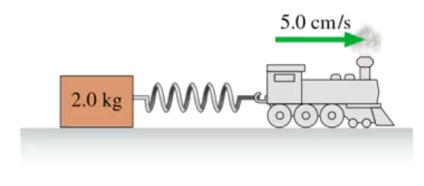
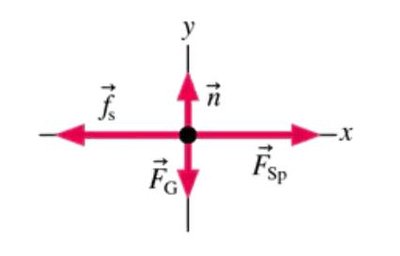
Q6. A spring attached to a 2.0 kg block is pulled by a motorized toy train that moves forward at 5.0 cm/s. The spring constant is 50 N/m, and the coefficient of static friction between the block and the surface is 0.60. The spring is at its equilibrium length at s when the train starts to move. When does the block slip?
Background
Topic: Static Friction and Hooke's Law
This question tests your understanding of the conditions under which an object overcomes static friction and begins to move, using the spring force and friction force.
Key Terms and Formulas
Hooke's Law:
Maximum Static Friction:
Normal Force: (for horizontal surfaces)
Slip Condition:
Step-by-Step Guidance
Calculate the maximum static friction:
Set the spring force equal to the maximum static friction:
Solve for (the displacement at which the block slips).
Calculate the time interval: , where is the speed of the train.
Try solving on your own before revealing the answer!
Final Answer: 4.7 s
The block slips when the spring force exceeds the maximum static friction.
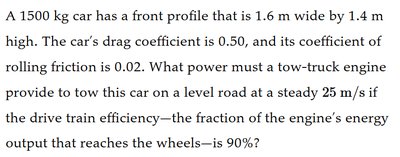
Q7. A 1500 kg car has a front profile that is 1.6 m wide by 1.4 m high. The car's drag coefficient is 0.50, and its coefficient of rolling friction is 0.02. What power must a tow-truck engine provide to tow this car on a level road at a steady 25 m/s if the drive train efficiency—the fraction of the engine's energy output that reaches the wheels—is 90%?
Background
Topic: Power, Drag, and Friction
This question tests your ability to calculate the power required to overcome both rolling friction and air drag, and to account for engine efficiency.
Key Terms and Formulas
Rolling Friction Force:
Drag Force:
Total Force:
Power:
Efficiency:
Step-by-Step Guidance
Calculate the rolling friction force:
Calculate the drag force: (use kg/m3 for air density, m2).
Add the forces to get total tension:
Calculate the power required:
Account for efficiency:
Try solving on your own before revealing the answer!
Final Answer: 20,000 W
The engine must provide extra power to compensate for inefficiency.
