 Back
BackPhysics I: Mechanics – Kinematics in 2D, Projectile Motion, Relative Motion, and Circular Motion – Step-by-Step Study Guidance
Study Guide - Smart Notes
 Tailored notes based on your materials, expanded with key definitions, examples, and context.
Q1. A sports car’s position on a winding road is given by:
, where is in seconds and is in meters. What are the car’s speed and direction at s?
Background
Topic: Kinematics in Two Dimensions
This question tests your understanding of how to find velocity (as a vector), speed (as a magnitude), and direction (as an angle) from a position function in 2D motion.
Key Terms and Formulas
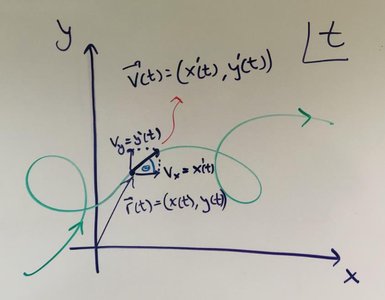
Position vector:
Velocity vector:
Speed:
Direction (angle from x-axis):
Step-by-Step Guidance
Find the velocity components by differentiating the position functions with respect to time: and .
Evaluate and at s by substituting into your derivatives.
Calculate the speed using the magnitude formula: .
Determine the direction by finding the angle with respect to the x-axis: .
Try solving on your own before revealing the answer!
Final Answer:
At s, m/s, m/s. The speed is $38 from the x-axis (measured counterclockwise).
These values are found by differentiating, substituting, and applying the magnitude and angle formulas as shown above.
Q2. In the distant future, a small spacecraft is drifting “north” through the galaxy at 680 m/s when it receives a command to return to the starship. The pilot rotates the spacecraft until the nose is pointed 25° north of east, then engages the ion engine. The spacecraft accelerates at 75 m/s². Plot the spacecraft’s trajectory for the first 20 s.
Background
Topic: Kinematics in Two Dimensions with Constant Acceleration
This question tests your ability to decompose initial velocity and acceleration vectors, and to use kinematic equations to describe 2D motion.
Key Terms and Formulas
Initial velocity:
Acceleration:
Position equations:
Step-by-Step Guidance
Decompose the initial velocity and acceleration into x and y components using trigonometry: , ,
Write the position equations for and using the kinematic formulas above, with and .
Substitute the values for , , and the angle into your equations to get explicit expressions for and .
To plot the trajectory, calculate and at several time points (e.g., s).
Try solving on your own before revealing the answer!
Final Answer:
The trajectory is given by and (with in seconds and , in meters). Plot these for to $20$ s to visualize the path.
The equations are derived by decomposing the vectors and applying the kinematic formulas for each direction.
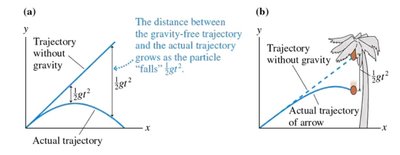
Q3. A hungry bow-and-arrow hunter in the jungle wants to shoot down a coconut that’s hanging from the branch of a tree. He points his arrow directly at the coconut, but as luck would have it, the coconut falls from the branch at the exact instant the hunter releases the string. Does the arrow hit the coconut?
Background
Topic: Projectile Motion and Relative Motion in Gravity
This question explores the effect of gravity on two objects released simultaneously: one projected and one dropped. It tests your understanding of how vertical motion under gravity affects both objects.
Key Terms and Formulas
Projectile motion equations:
Both the arrow and coconut experience the same vertical acceleration due to gravity ().
Step-by-Step Guidance
Recognize that both the arrow and coconut start their vertical motion at the same instant and are subject to the same gravitational acceleration.
Write the vertical position equations for both the arrow and the coconut as functions of time, considering their initial velocities and positions.
Set up the condition for the arrow to hit the coconut: their and positions must be equal at the same time .
Analyze how the vertical displacement due to gravity affects both objects equally, regardless of the arrow’s initial velocity.
Try solving on your own before revealing the answer!
Final Answer:
Yes, the arrow will hit the coconut. Both objects fall the same vertical distance in the same time, so their paths intersect as long as the arrow was initially aimed directly at the coconut.
This is a classic demonstration of the independence of horizontal and vertical motion in projectile problems.
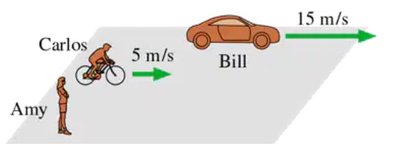
Q4. The police are chasing a bank robber. While driving at 50 m/s, they fire a bullet to shoot out a tire of his car. The police gun shoots bullets at 300 m/s. What is the bullet’s speed as measured by a TV camera crew parked beside the road?
Background
Topic: Relative Motion in One Dimension
This question tests your understanding of how to add velocities from different reference frames (Galilean transformation).
Key Terms and Formulas
Relative velocity:
Step-by-Step Guidance
Identify the velocity of the bullet relative to the police car () and the velocity of the police car relative to the ground ().
Add the two velocities to find the bullet’s velocity relative to the ground (TV camera).
Write the equation: .
Try solving on your own before revealing the answer!
Final Answer:
The bullet’s speed as seen by the TV camera is $350$ m/s. This is the sum of the bullet’s speed relative to the police and the police car’s speed relative to the ground.
Q5. Cleveland is 300 miles east of Chicago. A plane leaves Chicago flying due east at 500 mph. The pilot forgot to check the weather and doesn’t know that the wind is blowing to the south at 50 mph. What is the plane’s ground speed? Where is the plane 0.60 h later, when the pilot expects to land in Cleveland?
Background
Topic: Relative Motion in Two Dimensions
This question tests your ability to add velocity vectors in two dimensions and to use them to predict position after a given time.
Key Terms and Formulas
Ground speed:
Displacement:
Step-by-Step Guidance
Write the velocity vector of the plane relative to the ground by adding the plane’s velocity (east) and the wind’s velocity (south).
Calculate the magnitude of the ground speed using the Pythagorean theorem.
Multiply the velocity vector by the time (0.60 h) to find the displacement vector from Chicago.
Interpret the result: the plane will be south of Cleveland after 0.60 h due to the wind.
Try solving on your own before revealing the answer!
Final Answer:
The plane’s ground speed is $502 h, the plane is $300 miles south of Chicago, so it is $30$ miles south of Cleveland.
Q6. A ceiling fan spinning at 60 rpm coasts to a stop 25 s after being turned off. How many revolutions does it make while stopping?
Background
Topic: Rotational Kinematics with Constant Angular Acceleration
This question tests your ability to use rotational kinematic equations to find angular displacement when angular acceleration is constant.
Key Terms and Formulas
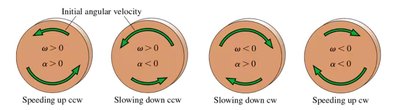
Initial angular velocity: (convert rpm to rad/s)
Final angular velocity: (since it stops)
Angular acceleration:
Angular displacement:
Number of revolutions:
Step-by-Step Guidance
Convert the initial angular velocity from rpm to rad/s: rad/s.
Calculate the angular acceleration using , with and s.
Use the angular displacement formula to find over the 25 s interval.
Divide by to find the number of revolutions.
Try solving on your own before revealing the answer!
Final Answer:
The fan makes approximately revolutions while stopping. This is found by calculating the total angular displacement and dividing by .
