 Back
BackPhysics I Practice Exam: Work, Energy, Momentum, and Circular Motion
Study Guide - Smart Notes
 Tailored notes based on your materials, expanded with key definitions, examples, and context.
Q1. What net work is done on a sled pushed with a force of 38.0 N over 3.60 m, if a frictional force of 16.0 N acts in the opposite direction?
Background
Topic: Work and Energy
This question tests your understanding of how to calculate net work when multiple forces act on an object, specifically when friction opposes motion.
Key Terms and Formulas:
Work (): The product of force and displacement in the direction of the force.
Net Work: The sum of work done by all forces.
(for constant force and displacement)
Frictional force acts opposite to motion, so its work is negative.
Step-by-Step Guidance
Identify the forces acting: the worker's force ( N) and the frictional force ( N).
Calculate the work done by each force: and (negative because friction opposes motion).
Add the work done by both forces to find the net work: .
Set up the expressions with the given values, but do not calculate the final result yet.
Try solving on your own before revealing the answer!
Q2. In energy problems, where should the zero value of potential energy be set for a ball thrown from a building?
Background
Topic: Gravitational Potential Energy
This question tests your understanding of reference points for potential energy and how they affect energy calculations.
Key Terms and Formulas:
Potential Energy (): Energy due to position, often for gravity.
Reference Point: The location where is defined.
Only differences in potential energy () affect physical outcomes.
Step-by-Step Guidance
Consider how potential energy is defined: , where is measured from the chosen zero point.
Think about how changing the zero point affects calculations: does it change the result for speed or energy differences?
Recall that only changes in potential energy () matter for energy conservation.
Try solving on your own before revealing the answer!
Q3. Two masses and () have equal momenta. How do their kinetic energies compare?
Background
Topic: Momentum and Kinetic Energy
This question tests your understanding of the relationship between momentum and kinetic energy for different masses.
Key Terms and Formulas:
Momentum ():
Kinetic Energy ():
If , then
Step-by-Step Guidance
Set up the equation for equal momenta: .
Express and in terms of and .
Write the kinetic energy for each mass using .
Compare the kinetic energies algebraically, but do not compute the final comparison yet.
Try solving on your own before revealing the answer!
Q4. For a point on a bicycle wheel turning at constant speed, how do the linear and angular velocities compare?
Background
Topic: Rotational Motion
This question tests your understanding of linear and angular velocity for points on a rotating object.
Key Terms and Formulas:
Angular velocity (): Rate of rotation, constant if wheel turns at steady speed.
Linear velocity (): , direction changes as the wheel rotates.
Step-by-Step Guidance
Recall that angular velocity () is constant for uniform rotation.
Linear velocity () has constant magnitude but its direction changes as the wheel turns.
Think about whether both velocities are constant in all respects (magnitude and direction).
Try solving on your own before revealing the answer!
PROBLEM 1: An object of mass 2 kg slides without friction on the inside of a vertical circular track of radius m. If the constant linear speed is 4 m/s and m/s2, answer:
a) What is the normal force, , acting on the object at the bottom of the trajectory?
Background
Topic: Circular Motion and Forces
This problem tests your understanding of forces acting on an object in circular motion, specifically how to calculate the normal force at different points in the trajectory.
Key Terms and Formulas:
Normal Force (): The force exerted by the track perpendicular to the surface.
Centripetal Force: Required for circular motion,
At the bottom, both gravity and centripetal force must be considered.
Step-by-Step Guidance
Draw a free-body diagram for the object at the bottom of the circle.
Identify forces: gravity () acts downward, normal force () acts upward.
Set up Newton's second law for vertical circular motion:
Rearrange to solve for :
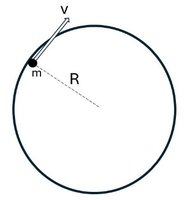
Try solving on your own before revealing the answer!
b) What is the normal force, , acting on the object at the top of the trajectory?
Background
Topic: Circular Motion and Forces
This part tests your understanding of how the normal force changes at the top of the trajectory, where gravity and centripetal force both act downward.
Key Terms and Formulas:
At the top, both gravity and normal force act downward toward the center.
Newton's second law:
Step-by-Step Guidance
Draw a free-body diagram for the object at the top of the circle.
Both gravity () and normal force () point toward the center.
Set up Newton's second law:
Rearrange to solve for :
Try solving on your own before revealing the answer!
PROBLEM 2: A 10.0-kg box starts at rest and slides 3.90 m down a ramp inclined at 10° with the horizontal. If there is no friction, what is the velocity of the crate at the bottom?
Background
Topic: Energy Conservation
This problem tests your ability to use energy conservation to find the final speed of an object sliding down an incline.
Key Terms and Formulas:
Potential Energy ():
Kinetic Energy ():
Energy Conservation: (no friction)
Height () can be found from the ramp length and angle:
Step-by-Step Guidance
Calculate the vertical height:
Find the initial potential energy:
Set this equal to the final kinetic energy:
Solve for in terms of and .
Try solving on your own before revealing the answer!
PROBLEM 3: A 2900-kg truck moving at 11.0 m/s strikes a car waiting at a traffic light, hooking bumpers. The two continue to move together at 7.00 m/s. What was the mass of the struck car?
Background
Topic: Conservation of Momentum
This problem tests your understanding of inelastic collisions and how to use conservation of momentum to solve for unknown mass.
Key Terms and Formulas:
Momentum ():
Conservation of Momentum:
Inelastic collision: The two objects stick together after collision.
Step-by-Step Guidance
Write the momentum conservation equation:
Plug in the known values: kg, m/s, m/s, m/s.
Set up the equation to solve for .
Rearrange the equation to isolate .
Try solving on your own before revealing the answer!
