 Back
BackPhysics II Exam Study Guidance: Rotational Dynamics, Thermodynamics, and Statics
Study Guide - Smart Notes
 Tailored notes based on your materials, expanded with key definitions, examples, and context.
Q1. A small ball of mass 3m is traveling on a frictionless plane with speed 2v₀ toward a uniform disk of mass 2m and radius R (I = ½MR² with M = 2m) that is moving to the left with a center of mass velocity of v₀. The disk is not rotating before the collision. The ball just grazes the edge of the disk and is caught in a massless catcher at the disk’s edge and sticks in it. All answers in terms of m, v₀, and R.
Background
Topic: Conservation of Momentum and Rotational Dynamics
This problem tests your understanding of the conservation of linear and angular momentum in collisions involving extended bodies, as well as the calculation of center of mass and moment of inertia for composite systems.
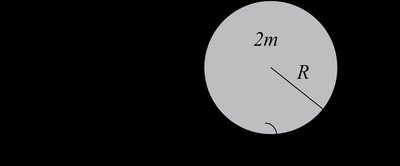
Key Terms and Formulas:
Center of Mass (CM):
Moment of Inertia (Parallel Axis Theorem):
Conservation of Linear Momentum:
Conservation of Angular Momentum:
Kinetic Energy:
Step-by-Step Guidance
Part (a): Identify the y-coordinates of the disk's center (at above the bottom edge) and the ball (at at the edge after sticking).
Write the center of mass formula for the combined system (disk + ball): .
Substitute , , , into the formula, but do not simplify to a final value yet.
Set up the expression for in terms of and .
Try solving on your own before revealing the answer!
Final Answer (Part a):
The center of mass is located above the bottom edge of the disk.
Q2. What is the moment of inertia of the system of the ball and disk about the system’s center of mass after the collision?
Background
Topic: Rotational Inertia of Composite Systems
This question tests your ability to use the parallel axis theorem and sum moments of inertia for objects about a common axis (the system's center of mass).
Key Terms and Formulas:
Moment of Inertia (Disk about its own CM):
Parallel Axis Theorem:
Point Mass: (where is the distance from the axis)
Step-by-Step Guidance
Calculate the distance from the system's center of mass to the center of the disk and to the ball (use from part a).
Apply the parallel axis theorem to the disk: .
For the ball, treat it as a point mass: .
Add the two contributions: .
Try solving on your own before revealing the answer!
Final Answer (Part b):
Substitute to get the final expression in terms of and .
