 Back
BackPhysics Midterm Study Guidance: Forces, Friction, Circular Motion, Work, Energy, and Momentum
Study Guide - Smart Notes
 Tailored notes based on your materials, expanded with key definitions, examples, and context.
Q1. What is the minimum coefficient of static friction required to keep a 4.0 kg block from sliding down a ramp inclined at 25°?
Background
Topic: Static Friction and Inclined Planes
This question tests your understanding of the forces acting on an object on an inclined plane and how to determine the minimum coefficient of static friction needed to prevent motion.
Key Terms and Formulas
Static friction force:
Normal force on an incline:
Component of gravity down the ramp:
Minimum coefficient: (when on the verge of sliding)
Step-by-Step Guidance
Draw a free-body diagram showing all forces: gravity, normal force, and friction.
Write the equilibrium condition along the ramp: (since the block is just about to slide).
Express the normal force: .
Substitute into the equilibrium equation and solve for up to the algebraic expression.
Try solving on your own before revealing the answer!
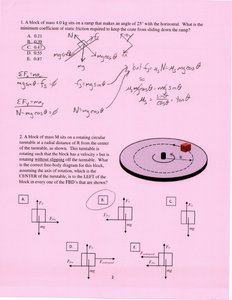
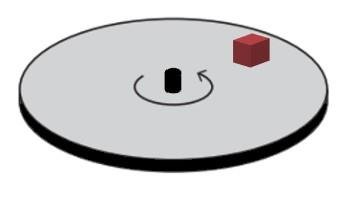
Q2. Which free-body diagram correctly represents the forces on a block of mass M sitting at a distance R from the center of a rotating turntable, rotating without slipping?
Background
Topic: Uniform Circular Motion and Free-Body Diagrams
This question tests your ability to identify the correct forces acting on an object in circular motion, specifically the direction of friction and normal forces.
Key Terms and Concepts
Centripetal force: (points toward the center of the circle)
Friction provides the centripetal force in this scenario.
Normal force acts perpendicular to the surface; gravity acts downward.
Step-by-Step Guidance
Identify all forces: gravity (down), normal force (up), friction (toward the center of rotation).
Recall that friction must point toward the center to provide the required centripetal force.
Examine each diagram and check the direction of the friction force relative to the center.
Eliminate diagrams where friction does not point toward the center or where other forces are misrepresented.
Try solving on your own before revealing the answer!
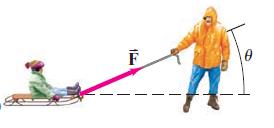
Q3. What magnitude of force is needed to pull a 23 kg sled at constant speed on snow (μₖ = 0.14) if the rope makes a 32° angle with the horizontal?
Background
Topic: Forces, Friction, and Inclined Pull
This question tests your ability to resolve forces, account for friction, and apply Newton's laws to a system in equilibrium.
Key Terms and Formulas
Kinetic friction:
Normal force:
Horizontal force balance:
Step-by-Step Guidance
Draw a free-body diagram showing all forces: tension, friction, normal, and gravity.
Write the vertical force balance to solve for the normal force: .
Express the friction force: .
Set up the horizontal force balance: and substitute the expression for .
Try solving on your own before revealing the answer!
Q4. When do you do work on a car with a dead battery if you push very hard, trying to move it?
Background
Topic: Work and Energy
This question tests your understanding of the definition of work in physics and the conditions under which work is done.
Key Terms and Concepts
Work:
Work is only done if there is displacement in the direction of the force.
Step-by-Step Guidance
Recall the definition of work: force must cause displacement.
Consider what happens if the car does not move versus if it does move.
Relate the answer choices to the physical meaning of work.
Try solving on your own before revealing the answer!
Q5. Two blocks (m₂ > m₁) with equal kinetic energy slide onto a rough surface and stop. Which block travels farther?
Background
Topic: Work-Energy Principle and Friction
This question tests your understanding of how kinetic energy, friction, and mass affect the stopping distance of objects.
Key Terms and Formulas
Kinetic energy:
Work done by friction:
Friction force:
Step-by-Step Guidance
Set the work done by friction equal to the initial kinetic energy: .
Express in terms of , , and .
Analyze how depends on when is the same for both blocks.
Try solving on your own before revealing the answer!
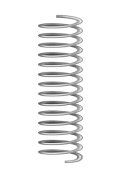
Q6. If it takes 3.0 J to stretch a spring by 2.0 cm, how much more work is needed to stretch it an additional 4.0 cm (to a total of 6.0 cm)?
Background
Topic: Work Done by a Spring (Hooke's Law)
This question tests your understanding of the work required to stretch a spring and the quadratic relationship between work and displacement.
Key Terms and Formulas
Work done by a spring:
Additional work:
Step-by-Step Guidance
Calculate the total work to stretch the spring to 6.0 cm: .
Calculate the work already done to stretch it to 2.0 cm: .
Find the difference: .
Use the given work value to solve for if needed.
Try solving on your own before revealing the answer!
Q7. What speed is required for a 59-kg pole vaulter to just pass over a bar 5.5 m high, starting from 0.70 m above the ground?
Background
Topic: Conservation of Energy
This question tests your ability to apply energy conservation to convert kinetic energy into gravitational potential energy.
Key Terms and Formulas
Kinetic energy:
Gravitational potential energy:
Energy conservation:
Step-by-Step Guidance
Write the energy conservation equation: .
Rearrange to solve for in terms of and .
Plug in the given values for , , and (note: cancels out).
Set up the equation for the student to solve for .
Try solving on your own before revealing the answer!
Q8. From what height h must a 3 kg block be dropped onto a spring (k = 2500 N/m, L = 8 cm) so that it compresses to half its length when the block comes to rest?
Background
Topic: Conservation of Mechanical Energy (Spring Compression)
This question tests your ability to apply energy conservation to a mass-spring system, including gravitational and elastic potential energy.
Key Terms and Formulas
Gravitational potential energy:
Elastic potential energy:
Energy conservation: (if starting from rest and ending at rest)
Step-by-Step Guidance
Determine the compression of the spring (half the original length: ).
Write the energy conservation equation: .
Substitute the known values for , , , and .
Set up the equation for the student to solve for .
Try solving on your own before revealing the answer!
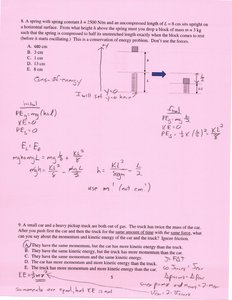
Q9. After pushing a car and a truck (truck has twice the mass) with the same force for the same time, compare their momentum and kinetic energy.
Background
Topic: Impulse, Momentum, and Kinetic Energy
This question tests your understanding of how impulse and work affect objects of different masses when the same force is applied for the same time.
Key Terms and Formulas
Impulse:
Kinetic energy:
Momentum:
Step-by-Step Guidance
Calculate the change in momentum for each vehicle using impulse: (same for both).
Express the final velocity for each using .
Calculate the kinetic energy for each using and compare.
Try solving on your own before revealing the answer!
Q10. A 0.5 kg billiard ball moving at 2.0 m/s collides elastically with a wall at a 30° angle. What is the change in its momentum?
Background
Topic: Conservation of Momentum and Elastic Collisions
This question tests your ability to analyze two-dimensional collisions and calculate the change in momentum vector.
Key Terms and Formulas
Momentum:
Elastic collision: perpendicular component of velocity reverses, parallel component remains unchanged.
Change in momentum:
Step-by-Step Guidance
Resolve the initial velocity into components parallel and perpendicular to the wall.
Determine how each component changes after the collision (perpendicular reverses, parallel stays the same).
Calculate the change in the perpendicular component of momentum.
Express the total change in momentum as a vector.
Try solving on your own before revealing the answer!
