 Back
BackPhysics Midterm Study Guidance: Units, Vectors, Newton's Laws, Kinematics, and 2D Motion
Study Guide - Smart Notes
 Tailored notes based on your materials, expanded with key definitions, examples, and context.
Q1. Which of the following quantities have the dimensions of Length [L]?
Background
Topic: Dimensional Analysis
This question tests your understanding of physical quantities and their dimensions, specifically how to identify which expressions represent length.
Key Terms and Formulas:
Dimension of Length: [L]
Dimensional analysis: Breaking down physical quantities into their fundamental units (e.g., mass [M], length [L], time [T]).
Step-by-Step Guidance
Examine each option and identify the physical quantities involved (e.g., displacement, velocity, acceleration).
Recall the dimensional formula for each quantity: for example, velocity is , acceleration is , and so on.
Analyze the mathematical expression in each option to determine its overall dimension.
Compare the resulting dimension to [L] to see which matches.
Try solving on your own before revealing the answer!
Final Answer: Option (a)
Option (a) has the dimension of length [L]. The other options involve different combinations of mass, time, or other units.
Q2. At what time duration does the particle have the highest speed?
Background
Topic: Kinematics and Speed
This question tests your ability to interpret speed from time intervals, likely based on a velocity-time graph or data.
Key Terms and Formulas:
Speed: The magnitude of velocity,
Highest speed: The interval where the change in position per unit time is greatest.
Step-by-Step Guidance
Review the time intervals provided in the options.
Consider how speed is calculated for each interval (change in position divided by change in time).
If a graph or data is given, identify where the slope (rate of change) is steepest.
Compare the calculated speeds for each interval to determine which is highest.
Try solving on your own before revealing the answer!
Final Answer: Option (c) 3s to 5s
The particle has the highest speed during the interval 3s to 5s, based on the greatest change in position per unit time.
Q3. A force N is acting on an object. What is the magnitude of the force?
Background
Topic: Vectors and Magnitude Calculation
This question tests your ability to calculate the magnitude of a vector given its components.
Key Terms and Formulas:
Vector magnitude:
Components: ,
Step-by-Step Guidance
Identify the vector components: , .
Use the formula for magnitude: .
Substitute the values into the formula.
Calculate the sum inside the square root.
Try solving on your own before revealing the answer!
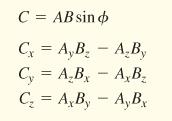
Final Answer: 10 N
N
The magnitude is calculated using the Pythagorean theorem for vector components.
Q4. How many forces are acting on a cellphone placed on a flat table?
Background
Topic: Forces and Equilibrium
This question tests your understanding of the forces acting on an object at rest on a surface.
Key Terms and Formulas:
Weight: The force due to gravity,
Normal force: The support force from the table
Friction force: If the phone is not moving, static friction may be present
Step-by-Step Guidance
Identify the forces acting vertically: weight (downward) and normal force (upward).
Consider if friction is present: if the phone is not sliding, static friction could exist.
List all possible forces acting on the phone.
Determine which forces are relevant based on the scenario (resting, not moving).
Try solving on your own before revealing the answer!
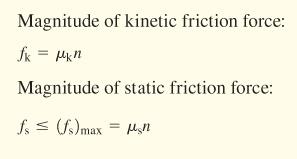
Final Answer: Option (c) Weight and Normal Forces
On a flat table, the phone experiences weight and normal force. Friction is only relevant if there is a tendency to move.
Q5. To maximize the horizontal distance (range) of a football kick, at what angle θ should the football be kicked?
Background
Topic: Projectile Motion
This question tests your understanding of the optimal angle for maximum range in projectile motion.
Key Terms and Formulas:
Range formula:
Maximum range occurs when is maximized.
Step-by-Step Guidance
Recall the formula for range in projectile motion.
Identify the value of that maximizes .
Calculate for each option.
Determine which angle gives the maximum value.
Try solving on your own before revealing the answer!
Final Answer: Option (c) 45°
The maximum range is achieved at 45°, where is maximized.
Q6. A box of mass m = 12 kg is initially at rest on a horizontal frictionless floor. A student pushes the box, and it moves 5 meters in 2 seconds starting from rest.
Background
Topic: Kinematics and Newton's Second Law
This question tests your ability to use kinematic equations and Newton's second law to analyze motion and forces.
Key Terms and Formulas:
Kinematic equation for constant acceleration:
Newton's second law:
Step-by-Step Guidance
Identify the known values: kg, m, s, initial velocity .
Use the kinematic equation to solve for acceleration .
Plug in the values: (with , ).
Rearrange to solve for .
Once is found, use Newton's second law to set up .
Try solving on your own before revealing the answer!
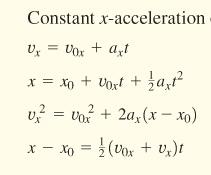
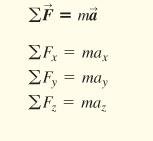
Final Answer: (a) m/s², (b) N
Using the kinematic equation, you solve for acceleration, then apply Newton's second law to find the force.
Q7. A hot air balloon moves straight upward from the launch pad with constant acceleration. After t = 3.1 s, the balloon is at a height of y = 95 m. Assume it starts from rest.
Background
Topic: Kinematics with Constant Acceleration
This question tests your ability to use kinematic equations to solve for acceleration, velocity, and position.
Key Terms and Formulas:
Kinematic equation:
Velocity equation:
Step-by-Step Guidance
Identify the known values: m, s, , .
Use the kinematic equation to solve for acceleration .
Plug in the values and rearrange to solve for .
For velocity at s, use with the acceleration found above.
For height at s, use the same kinematic equation with $t = 5.0$ s.
Try solving on your own before revealing the answer!
Final Answer: (a) m/s², (b) m/s, (c) m
Each part uses the kinematic equations for constant acceleration, plugging in the known values.
Q8. A package is dropped from a drone flying horizontally at a constant speed of 80 m/s at a height of 180 m above the ground. Assume m/s² and neglect air resistance.
Background
Topic: Projectile Motion
This question tests your ability to analyze projectile motion, including time of flight, horizontal distance, and velocity upon impact.
Key Terms and Formulas:
Vertical motion:
Horizontal motion:
Velocity magnitude:
Step-by-Step Guidance
For time to reach the ground, use the vertical motion equation with m, , .
Set and solve for .
For horizontal distance, use with the time found above.
For velocity just before impact, calculate at impact and combine with using the Pythagorean theorem.
Try solving on your own before revealing the answer!
Final Answer: (a) s, (b) m, (c) m/s at 36.9° below horizontal
Each part uses projectile motion equations, combining horizontal and vertical components.
Q9. A person starts at the origin and makes three displacements: 50 m due east, 70 m at an angle of 30° north of east, and 40 m due south.
Background
Topic: Vectors and Displacement
This question tests your ability to express vectors in component form, add vectors, and find magnitude and direction.
Key Terms and Formulas:
Component form:
Magnitude:
Direction:
Step-by-Step Guidance
Express each displacement in component form using trigonometry.
Add the components to find the resultant vector.
Calculate the magnitude of the resultant vector.
Determine the direction using the arctangent formula.
Try solving on your own before revealing the answer!
Final Answer: (a) Components: (50,0), (60.6,35), (0,-40); (b) Resultant: (110.6, -5); (c) Magnitude: 110.7 m; (d) Direction: 2.6° south of east
Each step uses vector addition and trigonometry to find the resultant displacement and its direction.
