 Back
BackPhysics of Simple and Compound Machines: Study Guide
Study Guide - Smart Notes
 Tailored notes based on your materials, expanded with key definitions, examples, and context.
Machines: Physics Concepts and Applications
Overview of Machines
Machines are devices that help make work easier by changing the magnitude or direction of a force. In physics, machines are classified as simple or compound, and their analysis involves concepts such as mechanical advantage, efficiency, energy, and equilibrium.
Simple Machines
Types of Simple Machines
Simple machines are fundamental mechanical devices that alter force and motion. The main types include:
Levers (First, Second, Third Class)
Inclined Planes
Wedges
Wheel and Axle (including gears)
Pulleys (including systems)
Screws
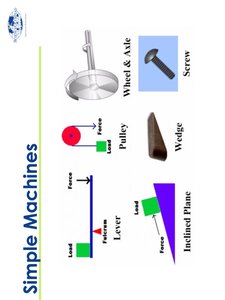
Classes of Levers
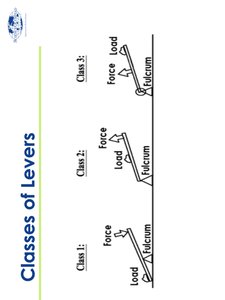
Levers are classified based on the relative positions of the fulcrum, load, and effort:
First Class Lever: Fulcrum between effort and load; direction of force is reversed; balanced when torques are equal.
Second Class Lever: Load between fulcrum and effort; force advantage but no directional change; always increases force.
Third Class Lever: Effort between fulcrum and load; increases speed and range of motion; load moves farther than effort.
Inclined Plane
An inclined plane is a flat surface set at an angle, used to reduce the force needed to raise objects by increasing the distance over which the force is applied.
Reduces force needed to raise objects
Increases distance to achieve height
Wedge
A wedge consists of two inclined planes joined back-to-back. It is used to split or lift materials, applying force over a greater distance.
Used to split or lift materials
Force applied over a greater distance
Wheel and Axle
The wheel and axle consists of two circular objects of different diameters. Effort applied to the wheel turns the axle, reducing friction or increasing force.
Reduces friction or increases force
Pulley
A pulley is a wheel with a rope or belt around it, used to change the direction or multiply force. Pulleys can be single or compound systems.
Changes direction or multiplies force
Single or compound systems
Screw
A screw is an inclined plane wrapped around a cylinder, converting rotational motion to linear force. It is used to hold materials or lift loads.
Converts rotational motion to linear force
Holds materials or lifts loads
Machines in Static Equilibrium
Static Equilibrium
Machines in static equilibrium have all forces and torques balanced. This means the net force and net torque are zero, and the system remains at rest.
Applies to levers, pulleys, inclined planes
Net force = 0
Net torque = 0
Compound Machines
Compound machines are made of two or more simple machines, combining the advantages of multiple systems. For example, a wheelbarrow combines a lever and a wheel and axle.
Combines advantages of multiple systems
Example: Wheelbarrow (lever + wheel and axle)
Mechanical Advantage
Ideal Mechanical Advantage (IMA)
IMA is the ratio of the distance input to the distance output, assuming no friction.
No friction considered
Actual Mechanical Advantage (AMA)
AMA is the ratio of output force to input force, including real-world effects like friction.
Includes real-world effects like friction
Efficiency of a Machine
Efficiency compares AMA to IMA and is expressed as a percentage.
Expressed as a percentage
Energy Concepts
Potential Energy (PE)
Potential energy is stored energy due to position, commonly calculated for objects at height.
Stored energy due to position
Conservation of Energy
Energy cannot be created or destroyed; total energy stays constant. Energy transforms between types, such as kinetic energy (KE) to potential energy (PE).
Total energy stays constant
Energy transforms between types (e.g., KE to PE)
Friction and Related Concepts
Coefficient of Friction (μ)
The coefficient of friction is the ratio of frictional force to normal force and depends on surface types.
Depends on surface types
Angle of Repose
The angle of repose is the maximum angle where material stays at rest, related to friction and slope.
Self-Locking and Non-Equilibrium Machines
Self-Locking Machines
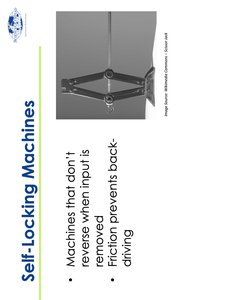
Self-locking machines do not reverse when input is removed; friction prevents back-driving.
Non-Equilibrium Machines
Machines with unbalanced forces or torques result in acceleration or continuous motion. For example, spinning gears accelerating under load.
Classical Physics Concepts Needed
Newton's Laws of Motion
First Law: An object in motion stays in motion unless acted upon by an unbalanced force.
Second Law: (Force equals mass times acceleration)
Third Law: For every action, there is an equal and opposite reaction. Example: Rocket thrust pushes downward, rocket moves upward.
Inertia
Inertia is the tendency of objects to resist changes in motion. Greater mass means greater inertia.
Force
Force is a push or pull acting on an object, measured in Newtons (N).
(Newton's Second Law)
Velocity and Acceleration
Velocity: Speed with direction; constant velocity means no acceleration; vector quantity.
Acceleration: Change in velocity over time; can be positive or negative; caused by unbalanced forces.
Momentum and Conservation of Momentum
More mass or velocity means more momentum; vector quantity.
Conservation of Momentum: Total momentum before = total momentum after (in closed system); applies to both elastic and inelastic interactions.
Math Requirements for Machine Analysis
Division B Math Requirements
Arithmetic & ratios
Simple algebra (1 variable)
2D geometry (triangles, vectors)
Basic trigonometry (no radians)
Division C Math Requirements
Advanced algebraic manipulations
2D geometry and vector analysis
Basic trigonometry
No calculus allowed
Sample Problems and Applications
Sample Pulley Problem
In a pulley diagram, a block-and-tackle supports a 300 N load with ideal 3 supporting rope segments. Neglecting friction, the ideal effort is:
Effort = Load / Number of supporting segments
Effort = 300 N / 3 = 100 N
Sample Screw Problem
For a screw with pitch = 2.0 mm and handle radius = 5.0 cm, IMA is approximately circumference divided by pitch:
Radius = 5.0 cm = 50 mm
IMA =
Sample Inclined Plane Problem
To compute IMA for an inclined plane:
For a ramp of length 2.4 m and height 0.40 m: IMA =
Summary Table: Simple Machines and Their Functions
Machine | Main Function | Example |
|---|---|---|
Lever | Force multiplication, directional change | Seesaw, crowbar |
Inclined Plane | Reduces force needed to lift | Ramp |
Wedge | Splitting, lifting | Axe, chisel |
Wheel and Axle | Reduces friction, increases force | Cart, doorknob |
Pulley | Changes direction, multiplies force | Flagpole, crane |
Screw | Converts rotation to linear force | Jar lid, screw |
Additional info:
Some content was inferred and expanded for academic completeness, including detailed explanations of energy, momentum, and sample calculations. Images were included only when directly relevant to the explanation of the paragraph.
