 Back
BackPhysics: Principles with Applications – Chapter 5 Study Guidance
Study Guide - Smart Notes
 Tailored notes based on your materials, expanded with key definitions, examples, and context.
Q1. In the game of tetherball, the struck ball whirls around a pole. In what direction does the net force on the ball point?
Background
Topic: Circular Motion and Centripetal Force
This question tests your understanding of forces acting on an object moving in a circle, specifically the direction of the net (centripetal) force.
Key Terms and Formulas:
Centripetal Force: The net force required to keep an object moving in a circular path, always directed toward the center of the circle.
Tension: The force exerted by the string or rope holding the ball.
Weight: The force due to gravity acting downward.
Step-by-Step Guidance
Visualize the ball moving in a horizontal circle around the pole. Identify the forces acting on the ball: tension in the string and gravity.
Recognize that the vertical component of tension balances the weight of the ball, so the ball does not move vertically.
The horizontal component of tension provides the centripetal force, which points toward the center of the circle (the pole).
Recall that the net force responsible for circular motion is always directed toward the center of the circle.

Try solving on your own before revealing the answer!
Final Answer: The net force points toward the center of the circle (the pole).
The horizontal component of the tension in the string provides the centripetal force, which is always directed toward the center.
Q2. You are a passenger in a car, not wearing a seat belt. The car makes a sharp left turn. From your perspective in the car, what do you feel is happening to you?
Background
Topic: Inertia and Non-Inertial Reference Frames
This question tests your understanding of Newton's First Law and the effects of inertia when in a non-inertial (accelerating) reference frame.
Key Terms and Formulas:
Inertia: The tendency of an object to resist changes in its state of motion.
Non-inertial reference frame: A frame of reference that is accelerating, such as a turning car.
Step-by-Step Guidance
When the car turns left, your body tends to continue moving in a straight line due to inertia.
From your perspective inside the car, it feels like you are being "thrown" to the right, toward the passenger door.
This sensation is due to your body's resistance to the change in direction, not an actual force pushing you to the right.
The car door provides a force that redirects your motion into the turn, keeping you inside the car.

Try solving on your own before revealing the answer!
Final Answer: You feel like you are thrown to the right, hitting the passenger door.
This is due to inertia; your body wants to keep moving straight while the car turns left.
Q3. During that sharp left turn, you found yourself hitting the passenger door. What is the correct description of what is actually happening?
Background
Topic: Centripetal Force and Newton's Laws
This question tests your understanding of the forces involved in circular motion and the concept of centripetal force.
Key Terms and Formulas:
Centripetal Force: The force that keeps an object moving in a circle, directed toward the center.
Newton's First Law: Objects in motion stay in motion unless acted upon by a net force.
Step-by-Step Guidance
As the car turns, your body wants to continue in a straight line due to inertia.
The passenger door exerts a force on you, redirecting your motion into the circular path of the car.
This force from the door is the centripetal force, pointing toward the center of the circle.
There is no actual "centrifugal force" pushing you outward; it's a fictitious force experienced in the non-inertial frame.
Try solving on your own before revealing the answer!
Final Answer: The door is exerting a leftward (centripetal) force on you.
This force keeps you moving in a circle with the car.
Q4. You drive your dad’s car too fast around a curve and the car starts to skid. What is the correct description of this situation?
Background
Topic: Friction and Circular Motion
This question tests your understanding of the role of friction in providing the centripetal force necessary for circular motion.
Key Terms and Formulas:
Friction: The force between the tires and the road that allows the car to turn.
Centripetal Force:
Step-by-Step Guidance
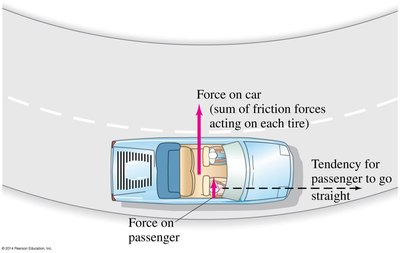
When a car turns, friction between the tires and the road provides the centripetal force.
If you go too fast, the required centripetal force increases.
If friction is not strong enough to provide this force, the car cannot follow the curve and will skid outward, moving in a straight line.
This is an application of Newton's First Law and the limits of static friction.
Try solving on your own before revealing the answer!
Final Answer: Friction between tires and road is not strong enough to keep the car in a circle.
The car skids because the required centripetal force exceeds what friction can provide.
Q5. A ping pong ball is shot into a circular tube lying flat on a tabletop. When the ball leaves the track, which path will it follow?
Background
Topic: Newton's First Law and Circular Motion
This question tests your understanding of what happens to an object when the force keeping it in circular motion is removed.
Key Terms and Formulas:
Newton's First Law: An object in motion continues in a straight line unless acted upon by a force.
Circular Motion: Requires a centripetal force.
Step-by-Step Guidance
While inside the tube, the ball is forced to move in a circle by the walls of the tube.
When the ball exits the tube, there is no longer a force acting on it to keep it moving in a circle.
According to Newton's First Law, the ball will continue in a straight line tangent to the circle at the point of exit.
Try solving on your own before revealing the answer!
Final Answer: The ball follows a straight-line path tangent to the circle at the exit point.
This is a direct application of Newton's First Law.
Q6. Two equal-mass rocks tied to strings are whirled in horizontal circles. The radius of circle 2 is twice that of circle 1. If the period of motion is the same for both rocks, what is the tension in cord 2 compared to cord 1?
Background
Topic: Centripetal Force and Tension in Circular Motion
This question tests your ability to relate tension, mass, velocity, radius, and period in uniform circular motion.
Key Terms and Formulas:
Tension: The force in the string providing the centripetal force.
Centripetal Force:
Period: The time for one complete revolution.
Velocity in terms of period:
Step-by-Step Guidance
Write the expression for tension:
Express velocity in terms of period:
Substitute into the tension formula:
Simplify and compare the tension for both circles, considering and .

Try solving on your own before revealing the answer!
Final Answer: The tension in cord 2 is twice that in cord 1 ().
For the same period, the velocity increases with radius, and tension is proportional to radius.
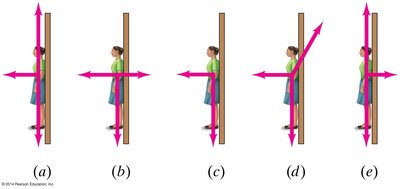
Q7. A rider in a “barrel of fun” finds herself stuck with her back to the wall. Which diagram correctly shows the forces acting on her?
Background
Topic: Circular Motion, Centripetal Force, and Friction
This question tests your understanding of the forces acting on a person in a rotating cylinder, including normal force, gravity, and friction.
Key Terms and Formulas:
Normal Force: The force exerted by the wall, directed toward the center of the circle.
Friction: The force that prevents the rider from sliding down, acting upward.
Gravity: The force acting downward.
Step-by-Step Guidance
Identify the forces: normal force (from the wall), friction (upward), and gravity (downward).
The normal force provides the centripetal force, keeping the rider in circular motion.
Friction balances gravity, preventing the rider from sliding down.
Draw or select the diagram showing these forces: normal force toward the center, friction upward, gravity downward.
Try solving on your own before revealing the answer!
Final Answer: Diagram (a) correctly shows the forces: normal force toward the center, friction upward, gravity downward.
The normal force is centripetal, friction is upward, and gravity is downward.
Q8. You’re on a Ferris wheel moving in a vertical circle. When the Ferris wheel is at rest, the normal force N exerted by your seat is equal to your weight mg. How does N change at the top of the Ferris wheel when you are in motion?
Background
Topic: Circular Motion in Vertical Circles
This question tests your understanding of how forces change in vertical circular motion, specifically at the top of the circle.
Key Terms and Formulas:
Normal Force: The force exerted by the seat.
Weight:
Centripetal Force:
Step-by-Step Guidance
At the top of the Ferris wheel, both gravity and the normal force act downward.
The sum of these forces provides the centripetal force required for circular motion.
Set up the equation:
Since is less than at the top, must be smaller than .
Try solving on your own before revealing the answer!
Final Answer: N is smaller than mg at the top of the Ferris wheel when in motion.
The normal force decreases because both gravity and the seat's force contribute to the centripetal force.
Q9. Which is stronger, Earth’s pull on the Moon, or the Moon’s pull on Earth?
Background
Topic: Newton's Third Law and Gravitational Force
This question tests your understanding of action-reaction pairs in gravity.
Key Terms and Formulas:
Newton's Third Law: For every action, there is an equal and opposite reaction.
Gravitational Force:
Step-by-Step Guidance
Recall Newton's Third Law: The force Earth exerts on the Moon is equal in magnitude and opposite in direction to the force the Moon exerts on Earth.
Both forces are described by the same formula and depend on the same masses and distance.
There is no difference in strength; the forces are equal.
Try solving on your own before revealing the answer!
Final Answer: They pull on each other equally.
Newton's Third Law guarantees equal and opposite forces.
Q10. If the distance to the Moon were doubled, then the force of attraction between Earth and the Moon would be:
Background
Topic: Universal Law of Gravitation
This question tests your understanding of how gravitational force depends on distance.
Key Terms and Formulas:
Gravitational Force:
Step-by-Step Guidance
Write the formula for gravitational force:
If the distance is doubled, substitute into the formula:
Simplify the denominator:
Compare the new force to the original force.
Try solving on your own before revealing the answer!
Final Answer: The force would be one quarter of the original value.
Doubling the distance reduces the force by a factor of four.
Q11. Two satellites A and B of the same mass are going around Earth in concentric orbits. The distance of satellite B from Earth’s center is twice that of satellite A. What is the ratio of the centripetal force acting on B compared to that acting on A?
Background
Topic: Universal Law of Gravitation and Circular Motion
This question tests your ability to compare gravitational forces at different distances.
Key Terms and Formulas:
Gravitational Force:
Ratio:
Step-by-Step Guidance
Write the formula for the force on each satellite: ,
Simplify :
Set up the ratio:
Try solving on your own before revealing the answer!
Final Answer: The ratio is 1/4.
Satellite B experiences one quarter the centripetal force of satellite A.
Q12. The Moon does not crash into Earth because:
Background
Topic: Orbital Motion and Centripetal Force
This question tests your understanding of why celestial bodies remain in orbit.
Key Terms and Formulas:
Orbital Motion: The balance between inertia and gravitational force.
Centripetal Force: Provided by gravity.
Step-by-Step Guidance
The Moon is moving at a high speed tangentially to Earth.
Gravity provides the centripetal force, keeping the Moon in orbit.
If the Moon stopped moving, it would fall directly into Earth.
If gravity were absent, the Moon would fly off in a straight line.

Try solving on your own before revealing the answer!
Final Answer: The Moon stays in orbit because its high speed and gravity provide the necessary centripetal force.
Orbital motion is a balance between inertia and gravitational attraction.
