 Back
BackPhysics Study Guide: Chapters 1–5 (Measurement, Kinematics, Vectors, and Motion)
Study Guide - Smart Notes
 Tailored notes based on your materials, expanded with key definitions, examples, and context.
Significant Figures and Scientific Notation
Understanding Scientific Notation
Scientific notation is a method used to express very large or very small numbers in a compact form. It consists of a prefactor (a number between 1 and 10) multiplied by a power of ten. This allows for easier comparison and calculation with numbers that are otherwise difficult to interpret.
Prefactor: The number between 1 and 10 in scientific notation.
Exponent: Indicates how many times the prefactor is multiplied or divided by ten.
Example: vs. — convert both to standard form to compare.
Significant figures are the digits in a measurement that are known with certainty plus one digit that is estimated. They are important for maintaining precision in calculations.
Key Point: Always use the correct number of significant figures in calculations and reporting results.
Unit Conversion and Dimensional Analysis
Converting Units
Unit conversion is essential for solving physics problems. Dimensional analysis involves writing conversion factors as fractions and multiplying to cancel units.
Conversion Factor: A ratio used to convert from one unit to another (e.g., ).
Method: Write facts as fractions, invert as needed, and multiply to cancel units.
Example: To convert 10 inches to centimeters:
Displacement, Average Velocity, and Average Acceleration
Definitions and Calculations
These quantities describe motion in one or more dimensions. Understanding the difference between average and instantaneous values is crucial.
Displacement (): The change in position, .
Average Velocity ():
Average Acceleration ():
Instantaneous values: Refer to a specific moment; average values are over an interval.
Key Point: For constant velocity, average and instantaneous values are equal.
Example: If a car moves from m to m in s, m/s.
Graph Reading and Vector Directions
Interpreting Position vs. Time Graphs
Graphs are a visual representation of motion. The slope of a position vs. time graph indicates velocity.
Slope:
Constant Slope: Indicates constant velocity.
Horizontal Line: Indicates zero velocity.
Algebraic Sign: Positive slope means motion in the positive direction; negative slope means motion in the opposite direction.
Example: Calculating average velocity from a graph:
Choose two points: and
Calculate
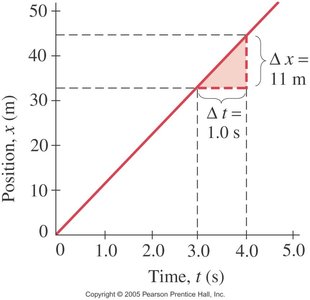
This image illustrates how to determine and from a position vs. time graph to calculate average velocity.
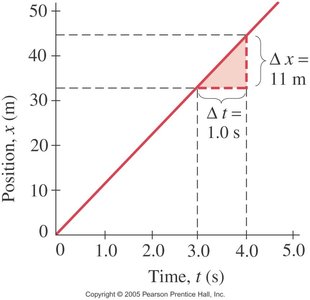
This image reinforces the concept that the slope of the line on a position vs. time graph represents the average velocity, and the sign of the slope indicates direction.
Vector Algebra
Component and Graphical Methods
Vectors are quantities with both magnitude and direction. Vector algebra involves decomposing vectors into components and adding/subtracting them.
Component Method: Break vectors into x- and y-components using trigonometry.
Graphical Method: Use the tail-to-tip method to add vectors visually.
Angle Description: Angles are typically measured counterclockwise from the positive x-axis unless specified otherwise.
Cardinal Directions: North, South, East, West can be associated with axes for direction specification.
Example: A vector 30° above the x-axis has components , .
Key Point: Translating a vector does not change its components.
Constant Acceleration Problems (1D and 2D)
Solving Motion Equations
Constant acceleration problems require careful use of kinematic equations. Always use the correct component and account for implied variables.
Kinematic Equations:
(if )
Key Point: For 2D problems, solve for each component separately.
Common Mistakes: Not using the correct component, forgetting implied variables, and not carefully writing equations.
Example: A projectile launched with and ; solve for position and velocity at a given time using the above equations.
Additional info: For free-fall, acceleration is typically m/s² (downward).
