 Back
BackPhysics Study Guide: Describing Motion, Speed, and Simple Harmonic Motion
Study Guide - Smart Notes
 Tailored notes based on your materials, expanded with key definitions, examples, and context.
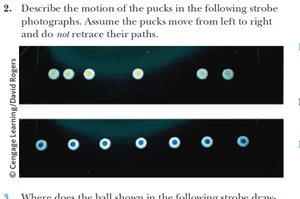
Q2. Describe the motion of the pucks in the following strobe photographs. Assume the pucks move from left to right and do not retrace their paths.
Background
Topic: Kinematics – Describing Motion
This question tests your ability to interpret visual data (strobe photographs) to describe the motion of objects, specifically changes in speed and uniform motion.
Key Terms:
Strobe photograph: A series of images taken at regular intervals to show the position of moving objects over time.
Uniform motion: Motion at a constant speed.
Acceleration: Change in speed over time.
Step-by-Step Guidance
Observe the spacing between the pucks in each photograph. Are the distances between each puck equal or changing?
Recall that equal spacing indicates constant speed, while increasing or decreasing spacing indicates acceleration or deceleration.
Compare the two rows: Does one show changing spacing and the other show uniform spacing?
Think about what this tells you about the motion of each puck: Is one speeding up or slowing down, and is the other moving at a constant speed?
Try solving on your own before revealing the answer!
Final Answer:
The first puck speeds up and then slows down, as shown by the changing spacing. The second puck moves at a constant speed, indicated by equal spacing between images.
Q13. Pat and Chris both travel from Los Angeles to New York along the same route. Pat rides a bicycle while Chris drives a sports car, but Chris's car breaks down for more than a week. Both arrive at the same time. Compare the average speeds of the two travelers.
Background
Topic: Average Speed
This question tests your understanding of average speed and how it is calculated regardless of the method of travel or interruptions.
Key Terms and Formula:
Average speed: Total distance traveled divided by total time taken.
Step-by-Step Guidance
Identify the total distance both travelers covered (Los Angeles to New York).
Determine the total time taken by each traveler (both arrive at the same time).
Recall that average speed depends only on total distance and total time, not on the speed at different segments.
Set up the formula for average speed for both Pat and Chris.
Try solving on your own before revealing the answer!
Final Answer:
Both have the same average speed, since they traveled the same distance in the same total time.
Q20. An ancient marathoner covered the first 20 miles of the race in 4 hours. Can you determine how fast he was running when he passed the 10-mile marker?
Background
Topic: Instantaneous Speed vs. Average Speed
This question tests your understanding of the difference between average speed and instantaneous speed, and what information is needed to determine each.
Key Terms:
Average speed: Total distance divided by total time.
Instantaneous speed: Speed at a specific moment or position.
Step-by-Step Guidance
Calculate the average speed for the first 20 miles using the formula .
Consider what information is needed to determine the speed at the 10-mile marker (instantaneous speed).
Think about whether the problem provides enough information about the runner's speed at the 10-mile point, or only the average speed over the whole segment.
Reflect on the difference between average and instantaneous speed in this context.

Try solving on your own before revealing the answer!
Final Answer:
You cannot determine the exact speed at the 10-mile marker with the information given; only the average speed for the first 20 miles can be calculated.
Q60. To be eligible to enter the Boston Marathon, a race that covers a distance of 26.2 miles, a runner must be able to finish in less than 3 hr. What minimum average speed must be maintained to accomplish this?
Background
Topic: Average Speed Calculation
This question tests your ability to calculate the minimum average speed required to complete a given distance within a specified time.
Key Formula:
Where:
Total distance = 26.2 miles
Total time = 3 hours
Step-by-Step Guidance
Write down the values for total distance and total time.
Set up the formula for average speed using these values.
Plug the numbers into the formula:
Check the units to make sure the answer will be in miles per hour (mi/hr).
Try solving on your own before revealing the answer!
Final Answer:
The minimum average speed required is approximately 8.7 mi/hr. This is found by dividing 26.2 miles by 3 hours.
