 Back
BackPhysics Study Guide: Electrostatics, Electric Fields, and Magnetism
Study Guide - Smart Notes
 Tailored notes based on your materials, expanded with key definitions, examples, and context.
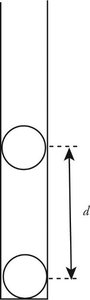
Q2. If the charge on each ball is doubled, what happens to the equilibrium distance between the balls in the test tube?
Background
Topic: Electrostatic Force and Equilibrium
This question tests your understanding of how the electrostatic force between two charged objects changes with charge, and how this affects their equilibrium separation.
Key Terms and Formulas
Coulomb's Law:
Equilibrium: The electrostatic force balances the gravitational force or other restoring forces.
k: Coulomb's constant ( N·m2/C2)
Step-by-Step Guidance
Recall that the electrostatic force between the balls is given by , where is the charge on each ball and is their separation.
At equilibrium, this force is balanced by another force (such as gravity or tension in the thread). The equilibrium distance depends on the magnitude of the charges.
If the charge on each ball is doubled, substitute for in the formula: .
Set up the proportional relationship between the new force and the new distance, considering the equilibrium condition remains the same.
Try solving on your own before revealing the answer!
Final Answer: 2d
Doubling the charge increases the force by a factor of 4, so the equilibrium distance must increase by a factor of 2 to maintain balance.
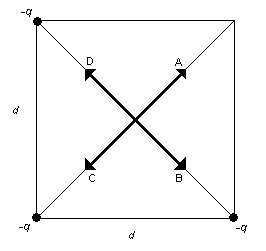
Q3. What is the direction of the net electric field at the center of a square with three equal negative point charges at three corners?
Background
Topic: Electric Field Superposition
This question tests your ability to determine the direction of the net electric field at a point due to multiple point charges.
Key Terms and Formulas
Electric field due to a point charge:
Superposition principle: The net electric field is the vector sum of fields from all charges.
Step-by-Step Guidance
Identify the location of the three negative charges and the center of the square.
For each charge, determine the direction of the electric field at the center (fields point toward negative charges).
Draw the vectors for each field and add them using vector addition.
Compare the resultant direction to the labeled arrows (A, B, C, D) in the diagram.
Try solving on your own before revealing the answer!
Final Answer: Arrow C
The net electric field points diagonally toward the corner without a charge, which is represented by arrow C.
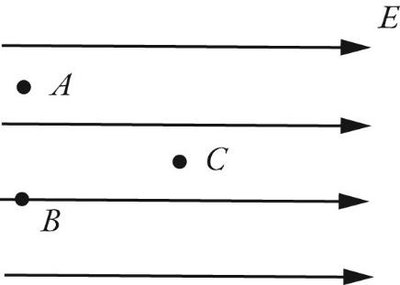
Q10. In a region with a uniform electric field directed to the right, which statement about the electric potential at points A, B, and C is true?
Background
Topic: Electric Potential in Uniform Fields
This question tests your understanding of how electric potential changes in a uniform electric field.
Key Terms and Formulas
Electric potential difference:
Uniform field: The field strength and direction are constant everywhere.
Step-by-Step Guidance
Recall that in a uniform electric field, the potential decreases in the direction of the field.
Identify the relative positions of points A, B, and C with respect to the field direction.
Use the formula to compare potentials at different points.
Determine which point has the highest, second highest, and lowest potential based on their positions.
Try solving on your own before revealing the answer!
Final Answer: D
The potential at point A is the highest, at B is the second highest, and at C is the lowest, since potential decreases in the direction of the field.
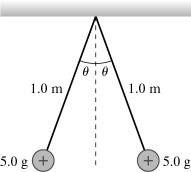
Free Response Q1. What is the angle θ for two tiny 5.0-g spheres suspended from 1.0-m threads, repelling each other after being charged?
Background
Topic: Electrostatic Equilibrium and Forces
This question tests your ability to analyze equilibrium conditions involving electrostatic repulsion and gravitational forces.
Key Terms and Formulas
Coulomb's Law:
Gravitational force:
Equilibrium: The sum of forces in each direction is zero.
Step-by-Step Guidance
Draw a free-body diagram for one sphere, showing tension, gravity, and electrostatic force.
Write equations for the vertical and horizontal components of the forces.
Set up the equilibrium conditions: and .
Combine these equations to solve for .
Try solving on your own before revealing the answer!
Final Answer: θ = tan-1()
Use the values for and to calculate θ. This gives the equilibrium angle based on the balance of forces.
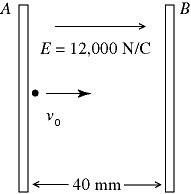
Free Response Q4. What is the velocity of an electron as it strikes plate B, given an initial velocity and a uniform electric field between two plates?
Background
Topic: Motion of Charged Particles in Electric Fields
This question tests your ability to analyze the motion of an electron under the influence of a uniform electric field.
Key Terms and Formulas
Electric force:
Acceleration:
Kinematic equations:
Step-by-Step Guidance
Calculate the force on the electron: .
Find the acceleration: .
Use the kinematic equation to relate initial velocity, acceleration, and distance to final velocity.
Plug in the values for , , and to set up the equation for .
Try solving on your own before revealing the answer!
Final Answer:
Substitute the calculated acceleration and distance to find the final velocity as the electron strikes plate B.
