 Back
BackPhysics Study Guide: Electrostatics, Electric Fields, and Capacitors
Study Guide - Smart Notes
 Tailored notes based on your materials, expanded with key definitions, examples, and context.
Q1. Based on the triboelectric charging table, which statement is NOT true?
Background
Topic: Triboelectric Effect and Charge Transfer
This question tests your understanding of how materials gain or lose charge when rubbed together, based on their position in the triboelectric series.
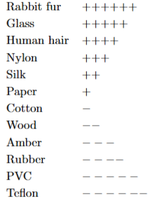
Key Terms:
Triboelectric series: A list of materials arranged by their tendency to gain or lose electrons.
Positive/Negative charging: Materials higher in the series become positively charged when rubbed with materials lower in the series.
Step-by-Step Guidance
Examine the triboelectric series to determine which materials become positive or negative when rubbed together.
Compare the position of each material in the series to predict the charge transfer direction.
Analyze each statement in the question and check if it matches the expected outcome based on the series.
Identify the statement that contradicts the triboelectric series.
Try solving on your own before revealing the answer!
Final Answer: Human hair is positively charged when rubbed with silk (Statement B is NOT true)
According to the triboelectric series, human hair is more positive than silk, so it becomes positively charged, not negatively charged.
Q2. A +1 C probe charge is placed at the origin, equidistant from two +2 C charges on the y-axis and two -3 C charges on the z-axis. In which direction does the probe charge experience a net force?
Background
Topic: Coulomb's Law and Superposition Principle
This question tests your ability to analyze the net force on a charge due to multiple point charges using symmetry and vector addition.
Key Terms and Formulas:
Coulomb's Law:
Superposition Principle: The net force is the vector sum of individual forces.
Step-by-Step Guidance
Identify the positions of all charges relative to the origin.
Calculate the direction of the force exerted by each charge on the probe charge.
Use symmetry to determine if the forces cancel out or add up in any direction.
Sum the forces from the y-axis and z-axis charges separately, then combine to find the net force direction.
Try solving on your own before revealing the answer!
Final Answer: No net force (G)
The probe charge experiences equal and opposite forces from each pair of charges, resulting in a net force of zero.
Q3. If a cone-shaped iron weight is charged with +Q, which statement about the charge distribution and electric field is NOT true?
Background
Topic: Conductors, Charge Distribution, and Electric Fields
This question tests your understanding of how charge distributes on a conductor and how electric field lines behave on irregular surfaces.
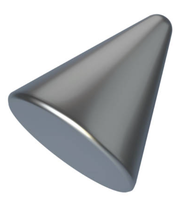
Key Terms:
Conductor: Material where charges move freely and reside on the surface.
Charge density: Amount of charge per unit area, higher at points or sharp edges.
Electric field line density: Indicates field strength; not uniform on irregular surfaces.
Step-by-Step Guidance
Recall that charges on a conductor reside on the surface and tend to concentrate at points or sharp edges.
Consider how the charge density varies between the vertex and the base of the cone.
Think about the electric field line density and whether it is uniform across the surface.
Evaluate each statement to identify which one is inconsistent with the physics of conductors.
Try solving on your own before revealing the answer!
Final Answer: The electric field line densities across the surface are NOT uniform (Statement D is NOT true)
On a conductor with an irregular shape, the electric field line density is higher at points or sharp edges, so it is not uniform.
Q4. A proton and an electron are released from rest at positions where the electric potential is 0 V. What happens to their motion?
Background
Topic: Electric Potential and Charge Motion
This question tests your understanding of how positive and negative charges move in response to electric potential differences.
Key Terms:
Electric potential: The energy per unit charge at a point in space.
Positive charges move toward lower potential; negative charges move toward higher potential.
Step-by-Step Guidance
Identify the initial positions and potentials for the proton and electron.
Recall the rule for how positive and negative charges move in an electric field.
Determine the direction each charge will move based on the potential gradient.
Match the motion to the answer choices provided.
Try solving on your own before revealing the answer!
Final Answer: The proton moves to the left, the electron moves to the right (E)
Positive charges move toward lower potential, negative charges move toward higher potential, so the proton and electron move in opposite directions.
Q5. Which parallel-plate capacitor stores the largest amount of energy, given the same electric field strength inside each?
Background
Topic: Capacitors, Energy Storage, and Dielectrics
This question tests your understanding of how plate area, separation, and dielectric materials affect the energy stored in a capacitor.
Key Formula:
Energy stored:
Capacitance:
Where is the dielectric constant, is plate area, is separation.
Step-by-Step Guidance
Recall the formula for energy stored in a capacitor and how capacitance depends on area, separation, and dielectric.
For the same electric field, relate voltage to plate separation: .
Express energy in terms of electric field, area, and dielectric constant.
Compare the energy stored in each capacitor based on their parameters.
Try solving on your own before revealing the answer!
Final Answer: The capacitor with the dielectric (dielectric constant 2) stores the largest energy
The dielectric increases the capacitance, which increases the energy stored for the same electric field.
