 Back
BackPhysics Study Guide: Forces, Kinematics, and Dynamics
Study Guide - Smart Notes
 Tailored notes based on your materials, expanded with key definitions, examples, and context.
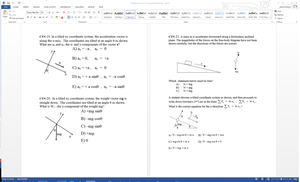
Q1. A mass is pulled along a rough table at constant velocity with an external force F at some angle above the horizontal. The magnitudes of the forces on the free-body diagram have not been drawn carefully, but the directions of the forces are correct. Which statement below must be true?
Background
Topic: Forces and Newton's Laws
This question tests your understanding of equilibrium and force components when an object moves at constant velocity on a rough surface.
Key Terms and Formulas:
Normal force (): The perpendicular contact force exerted by a surface.
Friction force (): The force opposing motion, proportional to the normal force.
Weight (): The force due to gravity.
Newton's First Law: If velocity is constant, net force is zero.
Newton's Second Law:
Step-by-Step Guidance
Draw the free-body diagram for the block, labeling all forces: weight () downward, normal force () upward, friction force () opposite to motion, and applied force () at an angle.
Since the block moves at constant velocity, the net force in both x and y directions must be zero ().
Resolve the applied force into horizontal () and vertical () components.
Write Newton's Second Law for the y-direction:
Write Newton's Second Law for the x-direction:
Try solving on your own before revealing the answer!
Final Answer:
The correct relationships are:
These equations show that the vertical forces balance the weight, and the horizontal component of the applied force balances friction.
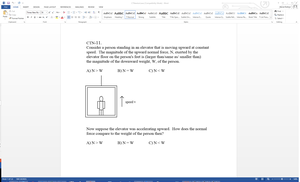
Q2. Consider a person standing in an elevator that is moving upward at constant speed. The magnitude of the upward normal force, N, exerted by the elevator floor on the person’s feet is (ignore floor mass or similar fixes) the magnitude of the downward weight, W, of the person.
Background
Topic: Forces in Equilibrium
This question tests your understanding of normal force and weight when an object is moving at constant velocity (no acceleration).
Key Terms and Formulas:
Normal force (): Upward force from the floor.
Weight (): Downward force due to gravity.
Newton's First Law: Net force is zero if velocity is constant.
Step-by-Step Guidance
Draw a free-body diagram for the person: upward normal force (), downward weight ().
Since the elevator moves at constant speed, acceleration .
Apply Newton's Second Law:
Substitute :
Try solving on your own before revealing the answer!
Final Answer:
When the elevator moves at constant speed, the normal force equals the weight.
Q3. Now suppose the elevator was accelerating upward. How does the normal force compare to the weight of the person then?
Background
Topic: Forces and Acceleration
This question tests your understanding of how normal force changes when the elevator accelerates upward.
Key Terms and Formulas:
Normal force (): Upward force from the floor.
Weight (): Downward force due to gravity.
Newton's Second Law:
Step-by-Step Guidance
Draw a free-body diagram for the person: upward normal force (), downward weight ().
Now, the elevator accelerates upward, so .
Apply Newton's Second Law:
Rearrange:
Try solving on your own before revealing the answer!
Final Answer:
The normal force is greater than the weight:
When the elevator accelerates upward, the normal force increases by .
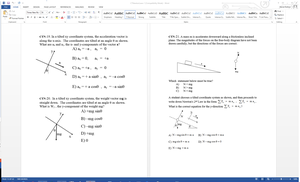
Q4. In a tilted xy coordinate system, the acceleration vector is always in the x-direction, and the coordinate axes are at an angle θ to the horizontal. What is the x-component of acceleration?
Background
Topic: Kinematics and Coordinate Systems
This question tests your ability to resolve vectors into components in a rotated coordinate system.
Key Terms and Formulas:
Acceleration vector (): The rate of change of velocity.
Component: Projection of a vector onto an axis.
Trigonometric relationships: or depending on orientation.
Step-by-Step Guidance
Draw the acceleration vector along the x-axis of the tilted coordinate system.
Identify the angle θ between the tilted x-axis and the horizontal.
Use trigonometry to find the x-component: (if x-axis is along the direction of acceleration).
Try solving on your own before revealing the answer!
Final Answer:
The x-component is found using the cosine of the angle between the acceleration and the x-axis.
Q5. A mass is on a frictionless inclined plane. Frictionless inclined plane means only gravity and normal force act. If the mass moves down the ramp, the direction of the net force is down the ramp. What component must be non-zero?
Background
Topic: Forces on Inclined Planes
This question tests your understanding of force components on an inclined plane.
Key Terms and Formulas:
Gravity (): Acts vertically downward.
Normal force (): Acts perpendicular to the surface.
Component of gravity along the ramp:
Step-by-Step Guidance
Draw the free-body diagram for the block: gravity downward, normal force perpendicular to the ramp.
Resolve gravity into two components: one perpendicular (), one parallel () to the ramp.
The net force is the parallel component:
Try solving on your own before revealing the answer!
Final Answer:
The parallel component () must be non-zero.
This is the force that causes the block to accelerate down the ramp.
Q6. Starting from rest, a sprinter undergoes constant acceleration until reaching 10 m/s after 5 s. How far did the sprinter travel during this 5 s interval?
Background
Topic: Kinematics with Constant Acceleration
This question tests your ability to use kinematic equations to solve for displacement.
Key Terms and Formulas:
Initial velocity (): Starting speed, here .
Final velocity (): m/s.
Time (): s.
Displacement (): The distance traveled.
Kinematic equation:
Acceleration (): Can be found using
Step-by-Step Guidance
Identify the known values: , m/s, s.
Use to solve for acceleration .
Plug and into to solve for displacement.
Try solving on your own before revealing the answer!
Final Answer:
The sprinter traveled 25 m during the 5 s interval.
We used the kinematic equations to find the distance.
