 Back
BackInternal Resistance, Circuits, and Potential Dividers SW 1
Study Guide - Smart Notes
 Tailored notes based on your materials, expanded with key definitions, examples, and context.
Q1a. Calculate the terminal p.d. and explain why it is not equal to the e.m.f. of the cell.
Background
Topic: Internal resistance and terminal potential difference
This question tests your understanding of how the internal resistance of a cell affects the voltage across an external resistor.
Key Terms and Formulas:
Electromotive force (e.m.f.),
Terminal potential difference (p.d.),
Internal resistance,
Current,
External resistance,
Key formula:
Step-by-Step Guidance
Identify the values given: , , .
Recall that the terminal p.d. is the voltage across the external resistor, not the total e.m.f. of the cell.
Use Ohm's law to find the voltage across the external resistor: .
Explain why the terminal p.d. is less than the e.m.f.: Some energy is lost inside the cell due to its internal resistance.
Try solving on your own before revealing the answer!
Q1b. Show that the internal resistance r of the cell is 0.30 Ω.
Background
Topic: Internal resistance calculation
This question tests your ability to use the relationship between e.m.f., terminal p.d., and internal resistance to solve for .
Key Terms and Formulas:
Or, rearranged:
Step-by-Step Guidance
Recall from part (a) the value of you calculated.
Substitute , , and into the formula for .
Simplify the expression to show that .
Try solving on your own before revealing the answer!
Q1c(i). Calculate the power dissipated when R = r.
Background
Topic: Maximum power transfer theorem
This question tests your understanding of how power is distributed in a circuit with internal resistance, especially when the external resistance equals the internal resistance.
Key Terms and Formulas:
Power dissipated in :
Total resistance:
Current:
Step-by-Step Guidance
Set in the formulas above.
Calculate the total resistance: .
Find the current: .
Substitute and into to get the power dissipated in .
Try solving on your own before revealing the answer!
Q1c(ii). Show that the power dissipated when R = 0.50 Ω and R = 0.20 Ω is less than that dissipated when R = r.
Background
Topic: Power in resistive circuits
This question tests your ability to compare power dissipation for different values of external resistance.
Key Terms and Formulas:
Use the same formulas as above:
Step-by-Step Guidance
For , calculate and then .
Repeat for .
Compare both results to the power found when .
Show mathematically that both are less than the maximum power case.
Try solving on your own before revealing the answer!
Q2. A resistor of resistance 6.0 Ω and a second resistor of resistance 3.0 Ω are connected in parallel across a battery of e.m.f. 4.5 V and internal resistance 0.50 Ω. What is the current in the battery?
Background
Topic: Parallel circuits and internal resistance
This question tests your ability to analyze a parallel circuit and include the effect of internal resistance on the total current.
Key Terms and Formulas:
Parallel resistance:
Total resistance:
Current:
Step-by-Step Guidance
Calculate the combined resistance of the two resistors in parallel.
Add the internal resistance to get the total resistance in the circuit.
Use Ohm's law to find the total current supplied by the battery.
Try solving on your own before revealing the answer!
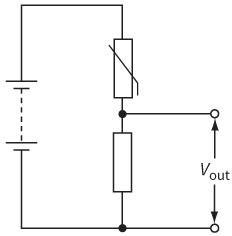
Q3. This diagram shows a potential divider. Explain what happens to the resistance of the thermistor and Vout when the temperature decreases.
Background
Topic: Potential dividers and thermistors
This question tests your understanding of how thermistors behave in a potential divider circuit as temperature changes.
Key Terms and Concepts:
Thermistor: A resistor whose resistance decreases as temperature increases (NTC type).
Potential divider: A circuit that splits the input voltage into a ratio determined by two resistors.
: The output voltage across the lower resistor.
Step-by-Step Guidance
Recall that for an NTC thermistor, resistance increases as temperature decreases.
As the thermistor's resistance increases, the voltage across it (and thus ) changes according to the potential divider rule.
Apply the potential divider formula: , where is the lower resistor (not the thermistor).
Explain how an increase in thermistor resistance affects .
Try solving on your own before revealing the answer!
Q4. Explain what is meant by the internal resistance of a cell.
Background
Topic: Internal resistance
This question tests your understanding of the concept of internal resistance in power sources.
Key Terms and Concepts:
Internal resistance: The resistance to current flow within the cell itself.
It causes energy loss inside the cell, reducing the terminal voltage when current flows.
Step-by-Step Guidance
Define internal resistance in your own words.
Explain how it affects the performance of a cell in a circuit.
Try solving on your own before revealing the answer!
Q5a. When a cell is connected in series with a resistor of 2.00 Ω there is a current of 0.625 A. If a second resistor of 2.00 Ω is put in series with the first, the current falls to 0.341 A. Calculate the internal resistance of the cell.
Background
Topic: Internal resistance calculation using two different loads
This question tests your ability to use two sets of circuit conditions to solve for the internal resistance of a cell.
Key Terms and Formulas:
Ohm's law:
Cell equation:
Step-by-Step Guidance
Write two equations for the two different current and resistance values using .
Set up a system of equations to eliminate and solve for .
Rearrange and solve for algebraically.
Try solving on your own before revealing the answer!
Q5b. Calculate the e.m.f. of the cell.
Background
Topic: Calculating e.m.f. from circuit data
This question tests your ability to use the internal resistance found in part (a) to calculate the cell's e.m.f.
Key Terms and Formulas:
Use with values from part (a).
Step-by-Step Guidance
Substitute the value of found in part (a) and one set of and values into .
Calculate algebraically, but do not compute the final value yet.
Try solving on your own before revealing the answer!
Q5c. A car battery needs to supply a current of 200 A to turn over the starter motor. Explain why a battery made of a series of cells of the type described above would not be suitable for a car battery.
Background
Topic: Practical limitations of cells with high internal resistance
This question tests your understanding of why internal resistance matters in high-current applications.
Key Terms and Concepts:
High current demand (e.g., 200 A for a car starter motor)
Voltage drop due to internal resistance:
Power loss inside the cell:
Step-by-Step Guidance
Consider the effect of a large current on the voltage drop across the internal resistance.
Explain how this would reduce the terminal voltage available to the starter motor.
Discuss the inefficiency and possible overheating due to high power loss inside the cell.
Try solving on your own before revealing the answer!
