 Back
BackPhysics Study Guide: Simple Machines, Mechanical Advantage, and Efficiency
Study Guide - Smart Notes
 Tailored notes based on your materials, expanded with key definitions, examples, and context.
Machines and Work
Definition and Basic Principles
Machines are mechanical devices designed to make tasks easier by allowing a smaller input force to accomplish the same amount of work over a greater distance. In physics, the work done by a machine is defined as the product of force and distance:
Work (W):
Input Force (Effort): The force applied to the machine.
Output Force (Resistance/Load): The force exerted by the machine to move the load.
Assumption: All machines are considered frictionless in ideal calculations.
Efficiency of Machines
Efficiency measures how well a machine converts input work into useful output work, accounting for energy lost to friction, heat, and sound. It is expressed as a percentage:
Efficiency (η):
Example: A lightbulb may be only 5% efficient in producing light, with the rest of the energy lost as heat.
Example Calculation
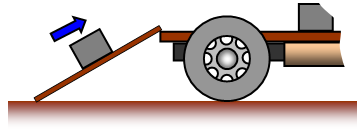
To lift a 1200 N motorcycle a vertical height of 1.3 m onto a pickup truck using a 2.4 m ramp with an effort force of 820 N:
Input Work:
Output Work:
Efficiency:
Mechanical Advantage (MA)
Definition and Calculation
Mechanical Advantage is the ratio of output force to input force, indicating how much a machine amplifies the applied force. It is dimensionless and assumes ideal (frictionless) conditions:
Mechanical Advantage (MA):
Ideal Mechanical Advantage (IMA): Calculated based on geometry, not actual forces.
Example Calculation
Ramp Example: If you exert 2800 N to lift a desk directly, but only 1400 N using a ramp, .
Types of Simple Machines
Ramp (Inclined Plane)
A ramp allows objects to be moved upward with less force over a longer distance. The trade-off is that the distance increases as the force decreases.
Key Principle: remains constant; decreasing force increases distance.
Wedge
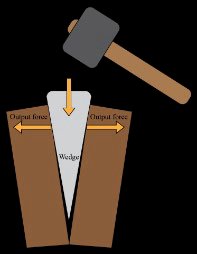
A wedge converts input force into forces that push materials apart. It is used to split objects, such as wood or metal.
Key Principle: Input force drives the wedge into the material, output forces act perpendicular to the input.
Screw
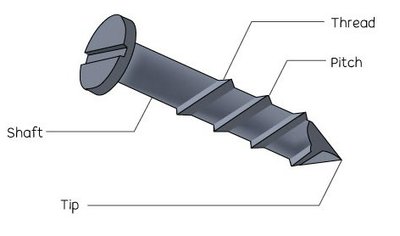
A screw is an inclined plane wrapped around a shaft. The pitch is the distance between threads, determining how far the screw advances per rotation.
Pitch (p): Distance between threads.
Radius (r): Radius of the shaft.
Lever
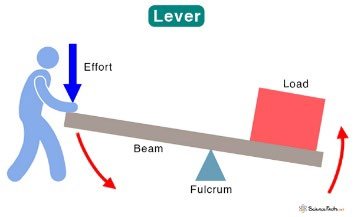
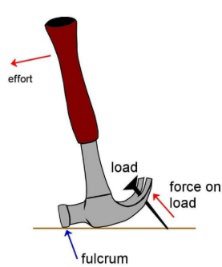
A lever consists of a beam and a fulcrum. The effort arm is where force is applied, and the resistance arm is where the load is located. Levers magnify force by increasing the distance from the fulcrum.
Ideal Mechanical Advantage:
Example: If the resistance arm is 3.0 m and the effort arm is 12 cm,
Pulley
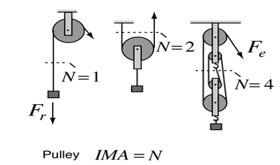
Pulleys redirect force and can multiply it. The mechanical advantage is determined by the number of supporting ropes.
IMA for Pulley: (where N is the number of supporting ropes)
Wheel and Axle
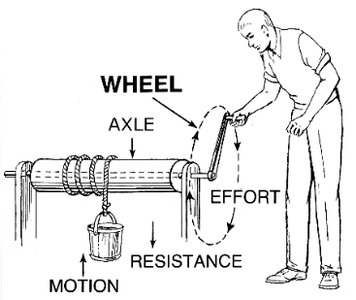
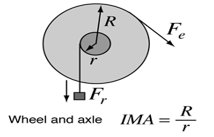
A wheel and axle system consists of a large wheel attached to a smaller axle. Turning the wheel applies force over a greater distance, magnifying the force at the axle.
IMA for Wheel and Axle: (R = radius of wheel, r = radius of axle)
Summary Table: Simple Machines
Machine | Key Principle | IMA Formula |
|---|---|---|
Ramp | Move object up slope with less force | |
Wedge | Split material by converting input force | Depends on wedge angle |
Screw | Inclined plane wrapped around shaft | |
Lever | Beam with fulcrum, magnifies force | |
Pulley | Redirects and multiplies force | |
Wheel & Axle | Large wheel around small axle |
Practice Problems
Lever Example
A 50.0 N load is 1 m from the fulcrum. You stand 5.0 m away and push down with 75 N. Find MA.
Pulley Example
A 15.0 kg crate is lifted 10.0 cm with a 95.0 N force over 20.0 cm. Find MA, IMA, and efficiency.
Key Takeaways
Simple machines allow us to perform tasks with less effort by increasing the distance over which force is applied.
Mechanical advantage quantifies the force amplification provided by a machine.
Efficiency measures how much input work is converted to useful output work.
