 Back
BackPhysics Study Guide: Vectors, Kinematics, and Projectile Motion
Study Guide - Smart Notes
 Tailored notes based on your materials, expanded with key definitions, examples, and context.
Q1. True or False: Conceptual Physics Statements
Background
Topic: Physics Concepts & Definitions
This section tests your understanding of fundamental physics concepts, including significant figures, vector and scalar quantities, kinematics, and projectile motion.
Key Terms:
Significant digits: Digits in a number that carry meaning contributing to its precision.
Vector quantity: Has both magnitude and direction (e.g., velocity, acceleration).
Scalar quantity: Has only magnitude (e.g., speed, mass).
Acceleration: Rate of change of velocity.
Projectile motion: Motion of an object thrown or projected into the air, subject only to gravity.
Step-by-Step Guidance
Read each statement carefully and identify the key concept being tested (e.g., significant digits, vectors, kinematics).
Recall the definitions and properties of the terms involved (e.g., difference between speed and velocity, what makes a quantity a vector).
Think about real-world examples or textbook definitions to help you decide if the statement is true or false.
For statements about motion (velocity, acceleration), visualize or sketch the scenario to clarify the direction and sign conventions.
Try solving on your own before revealing the answer!
Q2. Vector Components and Linear Combination
Background
Topic: Vectors and Components
This question tests your ability to break vectors into x and y components and to express one vector as a linear combination of others.
Key Terms and Formulas:
Vector components: ,
Linear combination:
Step-by-Step Guidance
Identify the magnitudes and angles given for each vector ( m, m, m, ).
Calculate the x and y components for and using trigonometric functions:
Set up the equation and write out the x and y component equations.
Express in terms of its x and y components, then set up a system of equations to solve for and .
Try solving on your own before revealing the answer!
Q3. Train Acceleration and Deceleration
Background
Topic: Kinematics (Constant Acceleration)
This question tests your ability to use kinematic equations to solve for time, acceleration, and distance under constant acceleration.
Key Terms and Formulas:
Kinematic equation:
Displacement:
Acceleration: Change in velocity per unit time.
Step-by-Step Guidance
Convert all units to SI (e.g., km/h to m/s for velocity).
For part (a), use to solve for time when starting from rest ().
For part (b), use the same equation but with negative acceleration (deceleration) and initial velocity equal to the top speed.
For part (c), rearrange to solve for emergency acceleration, given stopping time and initial velocity.
For part (d), use to find the stopping distance during emergency braking.
Try solving on your own before revealing the answer!
Q4. Runner's Velocity vs. Time Graph
Background
Topic: Kinematics and Graph Interpretation
This question tests your ability to interpret velocity-time graphs and calculate position, acceleration, and average velocity.
Key Terms and Formulas:
Area under velocity-time graph: Represents displacement.
Acceleration: Slope of velocity-time graph.
Average velocity:
Step-by-Step Guidance
Find the area under the velocity-time graph from to s to determine the runner's position.
Calculate the slope of the graph at s to find the acceleration.
Use the total displacement and total time to find the average velocity over the interval.
Try solving on your own before revealing the answer!
Q5. Projectile Motion: Golf Ball
Background
Topic: Projectile Motion
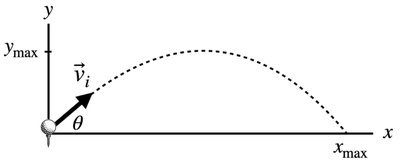
This question tests your understanding of two-dimensional motion under gravity, including vertical and horizontal components, time of flight, and launch angle.
Key Terms and Formulas:
Initial velocity components: ,
Maximum height:
Time of flight:
Horizontal range:
Launch angle:
Step-by-Step Guidance
For part (a), use the maximum height formula to solve for :
Rearrange to solve for .
For part (b), use the time of flight formula with your value for :
For part (c), use the horizontal range formula to solve for :
Rearrange to solve for .
For part (d), use the launch angle formula:
Try solving on your own before revealing the answer!
