 Back
BackPhysics Study Guide: Work, Energy, and Hooke's Law
Study Guide - Smart Notes
 Tailored notes based on your materials, expanded with key definitions, examples, and context.
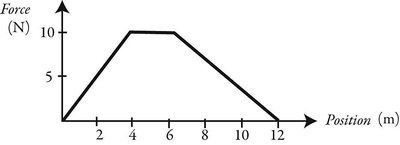
Q9. An object is acted upon by a force represented by the force vs. position graph in the figure. What is the work done as the object moves (a) from 4 m to 6 m? (b) from 6 m to 12 m?
Background
Topic: Work from Force vs. Position Graph
This question tests your understanding of how to calculate work done by a variable force using a force vs. position graph. The area under the curve between two points gives the work done.
Key Terms and Formulas
Work (): The energy transferred by a force acting over a distance.
Formula: (for variable force)
For piecewise constant or linear forces, work is the area under the force-position graph.
Step-by-Step Guidance
Examine the graph and identify the segments corresponding to the intervals: 4 m to 6 m, and 6 m to 12 m.
For (a) 4 m to 6 m: The force is constant at 10 N. Calculate the area of the rectangle under the curve for this interval.
For (b) 6 m to 12 m: The force decreases linearly from 10 N to 0 N. Calculate the area under the curve, which forms a trapezoid or triangle.
Set up the expressions for the areas: For the rectangle, . For the triangle, .
Try solving on your own before revealing the answer!
Final Answer:
(a) J
(b) J
The work done is the area under the force curve for each interval.
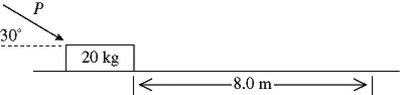
Q11. In the figure, a constant external force P = 160 N is applied to a 20.0-kg box, which is on a rough horizontal surface. While the force pushes the box a distance of 8.00 m, the speed changes from 0.500 m/s to 2.60 m/s. The work done by friction during this process is closest to:
Background
Topic: Work-Energy Principle and Friction
This question tests your ability to use the work-energy theorem and account for frictional forces when a box is pushed across a surface.
Key Terms and Formulas
Work-Energy Theorem:
Kinetic Energy:
Work by friction:
Step-by-Step Guidance
Calculate the change in kinetic energy: , where kg, m/s, m/s.
Find the work done by the applied force: , where N and m.
Use the work-energy theorem: .
Rearrange to solve for : .
Try solving on your own before revealing the answer!
Final Answer: -1040 J
The negative sign indicates that friction does work against the motion of the box.
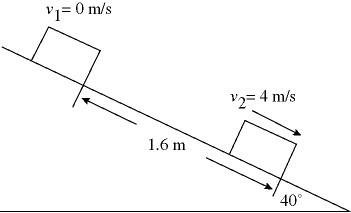
Q31. An 8.0-kg block is released from rest (v1 = 0.00 m/s) on a rough incline, as shown in the figure. The block moves a distance of 1.6 m down the incline, in a time interval of 0.80 s, and acquires a velocity of v2 = 4.0 m/s. How much work does gravity do on the block during this process?
Background
Topic: Work Done by Gravity on an Incline
This question tests your understanding of how to calculate the work done by gravity as an object moves down an inclined plane.
Key Terms and Formulas
Work by gravity:
Change in height:
Mass (): 8.0 kg, Distance (): 1.6 m, Angle (): 40°
Step-by-Step Guidance
Calculate the vertical height change: , where m and .
Plug in the values to find .
Calculate the work done by gravity: , where kg and m/s².
Set up the expression for , but do not compute the final value yet.
Try solving on your own before revealing the answer!
Final Answer: +81 J
Gravity does positive work as the block moves down the incline, increasing its kinetic energy.
