 Back
BackPhysics Study Guide: Work, Energy, and Power
Study Guide - Smart Notes
 Tailored notes based on your materials, expanded with key definitions, examples, and context.
Q23. A 15 kg cannonball is launched straight up with a speed of 25 m/s.
a. How high up will it go?
b. How much work was done on the cannonball to get it that high?
Background
Topic: Conservation of Energy, Work-Energy Principle
This question tests your understanding of how kinetic energy is converted to gravitational potential energy and how to calculate the work done to reach a certain height.
Key Terms and Formulas
Kinetic Energy (KE):
Gravitational Potential Energy (PE):
Work-Energy Theorem: The work done on an object is equal to its change in kinetic energy.
Step-by-Step Guidance
First, calculate the initial kinetic energy of the cannonball using where and .
At the highest point, all the kinetic energy will have been converted into gravitational potential energy: .
Set the initial kinetic energy equal to the potential energy at the highest point: .
Solve for (height): , where .
Try solving on your own before revealing the answer!
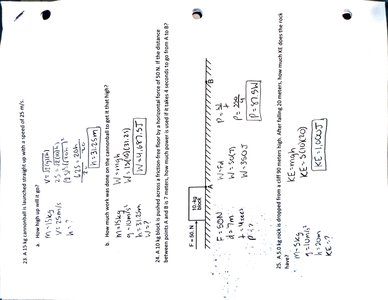
Q24. A 10 kg block is pushed across a friction-free floor by a horizontal force of 50 N. If the distance between points A and B is 7 meters, how much power is used if it takes 4 seconds to go from A to B?
Background
Topic: Work, Power, and Energy
This question tests your ability to calculate work done by a force and the power required to perform that work over a certain time interval.
Key Terms and Formulas
Work:
Power:
Where is force, is distance, and is time.
Step-by-Step Guidance
Calculate the work done using , where and .
Once you have the work, use the formula for power: , where .
Try solving on your own before revealing the answer!
Q25. A 5.0 kg rock is dropped from a cliff 90 meters high. After falling 20 meters, how much kinetic energy does the rock have?
Background
Topic: Conservation of Energy
This question tests your understanding of how gravitational potential energy is converted into kinetic energy as an object falls.
Key Terms and Formulas
Potential Energy lost:
Kinetic Energy gained: (if air resistance is ignored)
Where is mass, is acceleration due to gravity, and is the change in height.
Step-by-Step Guidance
Calculate the change in height: .
Calculate the potential energy lost: , where and .
The kinetic energy gained by the rock after falling 20 meters is equal to the potential energy lost.
Try solving on your own before revealing the answer!
Final Answers
Q23a: (using )
Q23b: (work equals the change in kinetic energy)
Q24: (work divided by time)
Q25: (potential energy lost equals kinetic energy gained)
Each answer is found by applying the relevant formulas and substituting the given values.
