 Back
BackPhysics Unit III Test Study Guidance: Forces, Friction, Vectors, and Equilibrium
Study Guide - Smart Notes
 Tailored notes based on your materials, expanded with key definitions, examples, and context.
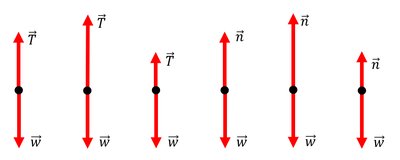
Q1. An elevator is moving downwards and slowing. Choose the FBD that represents the forces acting on the elevator.
Background
Topic: Free-Body Diagrams (FBD) and Newton's Second Law
This question tests your understanding of how forces are represented in a free-body diagram for an object (the elevator) that is moving downward but slowing down. You need to consider gravity and the tension/normal force acting on the elevator.
Key Terms:
Free-Body Diagram (FBD): A diagram showing all external forces acting on an object.
Weight (): The force due to gravity, acting downward.
Tension/Normal Force ( or ): The force exerted by the cable or support, acting upward.
Step-by-Step Guidance
Recall that the elevator is moving downward but slowing, which means the net force must be upward (opposite to the direction of motion).
Identify the forces: The weight () acts downward, and the tension () or normal force () acts upward.
For the elevator to slow down while moving downward, the upward force must be greater than the downward force.
Look for the FBD where the upward arrow (tension/normal) is longer than the downward arrow (weight).
Try solving on your own before revealing the answer!
Final Answer: The correct FBD is the one where the upward force is greater than the downward force.
This represents the situation where the elevator is slowing down while moving downward, so the net force is upward.
Q2. A 40 kg person is inside an elevator and the scale reads a steady 450 N. Which of the following statement is correct?
Background
Topic: Apparent Weight and Elevator Motion
This question tests your understanding of how the apparent weight changes depending on the motion of the elevator. The scale reading is the normal force exerted on the person.
Key Terms and Formulas:
Apparent Weight: The normal force () measured by the scale.
Actual Weight:
Normal Force in an Elevator: (upward acceleration), (downward acceleration)
Step-by-Step Guidance
Calculate the actual weight:
Compare the scale reading (450 N) to the actual weight.
If the scale reading is less than the actual weight, the elevator is accelerating downward.
If the scale reading is more than the actual weight, the elevator is accelerating upward.
Try solving on your own before revealing the answer!
Final Answer: The elevator is moving downward and slowing.
The scale reading is higher than the actual weight, indicating upward acceleration while moving downward.
Q3. A force of 70.0 N is acting at an angle of 20° from the x-axis. What are the components of the force?
Background
Topic: Vector Components
This question tests your ability to resolve a force into its x and y components using trigonometry.
Key formula:
Step-by-Step Guidance
Identify the magnitude of the force ( N) and the angle ().
Calculate the x-component:
Calculate the y-component:
Check your calculator is set to degrees.
Try solving on your own before revealing the answer!
Final Answer: N, N
These are the correct vector components for a force of 70 N at 20° from the x-axis.
Q4. The coefficients of static and kinetic friction between a 6.0 kg box and a floor are 0.30 and 0.20 respectively. What is the force of friction on the box when pushed horizontally with a force of 25 N?
Background
Topic: Friction Forces
This question tests your understanding of static and kinetic friction and how to determine which applies based on the applied force.
Key Terms and Formulas:
Static Friction:
Kinetic Friction:
Normal Force: (if no vertical forces other than gravity)
Step-by-Step Guidance
Calculate the normal force:
Find the maximum static friction:
Compare the applied force (25 N) to the maximum static friction.
If the applied force exceeds static friction, use kinetic friction:
Try solving on your own before revealing the answer!
Final Answer: The force of friction is 11.8 N (kinetic friction).
Since the applied force exceeds static friction, the box moves and kinetic friction applies.
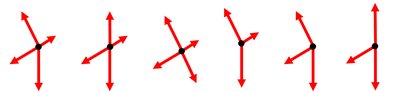
Q5. An object is given a push and moves along the ramp. Choose the FBD that represents the forces acting on the object as it moves along the ramp.
Background
Topic: Free-Body Diagrams on Inclined Planes
This question tests your ability to identify the correct free-body diagram for an object moving on an inclined plane, considering gravity, normal force, and friction.
Key Terms:
Gravity (): Acts downward.
Normal Force (): Acts perpendicular to the surface.
Friction (): Acts parallel to the surface, opposite to motion.
Step-by-Step Guidance
Identify the direction of motion (up the ramp).
Draw gravity acting downward, normal force perpendicular to the ramp, and friction opposing motion.
Look for the FBD with three forces: gravity, normal, and friction.
Try solving on your own before revealing the answer!
Final Answer: The correct FBD shows gravity, normal force, and friction.
This diagram accurately represents the forces acting on an object moving up a ramp.
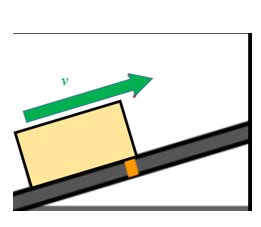
Q6. A 6.0 kg object is sliding up a ramp of incline 40°. The coefficient of kinetic friction between the object and the ramp is 0.2. What is the numerical value of the frictional force?
Background
Topic: Kinetic Friction on Inclined Planes
This question tests your ability to calculate the frictional force for an object moving on an inclined plane.
Key formula:
Kinetic Friction:
Normal Force:
Step-by-Step Guidance
Calculate the normal force:
Calculate the kinetic friction:
Make sure to use the correct angle and units.
Try solving on your own before revealing the answer!
Final Answer: The frictional force is approximately 9.2 N.
We used the normal force and the coefficient of kinetic friction to find the frictional force.
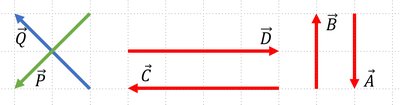
Q7. Consider vectors and represented in the diagram below. Which of the following vectors represents the sum ?
Background
Topic: Vector Addition
This question tests your ability to visually add vectors using the head-to-tail method and identify the resulting vector.
Key Terms:
Vector Addition: Place the tail of the second vector at the head of the first.
Resultant Vector: The vector from the tail of the first to the head of the second.
Step-by-Step Guidance
Identify the direction and magnitude of and in the diagram.
Use the head-to-tail method to add and .
Find the vector that starts at the tail of and ends at the head of .
Try solving on your own before revealing the answer!
Final Answer: The sum is represented by vector .
Vector is the correct resultant using the head-to-tail method.
Q8. Assume friction is negligible and that both the string and pulley are ideal. The mass of the hanging body is 1.0 kg and the other block is 2.0 kg. What will the acceleration be after the rope is released?
Background
Topic: Newton's Second Law and Atwood Machine
This question tests your ability to analyze a system of masses connected by a string over a pulley and calculate the acceleration.
Key formula:
Step-by-Step Guidance
Identify the masses: kg (hanging), kg (on surface).
Plug the values into the formula:
Simplify the numerator and denominator.
Try solving on your own before revealing the answer!
Final Answer: The acceleration is approximately 3.27 m/s2.
This is calculated using the Atwood machine formula for ideal conditions.
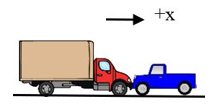
Q9. Two trucks are trying to drive in different directions. The larger truck is pushing the smaller truck and accelerating in the +x direction. Which of the following statements is correct?
Background
Topic: Newton's Third Law
This question tests your understanding of action-reaction pairs and the equality of forces between two interacting objects.
Key Terms:
Newton's Third Law: For every action, there is an equal and opposite reaction.
Force Pair: The force exerted by the larger truck on the smaller truck is equal in magnitude and opposite in direction to the force exerted by the smaller truck on the larger truck.
Step-by-Step Guidance
Identify the action-reaction pair: Larger truck pushes smaller truck; smaller truck pushes back.
Recall Newton's Third Law:
Compare the magnitudes of the forces.
Try solving on your own before revealing the answer!
Final Answer: The forces are equal in magnitude.
Newton's Third Law states that the action and reaction forces are equal and opposite.
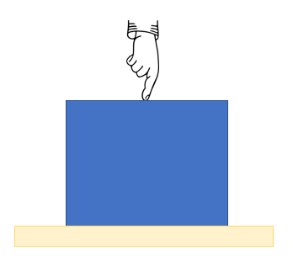
Q10. A 4.0 kg box is pushed vertically downward with a force of 10.0 N. If the coefficient of static friction between the box and floor is 0.50, how much horizontal force is necessary to overcome the static friction and get the box to start sliding across the surface?
Background
Topic: Static Friction and Normal Force
This question tests your ability to calculate the maximum static friction and determine the force needed to initiate motion.
Key formula:
Normal Force:
Maximum Static Friction:
Step-by-Step Guidance
Calculate the normal force:
Calculate the maximum static friction:
The horizontal force must exceed this value to start motion.
Try solving on your own before revealing the answer!
Final Answer: The required horizontal force is 25.0 N.
This is the minimum force needed to overcome static friction and start sliding.
