 Back
BackPhysics with Calculus: Current, Resistance, and EMF Study Guidance
Study Guide - Smart Notes
 Tailored notes based on your materials, expanded with key definitions, examples, and context.
Q1. A silver wire 2.6 mm in diameter transfers a charge of 420 C in 80 min. Silver contains free electrons per cubic meter.
Background
Topic: Electric Current and Drift Velocity
This question tests your understanding of electric current, charge flow, and the microscopic model of current (drift velocity of electrons).
Key Terms and Formulas:
Current ():
Drift velocity ():
= total charge (Coulombs)
= time (seconds)
= number density of free electrons (per )
= elementary charge ( C)
= cross-sectional area of the wire ()
Step-by-Step Guidance
Convert the diameter of the wire to meters and calculate the radius.
Find the cross-sectional area using .
Convert the time from minutes to seconds.
Calculate the current using .
Set up the drift velocity formula: and rearrange to solve for .
Plug in the known values to the drift velocity equation, but stop before calculating the final value.
Try solving on your own before revealing the answer!
Final Answer:
Part A: The current in the wire is A.
Part B: The magnitude of the drift velocity of the electrons is m/s.
We used the formulas for current and drift velocity, plugging in all values and converting units as needed.
Q2. In household wiring, copper wire 2.05 mm diameter is often used. Find the resistance of a piece of copper wire of length 23.1 m.
Background
Topic: Resistance of a Wire
This question tests your ability to calculate the resistance of a wire using its physical properties and material constants.
Key Terms and Formulas:
Resistance ():
= resistivity of copper ( )
= length of wire (meters)
= cross-sectional area ()
Step-by-Step Guidance
Convert the diameter to meters and calculate the radius.
Calculate the cross-sectional area using .
Write down the resistivity value for copper.
Plug the values into the resistance formula .
Set up the calculation, but stop before computing the final resistance value.
Try solving on your own before revealing the answer!
Final Answer:
The resistance of the copper wire is .
We used the formula for resistance, calculated the area, and substituted all values correctly.
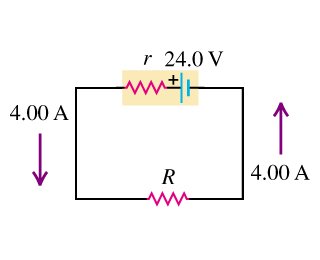
Q3. Consider the circuit shown in the figure. The terminal voltage of the 24.0-V battery is 21.2 V. The current in the circuit is 4.00 A.
Background
Topic: EMF, Internal Resistance, and Circuit Analysis
This question tests your understanding of how internal resistance affects terminal voltage and how to analyze simple circuits using Ohm's law and Kirchhoff's rules.
Key Terms and Formulas:
EMF (): The ideal voltage of the battery ( V)
Terminal voltage (): The measured voltage across the battery terminals ( V)
Internal resistance (): Resistance inside the battery
Current (): A
Ohm's Law for a battery:
Total circuit resistance:
Step-by-Step Guidance
Write down the formula for terminal voltage: .
Plug in the known values for , , and .
Rearrange the equation to solve for internal resistance .
For the circuit resistor , use Ohm's law: .
Set up the calculation for using the known values, but stop before computing the final values.
Try solving on your own before revealing the answer!
Final Answer:
Part A: The internal resistance of the battery is .
Part B: The resistance of the circuit resistor is .
We used the terminal voltage formula and Ohm's law to solve for and .
Q4. In Europe the standard voltage in homes is 220 V instead of the 120 V used in the United States. Therefore a "100-W" European bulb would be intended for use with a 220-V potential difference.
Background
Topic: Power, Resistance, and Current in Circuits
This question tests your understanding of how power ratings and current change when a device is used at a different voltage than intended.
Key Terms and Formulas:
Power ():
Resistance ():
Current ():
Step-by-Step Guidance
Calculate the resistance of the bulb using its European rating: .
Use this resistance to find the power rating when used at 120 V: .
Set up the calculation for the current drawn in the US: .
Stop before calculating the final numeric values for power and current.
Try solving on your own before revealing the answer!
Final Answer:
Part A: The U.S. power rating of the bulb is W.
Part B: The current drawn in the U.S. is A.
We calculated the resistance from the European rating and used it to find the U.S. power and current.
Q5. A battery-powered GPS receiver operating on a voltage of 8.8 V draws a current of 0.15 A. How much electrical energy does it consume during a time of 1.5 h?
Background
Topic: Electrical Energy and Power
This question tests your ability to calculate electrical energy consumed using power, voltage, current, and time.
Key Terms and Formulas:
Power ():
Energy ():
= time (seconds)
Step-by-Step Guidance
Convert the time from hours to seconds.
Calculate the power using .
Set up the calculation for energy: .
Stop before calculating the final numeric value for energy.
Try solving on your own before revealing the answer!
Final Answer:
The electrical energy consumed is J.
We converted the time to seconds, calculated power, and multiplied by time to find the energy.
