 Back
Physics with Calculus: Describing Motion – Study Guidance
Study Guide - Smart Notes
 Tailored notes based on your materials, expanded with key definitions, examples, and context.
Q1. In each case, is the object speeding up, slowing down, or traveling at constant speed?
Background
Topic: Motion Diagrams and Kinematics
This question tests your ability to interpret motion diagrams and determine whether an object's speed is increasing, decreasing, or remaining constant.
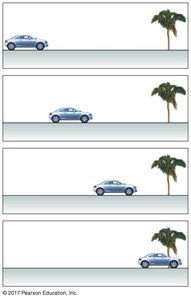
Key Terms:
Motion diagram: A sequence of images showing an object's position at equal time intervals.
Speeding up: The distance between positions increases with each frame.
Slowing down: The distance between positions decreases with each frame.
Constant speed: The distance between positions remains the same in each frame.
Step-by-Step Guidance
Examine the spacing between the dots or images in each motion diagram. Are the distances between each position equal, increasing, or decreasing?
If the spacing increases, the object is speeding up. If it decreases, the object is slowing down. If it stays the same, the object is moving at constant speed.
For each diagram, describe the pattern you observe and classify the motion accordingly.
Write your answer for each case based on your observations, but do not calculate or state the final answer yet.
Try solving on your own before revealing the answer!
Final Answer:
1. The object is speeding up (distance between positions increases).
2. The object is slowing down (distance between positions decreases).
3. The object is traveling at constant speed (distance between positions is equal).
These classifications are based on the patterns in the motion diagrams.
Q2. Match the motion diagrams (a), (b), and (c) to the descriptions:
Background
Topic: Interpreting Motion Diagrams
This question tests your ability to match visual representations of motion to physical descriptions of real-world scenarios.
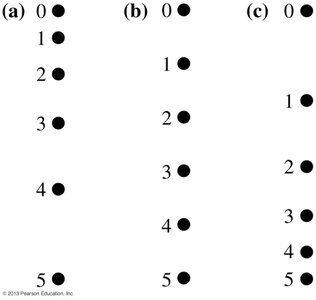
Key Terms:
Motion diagram: Shows the position of an object at equal time intervals.
Descriptions: Each scenario describes a different type of motion (constant speed, accelerating, decelerating).
Step-by-Step Guidance
Read each description carefully and identify the type of motion (constant speed, speeding up, slowing down).
Examine the diagrams (a), (b), and (c) for the pattern of spacing between dots.
Match the diagram where the spacing is equal to the description of constant speed.
Match the diagram where the spacing increases to the description of speeding up, and where it decreases to slowing down.
Write your matches, but do not reveal the final answer yet.
Try solving on your own before revealing the answer!
Final Answer:
(a) A piece of dust settles onto the ground at constant speed.
(b) A Falcon rocket lands on Earth (slowing down).
(c) A student drops a golf ball from the 2nd floor balcony (speeding up).
The matches are based on the patterns of spacing in the diagrams.
Q3. Complete the table of position and time for the motion diagram showing the position of a car at 1s intervals.
Background
Topic: Position-Time Data
This question tests your ability to read and interpret position and time data from a motion diagram.
Key Terms:
Position (): The location of the object at a given time.
Time (): The moment at which the position is recorded.
Step-by-Step Guidance
Identify the positions of the car at each labeled time interval (e.g., s, s, s, s).
Record the corresponding values for each time interval in the table.
Check for consistency in the intervals and ensure the data matches the diagram.
Fill in the table, but do not reveal the final completed table yet.
Try solving on your own before revealing the answer!
Final Answer:
The completed table is:
s, m
s, m
s, m
s, m
This matches the positions shown in the motion diagram.
Q4. What is the displacement of the car as it moves from s to s?
Background
Topic: Displacement Calculation
This question tests your understanding of displacement as the change in position over a specified time interval.
Key Formula:
= final position
= initial position
Step-by-Step Guidance
Identify the position of the car at s () and at s () from the motion diagram or table.
Set up the displacement formula: .
Plug in the values for and .
Calculate the difference, but do not state the final value yet.
Try solving on your own before revealing the answer!
Final Answer:
The displacement is 2 meters to the right.
Q5. Over what time interval does the car travel from 2m to 4m?
Background
Topic: Time Interval Calculation
This question tests your ability to determine the elapsed time for a specific change in position.
Key Formula:
= final time
= initial time
Step-by-Step Guidance
Identify the times at which the car is at 2m () and at 4m ().
Set up the formula for time interval: .
Plug in the values for and .
Calculate the difference, but do not state the final value yet.
Try solving on your own before revealing the answer!
Final Answer:
The car travels from 2m to 4m over a time interval of 2 seconds.
Q6. Use the motion diagram of a car to calculate each quantity:
Background
Topic: Displacement and Average Velocity
This question tests your ability to calculate displacement and average velocity, and to interpret direction and uniform motion.
Key Formulas:
Displacement:
Average velocity:
Step-by-Step Guidance
(a) Identify the initial and final positions for the entire motion ( s to s).
Set up the displacement formula: .
(b) Determine the direction of travel based on the sign of the displacement.
(c) Calculate the average velocity for the entire motion: , using the total displacement and total time interval.
(d) Calculate the average velocity from s to s using the same formula.
(e) Assess whether the car is in uniform motion by checking if the average velocity is constant and the spacing in the motion diagram is equal.
Do not reveal the final calculations or answers yet.
Try solving on your own before revealing the answer!
Final Answer:
(a) Displacement:
(b) The car is traveling to the right (positive displacement).
(c) Average velocity for entire motion:
(d) Average velocity from s to s:
(e) Yes, the car is in uniform motion because the average velocity is constant and the spacing in the diagram is equal.
