 Back
Physics with Calculus Exam 1 Practice Guidance: Waves, SHM, and Electric Fields
Study Guide - Smart Notes
 Tailored notes based on your materials, expanded with key definitions, examples, and context.
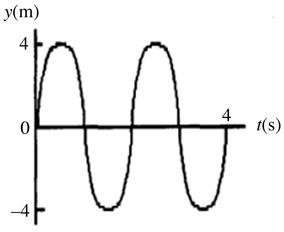
Q3. The frequency of the wave shown in the figure is:
Background
Topic: Wave Properties (Frequency and Period)
This question tests your ability to determine the frequency of a wave from its graphical representation, specifically by analyzing the period shown on a displacement vs. time graph.
Key Terms and Formulas
Period (T): The time it takes for one complete cycle of the wave.
Frequency (f): The number of cycles per second, measured in Hertz (Hz).
Relationship:
Step-by-Step Guidance
Examine the graph to determine the period of the wave. The period is the time interval between two consecutive points where the wave repeats its pattern (e.g., from peak to peak).
Identify the value of by looking at the time axis. For example, if the wave completes one cycle in 2 seconds, then s.
Recall the formula for frequency: .
Set up the calculation for frequency using the period you found from the graph.
Try solving on your own before revealing the answer!
Final Answer: 0.5 Hz
From the graph, the period is 2 seconds. Using , Hz.
This means the wave completes half a cycle per second.
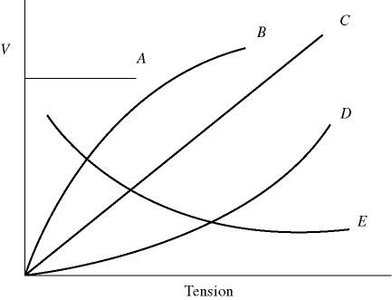
Q4. In the figure, which curve best represents the variation of wave speed as a function of tension for transverse waves on a stretched string?
Background
Topic: Wave Speed on a Stretched String
This question tests your understanding of how the speed of a transverse wave on a string depends on the tension in the string.
Key Terms and Formulas
Wave speed (): The speed at which a wave travels along the string.
Tension (): The force stretching the string.
Mass per unit length (): The mass of the string divided by its length.
Formula:
Step-by-Step Guidance
Recall that the speed of a wave on a string is proportional to the square root of the tension: .
Examine the curves in the figure. Identify which curve shows a square root relationship (i.e., increases rapidly at first, then more slowly as tension increases).
Compare the shapes of the curves to the expected mathematical form of vs. .
Determine which curve best matches the theoretical relationship.
Try solving on your own before revealing the answer!
Final Answer: Curve B
Curve B best represents the relationship , showing the correct square root dependence of wave speed on tension.
This is because the wave speed increases with tension, but not linearly—it follows a square root curve.
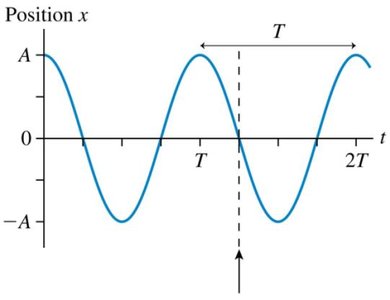
Q12. The position of an object oscillating on an ideal spring is given by . At time s, what is the magnitude of the acceleration of the object?
Background
Topic: Simple Harmonic Motion (SHM) and Acceleration
This question tests your ability to calculate the acceleration of an object in SHM at a specific time, using the position function.
Key Terms and Formulas
Position function:
Angular frequency (): The rate at which the object oscillates, in rad/s.
Acceleration in SHM:
Step-by-Step Guidance
Write the position function: , where m and rad/s.
Recall the formula for acceleration in SHM: .
Calculate by substituting s into the position function.
Set up the calculation for using the value of and .
Try solving on your own before revealing the answer!
Final Answer: 0.1 m/s2
Using , substitute rad/s and from the position function. The magnitude of the acceleration is m/s2.
This shows how the acceleration depends on both the angular frequency and the instantaneous position.
