 Back
Physics with Calculus Exam 1 Study Guidance
Study Guide - Smart Notes
 Tailored notes based on your materials, expanded with key definitions, examples, and context.
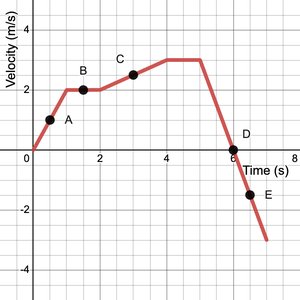
Q5. Rank the instantaneous acceleration at moments A, B, C, and D from most negative to most positive.
Background
Topic: Kinematics – Velocity vs. Time Graphs
This question tests your understanding of how to interpret velocity vs. time graphs and determine instantaneous acceleration at specific points. Acceleration is the slope of the velocity-time graph at each moment.
Key Terms and Formulas:
Instantaneous acceleration: The rate of change of velocity at a specific instant.
Slope of velocity-time graph:
Positive slope = positive acceleration; negative slope = negative acceleration.
Step-by-Step Guidance
Examine the graph at points A, B, C, and D. Identify whether the slope at each point is positive, negative, or zero.
Compare the steepness of the slopes at each point. The steeper the slope, the greater the magnitude of acceleration (positive or negative).
Rank the points from most negative to most positive acceleration based on the slope direction and magnitude.
Set up your ranking, but do not finalize the order yet. Consider if any points have equal slopes or if one is clearly more positive or negative than the others.
Try solving on your own before revealing the answer!
Final Answer:
The correct ranking is: E < D < B < C < A.
Point E has the most negative slope (steepest downward), D is less negative, B and C are positive but C is steeper than B, and A is the most positive.
Q6. Calculate the object’s displacement from t = 4 s to t = 6.5 s. Show your calculation.
Background
Topic: Kinematics – Displacement from Velocity vs. Time Graph
This question tests your ability to calculate displacement by finding the area under the velocity-time curve between two time points.
Key Terms and Formulas:
Displacement: The area under the velocity-time graph between two times.
Area under curve:
For straight segments, area can be calculated as rectangles and triangles.
Step-by-Step Guidance
Identify the section of the graph between s and s.
Break the area under the curve into geometric shapes (rectangles, triangles) for easier calculation.
Calculate the area of each shape, noting whether the area is above or below the time axis (positive or negative displacement).
Sum the areas to find the total displacement, but stop before adding the final values together.
Try solving on your own before revealing the answer!
Final Answer:
The displacement from s to s is m.
This is found by summing the areas under the curve (including negative areas below the axis) between these times.
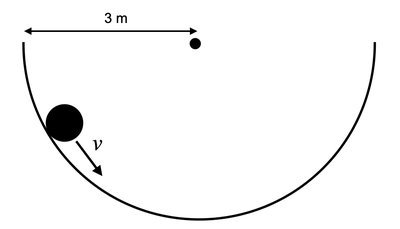
Q7. A ball is rolling down a circular half pipe as shown below. At the moment shown, the ball’s speed is increasing at a rate of 3.5 m/s per second and the ball has a total acceleration of 6.0 m/s2.
Background
Topic: Dynamics – Circular Motion and Acceleration Components
This question tests your understanding of tangential and centripetal acceleration in circular motion.
Key Terms and Formulas:
Tangential acceleration (): Rate of change of speed along the path.
Centripetal acceleration (): Directed toward the center of the circle,
Total acceleration:
Step-by-Step Guidance
Given m/s2 and m/s2, use the formula to solve for .
Once you have , use to solve for the speed at this moment. The radius is given as 3 m.
Set up the equation for but do not solve for the final value yet.
Try solving on your own before revealing the answer!
Final Answer:
The ball’s speed at this moment is m/s.
We first found using the Pythagorean relationship, then solved for using the centripetal acceleration formula.
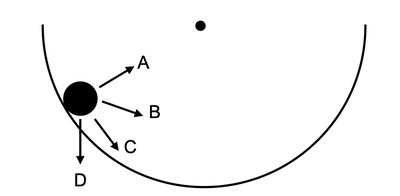
Q7b. Which arrow below best represents the direction of the total acceleration at this moment?
Background
Topic: Dynamics – Acceleration Vector in Circular Motion
This question tests your ability to identify the direction of the total acceleration vector, which is the vector sum of tangential and centripetal accelerations.
Key Terms and Formulas:
Total acceleration vector: Points between the tangential and centripetal directions.
Tangential acceleration: Along the path, in the direction of increasing speed.
Centripetal acceleration: Toward the center of the circle.
Step-by-Step Guidance
Identify the direction of tangential acceleration (along the path, down the slope).
Identify the direction of centripetal acceleration (toward the center of the circle).
The total acceleration vector is the vector sum of these two components.
Compare the arrows in the diagram to determine which best represents the combined direction.
Try solving on your own before revealing the answer!
Final Answer:
The correct arrow is B.
Arrow B points between the tangential and centripetal directions, representing the vector sum of both accelerations.
