 Back
Physics with Calculus Exam 2 Review – Electrostatics, Capacitance, and Gauss’s Law
Study Guide - Smart Notes
 Tailored notes based on your materials, expanded with key definitions, examples, and context.
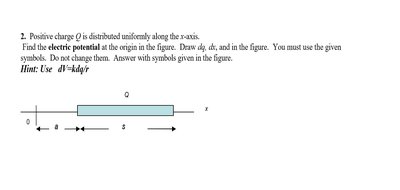
Q2. Positive charge is distributed uniformly along the x-axis. Find the electric potential at the origin in the figure. Draw , , and in the figure. You must use the given symbols. Do not change them. Answer with symbols given in the figure. Hint: Use
Background
Topic: Electric Potential from Continuous Charge Distributions
This question tests your ability to calculate the electric potential at a point due to a uniformly distributed charge along a line, using calculus and the principle of superposition.
Key Terms and Formulas:
: infinitesimal charge element
: infinitesimal length element
: distance from the origin to the start of the charge distribution
: Coulomb's constant
: potential due to a point charge
Step-by-Step Guidance
Identify the limits of the charge distribution along the x-axis (from to as shown in the figure).
Express the infinitesimal charge element in terms of the linear charge density and : .
Write the expression for the electric potential at the origin due to at position : , since the distance from the origin to $dq$ is $x$.
Set up the integral for the total potential at the origin: .
Substitute if needed, but keep all symbols as requested. Prepare to integrate and simplify, but stop before evaluating the integral.
Try solving on your own before revealing the answer!
Final Answer:
If you substitute , you can write in terms of , , and . The answer uses only the symbols given in the figure, as requested.
Q5. Two capacitors A and B of capacitance 2.0 μF and 4.0 μF, respectively, are connected in series to a 6.0 V battery.
Background
Topic: Series Capacitors and Charge Distribution
This question tests your understanding of how charge and voltage distribute across capacitors in series.
Key Terms and Formulas:
Capacitance (): ability to store charge per unit voltage
Series connection: same charge on each capacitor, voltage divides
Equivalent capacitance for series:
Step-by-Step Guidance
Calculate the equivalent capacitance for the series combination using .
Find the total charge stored using .
Recall that in series, each capacitor has the same charge .
To find the voltage across capacitor A, use .
Set up the calculation for but stop before plugging in the numbers.
Try solving on your own before revealing the answer!
Final Answer:
(a) Both capacitors have the same charge, since they are in series.
(b)
Plugging in the values: , ,
Q6. The separation of the two plates of a charged capacitor connected to a battery is halved.
Background
Topic: Capacitance and Plate Separation
This question tests your understanding of how capacitance and charge change when the plate separation is altered while connected to a battery.
Key Terms and Formulas:
Capacitance of parallel plate capacitor:
Charge:
Step-by-Step Guidance
Write the formula for capacitance: .
Consider what happens to when is halved.
Since the capacitor is connected to a battery, remains constant.
Write the formula for charge: .
Set up the calculation for the new charge, but stop before evaluating.
Try solving on your own before revealing the answer!
Final Answer:
(a) Capacitance doubles when is halved.
(b) Charge also doubles, since and is constant.
Q8. The potential at the surface of a solid metal sphere of radius is . What is the potential at a point of distance () from the center of the sphere?
Background
Topic: Electric Potential Outside a Charged Sphere
This question tests your understanding of the electric potential due to a charged conductor, using boundary conditions and the formula for potential outside a sphere.
Key Terms and Formulas:
Potential at distance from a sphere:
Potential at surface:
Step-by-Step Guidance
Write the expression for potential at the surface: .
Express in terms of and .
Write the expression for potential at distance : .
Substitute from step 2 into the expression for .
Set up the formula for in terms of , , and , but stop before simplifying.
Try solving on your own before revealing the answer!
Final Answer:
The potential at distance is proportional to the surface potential, scaled by the ratio .
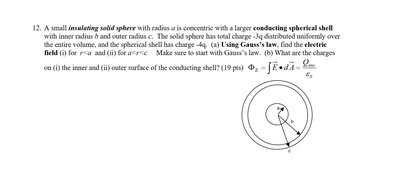
Q12. A small insulating solid sphere with radius is concentric with a larger conducting spherical shell with inner radius and outer radius . The solid sphere has total charge distributed uniformly over the entire volume, and the spherical shell has charge distributed uniformly over its surface. (a) Using Gauss’s law, find the electric field for and for . (b) What are the charges on (i) the inner and (ii) outer surface of the conducting shell?
Background
Topic: Gauss’s Law for Spherical Charge Distributions
This question tests your ability to apply Gauss’s law to find electric fields inside and outside a uniformly charged sphere, and to analyze charge distribution on a conducting shell.
Key Terms and Formulas:
Gauss’s law:
Electric field inside a sphere:
Charge distribution: in sphere, on shell
Step-by-Step Guidance
For , use Gauss’s law to find the enclosed charge: (since charge is uniformly distributed).
Write the expression for the electric field inside the sphere: .
For , the entire charge is enclosed, so .
Write the expression for the electric field in this region: .
For the shell, consider how the charges distribute on the inner and outer surfaces, but stop before stating the final values.
Try solving on your own before revealing the answer!
Final Answer:
(a) For :
For :
(b) The inner surface of the shell has charge (to neutralize the field inside the conductor), and the outer surface has charge $0$.
