 Back
Physics with Calculus Exam Practice – Step-by-Step Guidance
Study Guide - Smart Notes
 Tailored notes based on your materials, expanded with key definitions, examples, and context.
Q1. What is the velocity of the object at s?
Background
Topic: Kinematics – Velocity from a Motion Graph
This question tests your ability to interpret a motion graph and determine the velocity at a specific time.
Key Terms and Formulas:
Velocity (): The rate of change of position with respect to time.
From a position vs. time graph, velocity is the slope at a given point.
Step-by-Step Guidance
Examine the motion graph at s and identify the type of graph (position vs. time).
Determine the slope of the graph at s, since the slope represents velocity.
Estimate the change in position over a small interval around s to calculate the slope.
Set up the calculation for the slope: , using the values from the graph.
Try solving on your own before revealing the answer!
Final Answer: 10 m/s
At s, the slope of the position vs. time graph is 10 m/s, which is the velocity at that instant.
Q2. If the acceleration of the object is constant starting at s, what is its approximate value?
Background
Topic: Kinematics – Acceleration from a Velocity Graph
This question tests your ability to determine acceleration from a motion graph, specifically when acceleration is constant.
Key Terms and Formulas:
Acceleration (): The rate of change of velocity with respect to time.
For constant acceleration, .
Step-by-Step Guidance
Identify the section of the graph after s where acceleration is constant.
Find the change in velocity () over a chosen time interval after s.
Find the change in time () for the same interval.
Set up the formula: , using the values from the graph.
Try solving on your own before revealing the answer!
Final Answer: 2 m/s2
Using the slope of the velocity vs. time graph after s, the acceleration is approximately 2 m/s2.
Q3. If the acceleration of the object is constant starting at s, what is the approximate value of the velocity at s?
Background
Topic: Kinematics – Velocity with Constant Acceleration
This question tests your ability to use constant acceleration to predict future velocity.
Key Terms and Formulas:
Velocity with constant acceleration:
is the initial velocity at s, is the constant acceleration, and is the elapsed time.
Step-by-Step Guidance
Determine the initial velocity () at s from the graph.
Use the acceleration value found in the previous question.
Calculate the time interval: $10$ s $= 10$ s.
Set up the formula: .
Try solving on your own before revealing the answer!
Final Answer: 30 m/s
Using the initial velocity and constant acceleration, the velocity at s is 30 m/s.
Q4. 8 plumbuses cost 5 shmeckles, 14 sprinkles can be traded for 25 shmeckles, and 10 shmeckles are worth 16 togwogglers. If I have 6 plumbuses, how many togwogglers should I be able to purchase?
Background
Topic: Unit Conversion and Proportional Reasoning
This question tests your ability to convert between units using proportional relationships.
Key Terms and Formulas:
Proportional conversion: Use ratios to convert between different units.
Step-by-Step Guidance
Set up the ratio for plumbuses to shmeckles: .
Calculate how many shmeckles 6 plumbuses are worth.
Set up the ratio for shmeckles to togwogglers: .
Convert the shmeckles from step 2 into togwogglers using the ratio.
Try solving on your own before revealing the answer!
Final Answer: 6 togwogglers
By converting 6 plumbuses to shmeckles and then to togwogglers, you can purchase 6 togwogglers.
Q5. The position of an object is given by the equation , where $x$ is in meters and is the time in seconds. What is the maximum positive velocity attained by this object?
Background
Topic: Kinematics – Velocity from Position Function
This question tests your ability to find velocity from a position function and determine its maximum value.
Key Terms and Formulas:
Velocity:
Maximum value: Find where the velocity is maximized.
Step-by-Step Guidance
Differentiate the position function to find the velocity function .
Set up .
Analyze the velocity function to find its maximum positive value.
Determine the time at which the velocity is maximized.
Try solving on your own before revealing the answer!
Final Answer: 4 m/s
The maximum positive velocity is 4 m/s, which occurs at .
Q6. An atmospheric probe is launched straight up from the surface of planet X, which has very little atmosphere. If the probe is in flight for 10.0 seconds before hitting the ground, what was its initial speed if the magnitude of gravitational acceleration on planet X is 12.0 m/s2?
Background
Topic: Kinematics – Projectile Motion under Gravity
This question tests your ability to analyze vertical motion under gravity and determine initial speed.
Key Terms and Formulas:
Time of flight for vertical launch:
is the initial speed, is gravitational acceleration.
Step-by-Step Guidance
Set up the formula for total flight time: .
Plug in the values: s, m/s2.
Rearrange the formula to solve for .
Set up the calculation for using the rearranged formula.
Try solving on your own before revealing the answer!
Final Answer: 60 m/s
The initial speed required for a 10 s flight under 12 m/s2 gravity is 60 m/s.
Q7. A ball is dropped from rest a distance to the floor. If the speed of the ball as it rebounds from the floor is 3/4 of the speed at which it struck the floor, roughly how high will the ball rise?
Background
Topic: Energy Conservation – Kinetic and Potential Energy
This question tests your understanding of energy conservation and how rebound speed affects height.
Key Terms and Formulas:
Potential energy:
Kinetic energy:
Height after rebound:
Step-by-Step Guidance
Calculate the speed at which the ball strikes the floor using energy conservation.
Determine the rebound speed: .
Set up the formula for the height reached after rebound using .
Express in terms of using the ratio of speeds.
Try solving on your own before revealing the answer!
Final Answer:
The ball will rise to of the original height, since energy is proportional to the square of the speed.
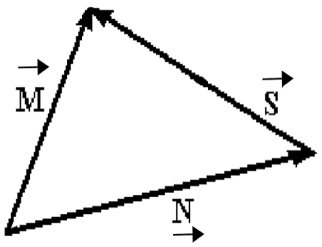
Q8. For the vectors shown in the figure, find the correct relationship between vectors , , and .
Background
Topic: Vector Addition and Subtraction
This question tests your ability to interpret vector diagrams and write vector equations.
Key Terms and Formulas:
Vector addition:
Vector subtraction:
Step-by-Step Guidance
Analyze the vector diagram and identify the direction and arrangement of vectors.
Write the vector equation based on the triangle rule for vector addition.
Check which vector equation matches the diagram.
Compare the options to the equation you derived.
Try solving on your own before revealing the answer!
Final Answer:
The correct relationship is , based on the vector diagram.
Q9. Persons X, Y, and Z walk along a circular path of radius 100 m. Person X walks halfway around the path, Person Y walks 3/4 of the way around the path, and Person Z walks completely around the path. What is the magnitude of Person Y’s displacement?
Background
Topic: Displacement vs. Distance in Circular Motion
This question tests your understanding of displacement in circular paths.
Key Terms and Formulas:
Displacement: The straight-line distance between starting and ending points.
For a circle, use geometry to find the chord length for a given arc.
Chord length:
Step-by-Step Guidance
Calculate the angle subtended by 3/4 of the circle: .
Use the chord length formula to find the displacement.
Plug in m and .
Set up the calculation for the chord length.
Try solving on your own before revealing the answer!
Final Answer: 140 m
The magnitude of Person Y’s displacement is 140 m, calculated using the chord length formula.
Q10. A stone is tied to a string and whirled at constant speed in a horizontal circle. The speed is then doubled, and the length is cut in half. Afterward, the magnitude of the acceleration of the stone is:
Background
Topic: Circular Motion – Centripetal Acceleration
This question tests your understanding of how changes in speed and radius affect centripetal acceleration.
Key Terms and Formulas:
Centripetal acceleration:
Analyze how changes when is doubled and is halved.
Step-by-Step Guidance
Write the original formula for acceleration: .
Write the new formula after changes: .
Simplify the new formula to see how it compares to the original.
Set up the ratio .
Try solving on your own before revealing the answer!
Final Answer: Eight times as great
The acceleration increases by a factor of 8 when speed is doubled and radius is halved.
Q11. The orbit of the international space station (ISS) is nearly circular, is about 413 km above the Earth’s surface, and has a period of 92.7 minutes. Given that the Earth’s radius is 6,378 km, determine the magnitude of acceleration of the ISS as a fraction of m/s2.
Background
Topic: Circular Motion – Orbital Acceleration
This question tests your ability to calculate centripetal acceleration for an orbiting object and compare it to gravity.
Key Terms and Formulas:
Centripetal acceleration:
Orbital speed:
Fraction of :
Step-by-Step Guidance
Calculate the total orbital radius: km.
Convert period to seconds.
Calculate orbital speed using .
Set up the formula for and compare to .
Try solving on your own before revealing the answer!
Final Answer:
The ISS’s acceleration is 0.88 times the acceleration due to gravity at Earth's surface.
Q12. A catapult is tested by ancient Romans. They find that if they launch a boulder from the ground at an angle of 53 degrees (measured with respect to the ground) then the boulder will land on level ground 100m away. What is the initial speed of launch of the boulder if air resistance is negligible?
Background
Topic: Projectile Motion – Range Equation
This question tests your ability to use the range equation for projectile motion to find initial speed.
Key Terms and Formulas:
Range equation:
is the initial speed, is the launch angle, is gravity.
Step-by-Step Guidance
Set up the range equation: .
Plug in m, , m/s2.
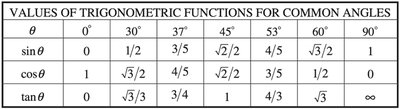
Find using the trigonometric table.
Rearrange the equation to solve for .
Try solving on your own before revealing the answer!
Final Answer: 32 m/s
The initial speed required for a 100 m range at 53 degrees is 32 m/s.
Q13. About how long does it take each bale to land on the ground?
Background
Topic: Projectile Motion – Free Fall Time
This question tests your ability to calculate the time for an object to fall from a given height.
Key Terms and Formulas:
Free fall time:
Solving for :
Step-by-Step Guidance
Set up the formula for free fall: .
Plug in m, m/s2.
Rearrange to solve for .
Set up the calculation for .
Try solving on your own before revealing the answer!
Final Answer: 6.1 s
Each bale takes about 6.1 seconds to land on the ground from 180 m altitude.
Q14. About how far apart from each other will the bales land on the ground?
Background
Topic: Projectile Motion – Horizontal Displacement
This question tests your ability to calculate horizontal distance traveled during free fall.
Key Terms and Formulas:
Horizontal distance:
is horizontal velocity, is time of fall.
Step-by-Step Guidance
Use the time of fall from the previous question.
Set up the formula: .
Plug in m/s, s (interval between drops).
Calculate the horizontal distance between bales.
Try solving on your own before revealing the answer!
Final Answer: 100 m
The bales will land about 100 m apart, based on the horizontal velocity and drop interval.
Q15. What is the final speed of each bale as it hits the ground?
Background
Topic: Projectile Motion – Final Speed Calculation
This question tests your ability to combine vertical and horizontal velocity components to find final speed.
Key Terms and Formulas:
Final speed:
is horizontal velocity, is vertical velocity at impact.
Step-by-Step Guidance
Calculate vertical velocity at impact: .
Use horizontal velocity m/s.
Set up the formula: .
Plug in the values for and .
Try solving on your own before revealing the answer!
Final Answer: 77.6 m/s
The final speed of each bale as it hits the ground is 77.6 m/s, combining both velocity components.
