 Back
Physics with Calculus: Forces, Energy, and Motion – Step-by-Step Guidance
Study Guide - Smart Notes
 Tailored notes based on your materials, expanded with key definitions, examples, and context.
Q1. A 10-kg mass slides down a flat hill that makes an angle of 10° with the horizontal. If friction is negligible, what is the resultant force on the sled?
Background
Topic: Newton's Second Law, Forces on an Inclined Plane
This question tests your understanding of how to resolve forces acting on an object on an inclined plane and apply Newton's second law to find the net force.
Key Terms and Formulas:
Newton's Second Law:
Component of gravity along the incline:
Where:
= mass (kg)
= acceleration due to gravity ()
= angle of incline
Step-by-Step Guidance
Identify the forces acting on the sled: gravity (downward), normal force (perpendicular to the surface), and since friction is negligible, ignore friction.
Resolve the gravitational force into two components: one parallel to the incline () and one perpendicular ().
The net force causing the sled to accelerate down the incline is the parallel component: .
Plug in the known values: , , .
Try solving on your own before revealing the answer!
Final Answer: 17 N
Using :
The net force is approximately 17 N down the incline.
Q2. During the investigation of a traffic accident, police find skid marks 90.0 m long. They determine the coefficient of friction between the car's tires and the roadway to be 0.500 for the prevailing conditions. Estimate the speed of the car when the brakes were applied.
Background
Topic: Work-Energy Principle, Friction
This question tests your ability to use the work-energy theorem and friction to estimate the initial speed of a car before it stopped.
Key Terms and Formulas:
Work-Energy Theorem:
Kinetic Energy:
Frictional Force:
Work done by friction:
Step-by-Step Guidance
Set up the work-energy theorem: the work done by friction brings the car to rest, so .
Express the frictional force as .
Substitute into the work equation: .
Notice that mass cancels out, so you can solve for in terms of , , and .
Try solving on your own before revealing the answer!
Final Answer: 29.7 m/s
Solving for :
The car's speed when the brakes were applied was approximately 29.7 m/s.
Q3. A 30-ton truck collides with a 1000-lb car and causes a lot of damage to the car. During the collision:
Background
Topic: Newton's Third Law
This question tests your understanding of action-reaction force pairs during a collision.
Key Terms and Concepts:
Newton's Third Law: For every action, there is an equal and opposite reaction.
Force during collision: Both objects experience forces of equal magnitude but opposite direction.
Step-by-Step Guidance
Recall Newton's Third Law: the force exerted by the truck on the car is equal in magnitude and opposite in direction to the force exerted by the car on the truck.
Consider that the damage is related to the difference in mass and acceleration, not the force magnitude.
Review the answer choices and identify which one correctly applies Newton's Third Law.
Try solving on your own before revealing the answer!
Final Answer: D) The force on the truck due to the collision is exactly equal to the force on the car.
Newton's Third Law states that the forces are equal and opposite, regardless of the masses involved.
Q4. Does the centripetal force acting on an object do work on the object?
Background
Topic: Work and Circular Motion
This question tests your understanding of the relationship between force, displacement, and work in the context of circular motion.
Key Terms and Concepts:
Work:
Centripetal force: Always directed toward the center of the circle, perpendicular to the instantaneous velocity of the object.
Step-by-Step Guidance
Recall that work is only done when a force has a component in the direction of displacement.
In uniform circular motion, the centripetal force is always perpendicular to the velocity (and thus displacement) of the object.
Consider whether a perpendicular force can do work on an object.
Try solving on your own before revealing the answer!
Final Answer: D) No, because the force and the displacement of the object are perpendicular.
Centripetal force does no work because it is always perpendicular to the direction of motion.
Q5. An object with a mass m slides down a rough 30° inclined plane where the coefficient of kinetic friction is 0.20. What is the acceleration of the object? If the plane is 10 m long and the mass starts from rest, what will be its speed at the bottom of the plane?
Background
Topic: Forces on an Inclined Plane, Friction, Kinematics
This question tests your ability to analyze forces on an inclined plane with friction and use kinematics to find the final speed.
Key Terms and Formulas:
Net force down the incline:
Kinetic friction:
Newton's Second Law:
Kinematic equation:
Step-by-Step Guidance
Calculate the gravitational force component down the incline: .
Calculate the normal force: .
Find the frictional force: .
Determine the net force: .
Use to solve for acceleration .
Set up the kinematic equation to solve for the final speed at the bottom, using , from above, and m.
Try solving on your own before revealing the answer!
Final Answer:
Acceleration:
Final speed:
These values are found by plugging in , , , and m into the formulas above.
Q6. A piece of leaf with 0.05 kg mass falls 15 m to the ground, where it lands with a speed of 5 m/s. (a) With what speed would the leaf have landed if there had been no air resistance? (b) What is the work done by the air resistance? (c) Did air resistance do positive work, negative work, or zero work on the leaf?
Background
Topic: Work-Energy Principle, Non-conservative Forces
This question tests your understanding of energy conservation, the effect of air resistance, and the concept of work done by non-conservative forces.
Key Terms and Formulas:
Conservation of Energy (no air resistance):
Work done by air resistance:
Where:
= mass
= gravity
= height
= final speed
Step-by-Step Guidance
Calculate the speed the leaf would have if it fell freely from 15 m with no air resistance using .
Calculate the actual kinetic energy at landing using the given speed (5 m/s).
Find the difference in mechanical energy to determine the work done by air resistance.
Decide if the work done by air resistance is positive, negative, or zero based on whether it removed or added energy.
Try solving on your own before revealing the answer!
Final Answer:
(a) (no air resistance)
(b)
(c) Air resistance did negative work (it removed energy from the system).
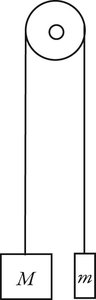
Q7. Two unequal masses M and m (M=10 kg; m=5 kg) are connected by a light cord passing over a pulley of negligible mass, as shown in the figure. When released, the system accelerates. Friction is negligible. What is the acceleration of M? What is the tension force in the string?
Background
Topic: Atwood Machine, Newton's Second Law
This question tests your ability to analyze a two-mass system connected by a string over a pulley, applying Newton's laws to each mass.
Key Terms and Formulas:
Newton's Second Law for each mass:
For :
For :
Solve the two equations simultaneously to find and .
Acceleration:
Tension:
Step-by-Step Guidance
Write Newton's second law for each mass, considering the direction of acceleration.
Set up the equations: for the heavier mass, for the lighter mass.
Add the two equations to eliminate and solve for .
Once is found, substitute back into one of the original equations to solve for .
Try solving on your own before revealing the answer!
Final Answer:
Acceleration:
Tension:
These values are found by plugging kg, kg, and m/s² into the formulas above.
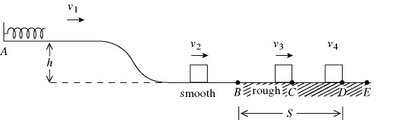
Q8. A 1.5-kg block is held in place against the spring by a 100-N horizontal external force (see the figure). The external force is removed, and the block is projected with a velocity v1 = 1.0 m/s upon separation from the spring. The block descends a ramp and has a velocity v2 = 1.5 m/s at the bottom. The track is frictionless between points A and B. The block enters a rough section at B, extending to E. The coefficient of kinetic friction over this section is 0.2. The velocity of the block is v3 = 1.2 m/s at C. The block moves on to D, where it stops. (a) What is the spring constant? (b) What is the initial compression length of the spring? (c) What is the height of the ramp? (d) What is the distance between B and C? (e) What is the distance between C and D?
Background
Topic: Conservation of Energy, Work by Friction, Springs
This multi-part question tests your ability to apply energy conservation, work done by friction, and spring energy concepts to a block-spring-ramp system.
Key Terms and Formulas:
Spring potential energy:
Kinetic energy:
Gravitational potential energy:
Work done by friction:
Energy conservation:
Step-by-Step Guidance
For (a) and (b): Use energy conservation at the spring release point to relate the spring energy to the block's kinetic energy and the work done by the external force.
For (c): Use energy conservation between the top and bottom of the ramp to relate the change in potential energy to the change in kinetic energy.
For (d): Use the work-energy principle between points B and C, accounting for the work done by friction to find the distance.
For (e): Similarly, use the work-energy principle between points C and D, knowing the block stops at D.
Try solving on your own before revealing the answer!
Final Answer:
(a) Spring constant:
(b) Initial compression:
(c) Height of ramp:
(d) Distance B to C:
(e) Distance C to D:
Each part is solved using the appropriate energy and work formulas as outlined above.
