 Back
BackPhysics with Calculus: Forces, Motion, and Circular Dynamics Study Guide
Study Guide - Smart Notes
 Tailored notes based on your materials, expanded with key definitions, examples, and context.
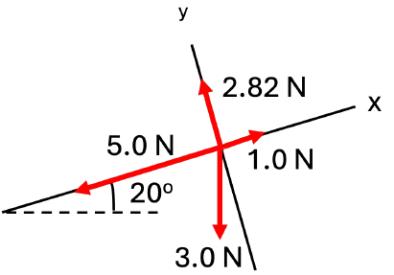
Q1. What is the value of (x-component) of the object's acceleration? (in m/s²)
Background
Topic: Newton's Second Law & Vector Components
This question tests your ability to resolve forces into components and apply Newton's Second Law () to find the acceleration in the x-direction.
Key Terms and Formulas:
Newton's Second Law:
Vector components:
Sum all x-direction forces to find
Step-by-Step Guidance
Identify all forces acting in the x-direction from the diagram: 1.0 N, 5.0 N (at 20°), and any others.
Resolve the 5.0 N force into its x-component: .
Add up all x-components, considering direction (positive/negative).
Apply Newton's Second Law: , where kg.
Set up the calculation for using the summed forces and mass, but stop before plugging in the final numbers.
Try solving on your own before revealing the answer!
Final Answer: 0.25 m/s²
m/s²
The x-components of the forces were summed and divided by the mass to find the acceleration.
Q2. What is the value of (y-component) of the object's acceleration? (in m/s²)
Background
Topic: Newton's Second Law & Vector Components
This question tests your ability to resolve forces into y-components and apply Newton's Second Law to find the acceleration in the y-direction.
Key Terms and Formulas:
Newton's Second Law:
Vector components:
Sum all y-direction forces to find
Step-by-Step Guidance
Identify all forces acting in the y-direction from the diagram: 2.82 N, 3.0 N (down), 5.0 N (at 20°).
Resolve the 5.0 N force into its y-component: .
Add up all y-components, considering direction (positive/negative).
Apply Newton's Second Law: , where kg.
Set up the calculation for using the summed forces and mass, but stop before plugging in the final numbers.
Try solving on your own before revealing the answer!
Final Answer: 0.5 m/s²
m/s²
The y-components of the forces were summed and divided by the mass to find the acceleration.
Q3. What is the coefficient of kinetic friction of the box on the floor?
Background
Topic: Friction & Newton's Laws
This question tests your understanding of kinetic friction and how to use force balance for an object moving at constant speed.
Key Terms and Formulas:
Kinetic friction force:
Normal force: (for horizontal surfaces)
Force balance: (since speed is constant)
Step-by-Step Guidance
Sum the forces applied: 225 N (push) + 310 N (pull).
Since the box moves at constant speed, the total applied force equals the kinetic friction force.
Calculate the normal force: , where kg and m/s².
Set up the equation: .
Prepare to substitute the values, but stop before the final calculation.
Try solving on your own before revealing the answer!
Final Answer: 0.32
The coefficient of kinetic friction is found by dividing the total applied force by the normal force.
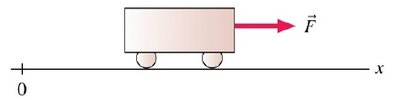
Q4. If the same force is applied for the same time to a second cart with four times the mass, what is the final speed of the second cart?
Background
Topic: Impulse & Newton's Second Law
This question tests your understanding of how impulse and mass affect the final speed of an object.
Key Terms and Formulas:
Impulse:
Change in velocity:
Step-by-Step Guidance
Recall that the same force and time are applied to both carts.
For the first cart: .
For the second cart: (since mass is four times larger).
Compare to to see how the speed changes.
Set up the ratio, but stop before stating the final value.
Try solving on your own before revealing the answer!
Final Answer: 1/4 v
The second cart's speed is one-fourth that of the first cart, since the mass is four times greater and impulse is the same.
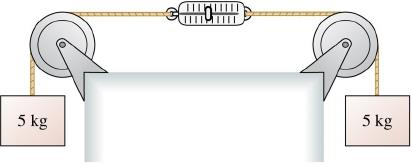
Q5. What is the reading of the spring scale in the pulley system?
Background
Topic: Equilibrium & Tension
This question tests your understanding of tension in a massless string and equilibrium in a pulley system.
Key Terms and Formulas:
Tension: (same throughout a massless string)
Equilibrium:
Weight:
Step-by-Step Guidance
Each mass is 5 kg and hangs from the string.
The spring scale measures the tension in the string.
Since the system is at rest and the string is massless, tension is the same throughout.
Consider the forces acting on each mass and relate them to the tension.
Set up the equation for tension, but stop before stating the final value.
Try solving on your own before revealing the answer!
Final Answer: 10 kg
The spring scale reads the total weight supported, which is 10 kg (the sum of both masses).
Q6. Which diagram could be the car's free-body diagram as it turns a corner on a banked road?
Background
Topic: Free-Body Diagrams & Circular Motion
This question tests your ability to identify the correct free-body diagram for a car on a banked curve, considering normal force, gravity, and friction.
Key Terms and Formulas:
Normal force (), gravity (), friction ()
Banked curve: forces are not all vertical/horizontal
Step-by-Step Guidance
Recall that on a banked curve, the normal force is angled, not vertical.
Gravity always acts downward.
Friction may act up or down the slope, depending on the situation.
Compare the diagrams to these force directions.
Identify which diagram matches these criteria, but stop before stating the answer.
Try solving on your own before revealing the answer!
Final Answer: C
Diagram C correctly shows the normal force angled, gravity downward, and friction as appropriate for a banked curve.
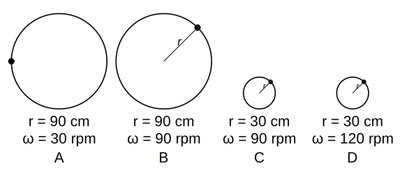
Q7. Which statement about the tension in the string for a block spinning in a horizontal circle is correct?
Background
Topic: Circular Motion & Tension
This question tests your understanding of how tension varies along a string for a block spinning in a circle.
Key Terms and Formulas:
Centripetal force:
Tension is highest where the string is attached to the center.
Step-by-Step Guidance
Recall that tension provides the centripetal force for circular motion.
The tension is greatest at the point closest to the center.
Compare the tension values at different points along the string.
Review the answer choices for the correct order, but stop before stating the answer.
Try solving on your own before revealing the answer!
Final Answer: A. TA > TB > TC > TD
Tension decreases as you move away from the center; the point closest to the center has the highest tension.
Q8. What is the velocity of an object in a circular orbit near the surface of a planet (gravity: 6.7 m/s²; radius: 9,800 km)?
Background
Topic: Circular Orbits & Gravity
This question tests your ability to calculate orbital velocity using gravitational acceleration and radius.
Key Terms and Formulas:
Orbital velocity:
= gravitational acceleration, = radius
Step-by-Step Guidance
Convert the radius to meters: km m.
Use the formula .
Plug in m/s² and m.
Set up the calculation, but stop before finding the final value.
Try solving on your own before revealing the answer!
Final Answer: 8 km/s
m/s km/s
The orbital velocity is found using the square root of the product of gravity and radius.
Q9. During a collision between a mosquito and a truck, which statement about the forces is true?
Background
Topic: Newton's Third Law
This question tests your understanding of action-reaction pairs during collisions.
Key Terms and Formulas:
Newton's Third Law: For every action, there is an equal and opposite reaction.
Force pairs:
Step-by-Step Guidance
Recall that both objects exert equal and opposite forces on each other.
Consider the implications for a collision between objects of very different mass.
Review the answer choices for the correct statement, but stop before stating the answer.
Try solving on your own before revealing the answer!
Final Answer: C. The mosquito exerts the same force on the truck as the truck exerts on the mosquito.
Newton's Third Law states that the forces are equal and opposite, regardless of mass.
Q10. What is the size of the friction force on a 1600 kg car taking a 50-m-radius unbanked curve at 15 m/s?
Background
Topic: Circular Motion & Friction
This question tests your ability to calculate the friction force required for circular motion.
Key Terms and Formulas:
Centripetal force:
Friction provides the centripetal force in an unbanked curve.
Step-by-Step Guidance
Identify the mass ( kg), radius ( m), and speed ( m/s).
Use the formula for centripetal force: .
Set up the calculation for the friction force, but stop before plugging in the numbers.
Try solving on your own before revealing the answer!
Final Answer: 7200 N
N
The friction force required for the car to make the turn is 7200 N.
Q11. What rotation period will provide "normal" gravity for a 1200-m-diameter space station?
Background
Topic: Artificial Gravity & Rotational Motion
This question tests your ability to calculate the rotation period needed to simulate Earth's gravity in a rotating space station.
Key Terms and Formulas:
Artificial gravity:
Earth gravity: m/s²
Radius: m
Period:
Step-by-Step Guidance
Set m/s² and m.
Use to solve for .
Calculate .
Find the period , but stop before plugging in the numbers.
Try solving on your own before revealing the answer!
Final Answer: 49 s
rad/s; s
The space station must rotate with a period of about 49 seconds to simulate normal gravity.
