 Back
BackPhysics with Calculus: Forces, Motion, and Circular Dynamics – Guided Study Notes
Study Guide - Smart Notes
 Tailored notes based on your materials, expanded with key definitions, examples, and context.
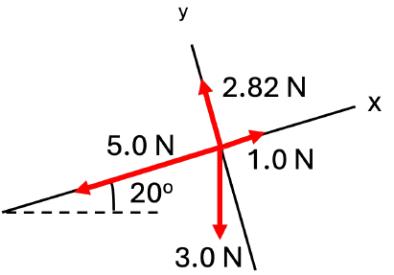
Q1. What is the value of (x-component) of the object's acceleration? (in m/s²)
Background
Topic: Newton's Second Law, Vector Components
This question tests your ability to resolve forces into components and apply Newton's Second Law () to find the acceleration in the x-direction.
Key Terms and Formulas:
Newton's Second Law:
Vector components: Break each force into x and y components using trigonometry.
Step-by-Step Guidance
List all the forces acting on the object and identify their x-components. For angled forces, use or as appropriate.
Sum all the x-components of the forces to find .
Apply Newton's Second Law in the x-direction: , where kg.
Set up the equation with the calculated and the given mass, but do not solve for yet.
Try solving on your own before revealing the answer!
Final Answer: m/s²
By summing the x-components of all forces and dividing by the mass, you find m/s².
This shows the net force in the x-direction causes a small positive acceleration.
Q2. What is the value of (y-component) of the object's acceleration? (in m/s²)
Background
Topic: Newton's Second Law, Vector Components
This question is similar to Q1 but focuses on the y-direction. You need to resolve all forces into their y-components and apply Newton's Second Law.
Key Terms and Formulas:
Newton's Second Law:
Vector components: or as appropriate.
Step-by-Step Guidance
List all the forces acting on the object and identify their y-components.
Sum all the y-components of the forces to find .
Apply Newton's Second Law in the y-direction: , where kg.
Set up the equation with the calculated and the given mass, but do not solve for yet.
Try solving on your own before revealing the answer!
Final Answer: m/s²
The sum of the y-components of all forces is zero, so the acceleration in the y-direction is zero.
Q3. Two friends are sliding a 175 kg box across the floor. The box slides with a constant speed if one person pushes from behind with a 225 N force while the other pulls forward on a rope with a 310 N force. What is the coefficient of kinetic friction of the box on the floor?
Background
Topic: Friction, Newton's Laws
This question tests your understanding of kinetic friction and equilibrium of forces when an object moves at constant velocity.
Key Terms and Formulas:
Kinetic friction force:
Normal force (): For a horizontal surface,
Constant speed: Net force is zero ()
Step-by-Step Guidance
Add the two applied forces to find the total force moving the box forward.
Since the box moves at constant speed, set the total applied force equal to the kinetic friction force.
Express the friction force as and set it equal to the total applied force.
Rearrange the equation to solve for , but do not calculate the final value yet.
Try solving on your own before revealing the answer!
Final Answer:
The coefficient of kinetic friction is found by dividing the total applied force by the normal force ().
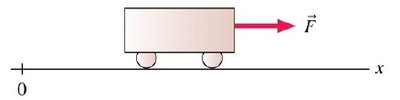
Q4. A cart is initially at rest. A force is applied to the cart for time , after which the cart has speed . Suppose the same force is applied for the same time to a second cart with four times the mass. Afterward, the second cart's speed will be:
Background
Topic: Impulse and Momentum, Newton's Second Law
This question tests your understanding of how impulse () changes the velocity of objects with different masses.
Key Terms and Formulas:
Impulse:
Change in velocity:
Step-by-Step Guidance
Write the impulse-momentum theorem for the first cart: .
For the second cart, substitute for the mass and solve for its final speed .
Compare to to see how the speed changes with increased mass.
Try solving on your own before revealing the answer!
Final Answer:
The second cart's speed is one-fourth that of the first cart because the same impulse is distributed over four times the mass.
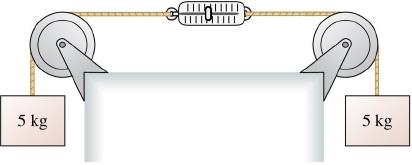
Q5. The figure shows two masses at rest. The string is massless and the pulleys are frictionless. The spring scale reads in kg. What is the reading of the scale?
Background
Topic: Tension, Equilibrium, Newton's Laws
This question tests your understanding of tension in a massless string and how a spring scale measures force in a system at equilibrium.
Key Terms and Formulas:
Tension in a massless string is the same throughout if the system is in equilibrium.
Spring scale measures the tension force, which can be converted to mass using .
Step-by-Step Guidance
Analyze the forces acting on each mass and the string.
Recognize that the system is at rest, so the tension in the string equals the weight of one mass.
Convert the tension force to the equivalent mass reading on the scale.
Try solving on your own before revealing the answer!
Final Answer: 5 kg
The spring scale reads the tension, which equals the weight of one 5 kg mass in this equilibrium setup.
Q6. A car turns a corner on a banked road. Which of the diagrams could be the car's free-body diagram?
Background
Topic: Circular Motion, Free-Body Diagrams
This question tests your ability to identify the correct free-body diagram for a car on a banked curve, considering forces such as gravity, normal force, and friction.
Key Terms and Formulas:
Normal force (): Perpendicular to the surface of the road.
Friction force (): Parallel to the surface, can point up or down the bank depending on the situation.
Gravity (): Always points downward.
Step-by-Step Guidance
Recall that the normal force acts perpendicular to the banked surface, and gravity acts vertically downward.
Consider the direction of friction, which may act up or down the bank depending on the car's speed.
Compare the given diagrams to these force directions to identify the correct one.
Try solving on your own before revealing the answer!
Final Answer: Diagram B
Diagram B correctly shows the normal force perpendicular to the surface and gravity downward, matching the physical situation.
Q7. A block on a string spins in a horizontal circle on a frictionless table counterclockwise. The block is held by the tension of the string (TA to TD). Which one is correct?
Background
Topic: Circular Motion, Tension
This question tests your understanding of how tension varies along a string in uniform circular motion.
Key Terms and Formulas:
Centripetal force:
Tension is greatest where the string is attached to the center and decreases outward.
Step-by-Step Guidance
Recall that the tension must provide the centripetal force to keep the block moving in a circle.
Consider how the tension changes from the center of the circle outward along the string.
Compare the options to determine which correctly orders the tensions.
Try solving on your own before revealing the answer!
Final Answer: TA > TB > TC > TD
The tension is greatest at the point closest to the center and decreases outward.
Q8. An object in a circular orbit near the surface of a planet (gravity: 6.7 m/s²; radius: 9,800 km) is experiencing uniform circular motion. Its velocity is:
Background
Topic: Circular Orbits, Gravity
This question tests your ability to relate gravitational acceleration to orbital velocity for an object in circular motion near a planet's surface.
Key Terms and Formulas:
Orbital velocity:
is the gravitational acceleration, is the radius of the orbit.
Step-by-Step Guidance
Write the formula for orbital velocity: .
Convert the radius to meters if necessary ( km m).
Plug in the values for and , but do not calculate the final value yet.
Try solving on your own before revealing the answer!
Final Answer: 8 km/s
Plugging in the values gives an orbital velocity of approximately 8 km/s.
Q9. A mosquito runs head-on into a truck. Which is true during the collision?
Background
Topic: Newton's Third Law
This question tests your understanding of action-reaction force pairs during a collision.
Key Terms and Formulas:
Newton's Third Law: For every action, there is an equal and opposite reaction.
Step-by-Step Guidance
Recall that the force the mosquito exerts on the truck is equal in magnitude and opposite in direction to the force the truck exerts on the mosquito.
Consider the implications of Newton's Third Law for collisions between objects of very different masses.
Try solving on your own before revealing the answer!
Final Answer: The mosquito exerts the same force on the truck as the truck exerts on the mosquito.
This is a direct application of Newton's Third Law.
Q10. A 1600 kg car takes a 50-m-radius unbanked curve at 15 m/s. What is the size of the friction force on the car? (in N)
Background
Topic: Circular Motion, Friction
This question tests your ability to calculate the friction force required to keep a car moving in a circle (centripetal force).
Key Terms and Formulas:
Centripetal force:
Friction provides the centripetal force on an unbanked curve.
Step-by-Step Guidance
Write the formula for centripetal force: .
Plug in the values: kg, m/s, m.
Set up the calculation, but do not compute the final value yet.
Try solving on your own before revealing the answer!
Final Answer: 7200 N
The friction force required to keep the car on the curve is 7200 N.
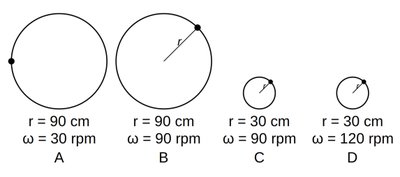
Q11. It is proposed that future space stations create an artificial gravity by rotating. Suppose a space station is constructed as a 1200-m-diameter cylinder that rotates about its axis. The inside surface is the deck of the space station. What rotation period will provide "normal" gravity? (in s)
Background
Topic: Artificial Gravity, Circular Motion
This question tests your ability to relate centripetal acceleration to artificial gravity and solve for the rotation period of a rotating space station.
Key Terms and Formulas:
Centripetal acceleration:
"Normal" gravity: m/s²
Angular velocity: , where is the period
Radius: m
Step-by-Step Guidance
Set and write .
Solve for : .
Relate to the period using .
Set up the equation to solve for , but do not calculate the final value yet.
Try solving on your own before revealing the answer!
Final Answer: 49 s
The rotation period that provides normal gravity is 49 seconds.
