 Back
Physics with Calculus: Foundations, Kinematics, and Newton's Laws
Study Guide - Smart Notes
 Tailored notes based on your materials, expanded with key definitions, examples, and context.
Chapter 1: Introduction to Physics
Physics and the Laws of Nature
Physics is the natural science that studies matter, its motion and behavior through space and time, and the related entities of energy and force. The discipline is based on a small number of fundamental laws and principles that describe the universe.
Matter: Anything that has mass and occupies space.
Energy: The capacity to do work or produce change.
Force: A push or pull acting upon an object as a result of its interaction with another object.
Units of Length, Mass, and Time
Physics relies on precise measurements, which require both a magnitude and a unit. The International System of Units (SI) is used for consistency and reproducibility.
Base units: meter (m) for length, kilogram (kg) for mass, second (s) for time.
Other units, such as the foot or stone, are not used due to variability and lack of reproducibility.
Dimensional Analysis, Scientific Notation, and Converting Units
Dimensional analysis helps verify equations and convert between units. Scientific notation is used to express very large or small numbers efficiently.
Problem Solving in Physics
Effective problem solving in physics involves a systematic approach:
Read the problem carefully.
Sketch the system.
Visualize the physical process.
Strategize and develop a plan.
Identify appropriate equations.
Solve the equations.
Check your answer for reasonableness and correct dimensions.
Explore limits and special cases.
Chapter 2: One-Dimensional Kinematics
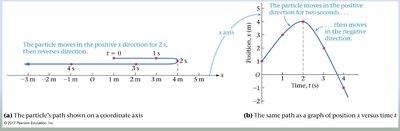
Position, Distance, and Displacement
Kinematics is the study of objects in motion without considering the causes of motion.
Position (x): The location of an object at a particular time.
Distance: The total path length traveled, regardless of direction.
Displacement (Δx): The change in position; a vector quantity.
Average and Instantaneous Velocity
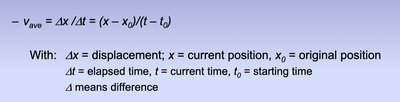
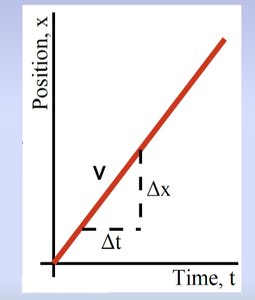
Velocity describes the rate of change of position.
Average velocity (vave):
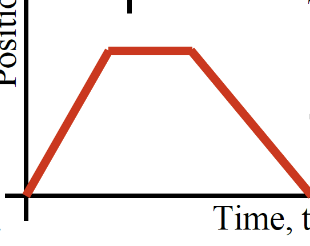
Instantaneous velocity: The velocity at a specific instant, found as the slope of the tangent to the position-time curve.
Acceleration
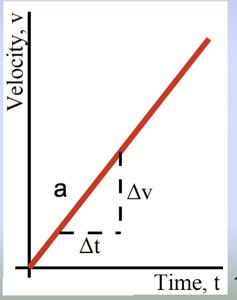
Acceleration is the rate of change of velocity.
Average acceleration (aave):
Instantaneous acceleration:
Equations of Motion for Constant Acceleration
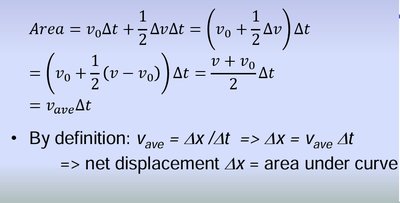
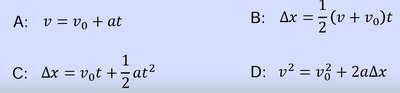
When acceleration is constant, the following equations relate position, velocity, acceleration, and time:
Freely Falling Objects
Objects in free fall experience constant acceleration due to gravity ( downward). The equations of motion apply with .
Chapter 3: Vectors in Physics
Scalars and Vectors
Physical quantities are classified as either scalars (magnitude only) or vectors (magnitude and direction).
Scalar: Temperature, mass, time, etc.
Vector: Displacement, velocity, acceleration, force, etc.
Vector Components and Operations
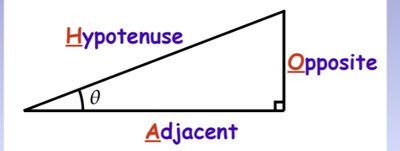
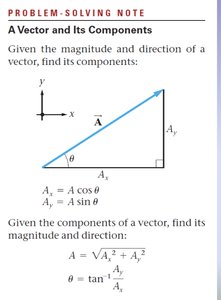
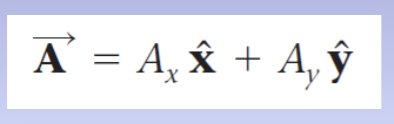
Vectors can be represented by their components along coordinate axes. The magnitude and direction can be found using trigonometry.
Given with magnitude and angle :
,
,
Vector Addition and Subtraction
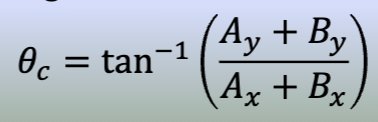
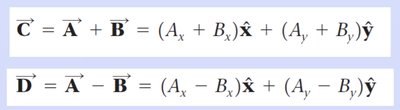
Vectors are added or subtracted by combining their components:
Unit Vectors
Unit vectors have a magnitude of 1 and indicate direction along coordinate axes (e.g., , ).
Position, Displacement, Velocity, and Acceleration as Vectors
Position vector: points from the origin to the object's location.
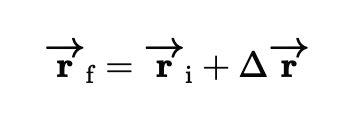
Displacement:
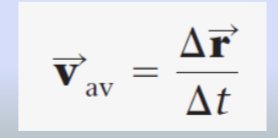
Velocity:
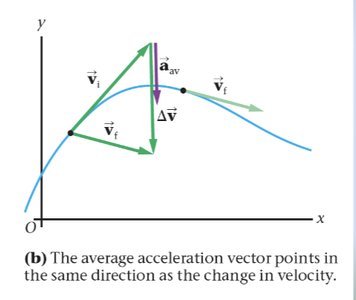
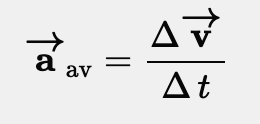
Acceleration:
Chapter 4: Two-Dimensional Kinematics
Motion in Two Dimensions
When an object moves in two dimensions, its position, velocity, and acceleration are described by vectors. The motion can be analyzed by breaking it into independent x and y components.
For constant velocity:
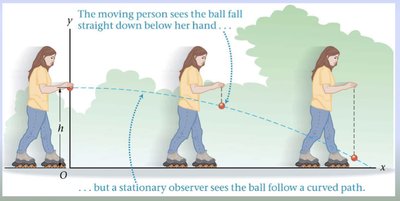
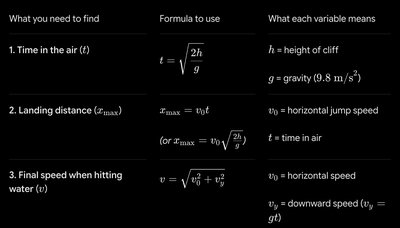
For projectile motion: horizontal and vertical motions are treated separately.
Projectile Motion: Basic Equations
Horizontal motion:
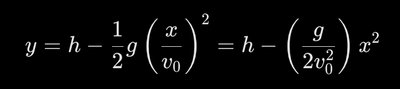
Vertical motion:
Velocity components: ,

Relative Velocities
The observed velocity of an object depends on the observer's frame of reference. Relative velocity is the vector sum of the object's velocity with respect to one frame and the velocity of that frame with respect to another.
Key Characteristics of Projectile Motion
Horizontal and vertical motions are independent.
The path is parabolic.
Maximum range occurs at a launch angle of 45° (for level ground).

Chapter 5: Newton's Laws of Motion
Force and Mass
Force is a vector quantity that causes changes in motion. Mass is a measure of an object's resistance to acceleration (inertia).
Unit of force: Newton (N) = kg·m/s²
Newton's First Law (Law of Inertia)
An object at rest remains at rest, and an object in motion continues in motion with constant velocity unless acted upon by a net external force.
Newton's Second Law
The acceleration of an object is directly proportional to the net force acting on it and inversely proportional to its mass:

Newton's Third Law
For every action, there is an equal and opposite reaction. Forces always occur in pairs acting on different objects.
Free Body Diagrams
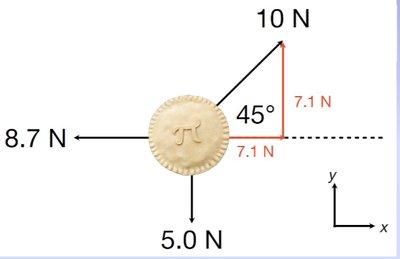
Free body diagrams are essential tools for visualizing all the forces acting on a single object. They help in applying Newton's laws to solve problems.
Chapter 6: Applications of Newton's Laws
Frictional Forces
Friction is the force that opposes the relative motion of two surfaces in contact. There are two main types:
Static friction (fs): Prevents motion up to a maximum value
Kinetic friction (fk): Opposes motion with
and are the coefficients of static and kinetic friction, respectively.
Strings, Springs, and Tension
Tension is the force transmitted through a string, rope, or wire when it is pulled tight by forces acting from opposite ends. In an ideal (massless) string, tension is the same throughout.
Translational Equilibrium
An object is in translational equilibrium if the vector sum of all forces acting on it is zero (), resulting in zero acceleration.
Connected Objects and Pulleys
When objects are connected by strings or pulleys, their accelerations are related, and the tension in the string must be considered in force analysis.
Circular Motion
When an object moves in a circle at constant speed, it experiences a centripetal acceleration directed toward the center of the circle, requiring a net inward force.
Appendix: Common Prefixes and Dimensions
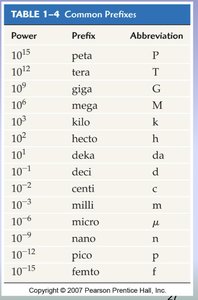
Power | Prefix | Abbreviation |
|---|---|---|
1015 | peta | P |
1012 | tera | T |
109 | giga | G |
106 | mega | M |
103 | kilo | k |
102 | hecto | h |
101 | deka | da |
10-1 | deci | d |
10-2 | centi | c |
10-3 | milli | m |
10-6 | micro | μ |
10-9 | nano | n |
10-12 | pico | p |
10-15 | femto | f |
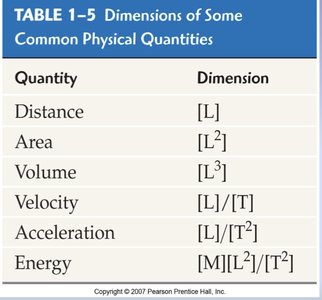
Quantity | Dimension |
|---|---|
Distance | [L] |
Area | [L]2 |
Volume | [L]3 |
Velocity | [L]/[T] |
Acceleration | [L]/[T]2 |
Energy | [M][L]2/[T]2 |
Additional info: This guide covers the foundational chapters of a calculus-based physics course, including units, kinematics, vectors, Newton's laws, and their applications. It is suitable for exam preparation and as a reference for problem-solving strategies.
