 Back
Physics with Calculus: Kinematics and Projectile Motion Practice
Study Guide - Smart Notes
 Tailored notes based on your materials, expanded with key definitions, examples, and context.
Q1. What is the average acceleration of a particle between s and s, given ?
Background
Topic: Kinematics – Average Acceleration
This question tests your ability to calculate average acceleration from a velocity function over a specified time interval.
Key Terms and Formulas:
Average acceleration:
Velocity function:
Step-by-Step Guidance
Evaluate the velocity at s and s using the given function.
Calculate the change in velocity: .
Determine the time interval: s.
Set up the formula for average acceleration: .
Try solving on your own before revealing the answer!
Final Answer: -15 m/s2
Using the velocity function, m/s, and m/s.
m/s2
The negative sign indicates the particle is decelerating over this interval.
Q2. How far did a jet plane travel during 2.0 s if it reached a speed of 42 m/s at the end, assuming constant acceleration?
Background
Topic: Kinematics – Constant Acceleration
This question tests your ability to use kinematic equations to find displacement when acceleration is constant.
Key Terms and Formulas:
Initial velocity (): 0 m/s (starts from rest)
Final velocity (): 42 m/s
Time (): 2.0 s
Displacement formula:
Acceleration formula:
Step-by-Step Guidance
Identify the initial velocity ( m/s), final velocity ( m/s), and time ( s).
Calculate the acceleration using .
Plug the values into the displacement formula .
Set up the calculation for displacement.
Try solving on your own before revealing the answer!
Final Answer: 42 m
Acceleration: m/s2. Displacement: m.
The jet travels 42 meters during the 2 seconds of acceleration.
Q3. An object starts from rest and undergoes uniform acceleration. It travels 5.0 m in the first second. How far will it travel during the third second?
Background
Topic: Kinematics – Uniform Acceleration
This question tests your understanding of displacement during specific time intervals under constant acceleration.
Key Terms and Formulas:
Displacement in th second:
Initial velocity (): 0 m/s (starts from rest)
Uniform acceleration ()
Step-by-Step Guidance
Use the formula for displacement in the first second to find the acceleration.
Set up the formula for displacement during the third second.
Plug in the values for and .
Prepare to calculate the displacement for the third second.
Try solving on your own before revealing the answer!
Final Answer: 15 m
Acceleration found from first second: m/s2. Displacement in third second: m.
The object travels 15 meters during the third second.
Q4. What is the upward acceleration of a toy rocket during the burn phase, given it rises to 81 m and has an upward velocity of 40 m/s at burnout?
Background
Topic: Kinematics – Constant Acceleration, Rocket Motion
This question tests your ability to use kinematic equations to solve for acceleration given displacement and final velocity.
Key Terms and Formulas:
Displacement (): 81 m
Final velocity (): 40 m/s
Initial velocity (): 0 m/s (starts from rest)
Kinematic equation:
Step-by-Step Guidance
Identify the known values: m/s, m/s, m.
Set up the kinematic equation: .
Rearrange to solve for : .
Prepare to substitute the values into the formula.
Try solving on your own before revealing the answer!
Final Answer: 9.9 m/s2
m/s2
The rocket's upward acceleration during the burn phase is approximately 9.9 m/s2.
Q5. What is the height of a rock on the Moon when it is descending with a speed of 20.0 m/s, given it was projected upward at 30.0 m/s?
Background
Topic: Kinematics – Projectile Motion, Gravity on the Moon
This question tests your ability to use kinematic equations to find height at a specific velocity during projectile motion.
Key Terms and Formulas:
Initial velocity (): 30.0 m/s
Final velocity (): -20.0 m/s (descending)
Acceleration (): -1.62 m/s2 (Moon's gravity)
Kinematic equation:
Step-by-Step Guidance
Identify the known values: m/s, m/s, m/s2.
Set up the kinematic equation: .
Rearrange to solve for : .
Prepare to substitute the values into the formula.
Try solving on your own before revealing the answer!
Final Answer: 135 m
m
The height of the rock when it is descending at 20.0 m/s is approximately 135 meters.
Q6. What is the height of a bridge if a stone dropped from it hits the water in 2.3 s? (Neglect air resistance.)
Background
Topic: Kinematics – Free Fall
This question tests your ability to calculate displacement in free fall using time and gravity.
Key Terms and Formulas:
Initial velocity (): 0 m/s (dropped)
Time (): 2.3 s
Acceleration (): 9.8 m/s2 (gravity)
Displacement formula:
Step-by-Step Guidance
Identify the known values: m/s, s, m/s2.
Set up the displacement formula: .
Prepare to substitute the values into the formula.
Try solving on your own before revealing the answer!
Final Answer: 26 m
m
The height of the bridge is approximately 26 meters.
Q7. What is the speed of a ball when it returns to the same horizontal level, if thrown at 8.0 m/s at 35° above the horizontal (no air resistance)?
Background
Topic: Projectile Motion – Conservation of Energy
This question tests your understanding of projectile motion and the conservation of energy in the absence of air resistance.
Key Terms and Formulas:
Initial speed (): 8.0 m/s
Angle (): 35°
Speed at same level: (if no air resistance)
Step-by-Step Guidance
Recall that in projectile motion without air resistance, the speed when returning to the original level equals the initial speed.
Consider the conservation of energy: kinetic energy is conserved.
Set up the reasoning for why the speed is unchanged.
Try solving on your own before revealing the answer!
Final Answer: 8.0 m/s
The speed of the ball when it returns to the same horizontal level is equal to its initial speed, 8.0 m/s, due to conservation of energy.
Q8. How far does a rock travel horizontally before striking the water, if thrown horizontally at 10 m/s from a bridge 20 m above the water (neglect air resistance)?
Background
Topic: Projectile Motion – Horizontal Launch
This question tests your ability to calculate horizontal displacement in projectile motion.
Key Terms and Formulas:
Initial horizontal velocity (): 10 m/s
Height (): 20 m
Time to fall:
Horizontal distance:
Step-by-Step Guidance
Calculate the time it takes for the rock to fall 20 m: .
Use the horizontal velocity to find the horizontal distance: .
Set up the calculation for horizontal displacement.
Try solving on your own before revealing the answer!
Final Answer: 14 m
Time to fall: s. Horizontal distance: m (closest answer: 14 m).
The rock travels approximately 14 meters horizontally before striking the water.
Q9. What is the highest point of a cat's trajectory if it jumps at 60° with an initial velocity of 2.74 m/s (neglecting air resistance)?
Background
Topic: Projectile Motion – Maximum Height
This question tests your ability to calculate the maximum height reached in projectile motion.
Key Terms and Formulas:
Initial velocity (): 2.74 m/s
Angle (): 60°
Maximum height:
Step-by-Step Guidance
Calculate the vertical component of velocity: .
Set up the formula for maximum height: .
Prepare to substitute the values into the formula.
Try solving on your own before revealing the answer!
Final Answer: 0.29 m
Maximum height: m
The highest point of the cat's trajectory is approximately 0.29 meters.
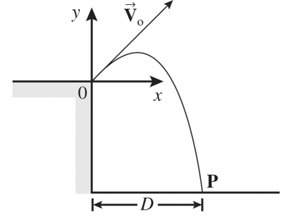
Q10. What is the horizontal distance for a projectile fired from a cliff with m/s, m/s, and a time of flight of 75.0 s?
Background
Topic: Projectile Motion – Horizontal Range
This question tests your ability to calculate the horizontal range of a projectile given its horizontal velocity and time of flight.
Key Terms and Formulas:
Horizontal velocity (): 30 m/s
Time of flight (): 75.0 s
Horizontal distance:
Step-by-Step Guidance
Identify the horizontal velocity and time of flight.
Set up the formula for horizontal distance: .
Prepare to substitute the values into the formula.
Try solving on your own before revealing the answer!
Final Answer: 2250 m
Horizontal distance: m
The projectile travels 2250 meters horizontally before landing in the sea.
Q11. What was the angle of launch for a projectile that reached a maximum height of 72.3 m and landed 111 m from the launch point?
Background
Topic: Projectile Motion – Launch Angle Calculation
This question tests your ability to use projectile motion equations to determine the launch angle from maximum height and range.
Key Terms and Formulas:
Maximum height:
Range:
Acceleration due to gravity (): 9.8 m/s2
Step-by-Step Guidance
Set up the equations for maximum height and range.
Express in terms of and using the height equation.
Substitute into the range equation to solve for .
Prepare to solve for the launch angle.
Try solving on your own before revealing the answer!
Final Answer: 44.8°
Using the equations and substituting values, the launch angle is approximately 44.8°.
Q12. If the initial speed of a projectile is doubled (neglecting air resistance), how does its range change?
Background
Topic: Projectile Motion – Range Dependence on Initial Speed
This question tests your understanding of how the range of a projectile depends on its initial speed.
Key Terms and Formulas:
Range:
Doubling means changes by a factor of .
Step-by-Step Guidance
Recall the formula for range: .
Consider what happens when is doubled: .
Set up the comparison between and .
Try solving on your own before revealing the answer!
Final Answer: Its range will quadruple.
Doubling the initial speed increases the range by a factor of four, since range depends on the square of the initial speed.
