 Back
Physics with Calculus: Kinematics, Vectors, and Projectile Motion – Study Notes & Problem Solutions
Study Guide - Smart Notes
 Tailored notes based on your materials, expanded with key definitions, examples, and context.
Kinematics and Motion in One and Two Dimensions
Concepts of Motion and Kinematics
Kinematics is the branch of physics that describes the motion of objects without considering the causes of motion. It involves quantities such as displacement, velocity, acceleration, and time. These concepts are foundational for understanding more advanced topics in physics.
Displacement (\( \Delta x \)): The change in position of an object. It is a vector quantity, having both magnitude and direction.
Velocity (\( v \)): The rate of change of displacement with respect to time. Average velocity is given by \( v_{avg} = \frac{\Delta x}{\Delta t} \).
Acceleration (\( a \)): The rate of change of velocity with respect to time. Average acceleration is \( a_{avg} = \frac{\Delta v}{\Delta t} \).
Equations of Motion (Constant Acceleration):
Projectile Motion: The motion of an object thrown or projected into the air, subject only to acceleration due to gravity. The horizontal and vertical motions are analyzed separately.
Example Problem: Kayaker Motion
A kayaker needs to paddle north across 100 m wide river. The river flows east at 2.0 m/s. The kayaker can paddle at 3.0 m/s. Find the resultant speed and direction.
Key Steps:
Draw a vector diagram to represent the velocities.
Use the Pythagorean theorem to find the resultant speed:
Find the direction using trigonometry:
east of north
Vectors and Coordinate Systems
Vector Components and Operations
Vectors are quantities that have both magnitude and direction. They can be represented graphically by arrows and analytically by their components.
Component Form: Any vector \( \vec{A} \) can be written as \( \vec{A} = A_x \hat{i} + A_y \hat{j} \).
Magnitude: \( |\vec{A}| = \sqrt{A_x^2 + A_y^2} \)
Direction: \( \theta = \tan^{-1}\left(\frac{A_y}{A_x}\right) \)
Vector Addition: Add corresponding components: \( \vec{C} = \vec{A} + \vec{B} = (A_x + B_x)\hat{i} + (A_y + B_y)\hat{j} \)
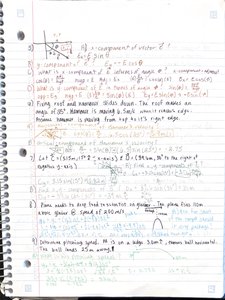
Kinematics in Two Dimensions: Projectile Motion
Projectile Motion Analysis
Projectile motion involves two-dimensional motion under constant acceleration due to gravity. The horizontal and vertical motions are independent of each other.
Horizontal Motion: Constant velocity, \( x = v_{0x} t \)
Vertical Motion: Constant acceleration, \( y = v_{0y} t - \frac{1}{2} g t^2 \)
Time of Flight: Determined by vertical motion.
Range: The horizontal distance traveled.
Example: A ball is thrown horizontally from a 3.0 m high table. Find the time to hit the ground and the horizontal distance traveled if the initial speed is 2.0 m/s.
Rotational Kinematics
Angular Velocity and Acceleration
Rotational kinematics describes the motion of objects rotating about an axis. Key quantities include angular displacement, angular velocity, and angular acceleration.
Angular Displacement (\( \theta \)): The angle through which an object rotates, measured in radians.
Angular Velocity (\( \omega \)): The rate of change of angular displacement, \( \omega = \frac{d\theta}{dt} \).
Angular Acceleration (\( \alpha \)): The rate of change of angular velocity, \( \alpha = \frac{d\omega}{dt} \).
Relationship to Linear Quantities: \( v = r\omega \), \( a = r\alpha \)
Example: A spinning record rotates at 45 rpm. Find the angular velocity in rad/s.
Problem Solving Strategies in Kinematics
General Steps
Draw a diagram and label all known and unknown quantities.
Choose a coordinate system and resolve vectors into components if necessary.
Write down the relevant kinematic equations.
Solve algebraically for the desired quantity before substituting numbers.
Check units and reasonableness of your answer.
Sample Problems and Solutions
Vertical Motion Example
A rock is tossed straight up from the ground with speed \( v_0 \). When it returns, it falls into a hole 10.0 m deep. Find the speed when it hits the bottom.
Solution: Use energy conservation or kinematic equations. The total distance fallen is the sum of the ascent and the extra 10.0 m.
Projectile Motion Example
A stone is thrown horizontally from a cliff 3.0 m above the ground. Find the time to hit the ground and the horizontal distance if the initial speed is 2.0 m/s.
Solution: Use vertical motion to find time, then horizontal motion for distance.
Relative Velocity Example
A boat moves in a river with a current. The velocity of the boat relative to the ground is the vector sum of the boat's velocity relative to the water and the water's velocity relative to the ground.
Equation:
Summary Table: Kinematic Equations
Equation | Physical Meaning |
|---|---|
Velocity after time t with constant acceleration | |
Position after time t with constant acceleration | |
Relates velocity and displacement without time |
Additional info:
Some problems reference textbook sections and provide step-by-step solutions, reinforcing the application of kinematic equations and vector analysis.
Diagrams and vector breakdowns are essential for visualizing and solving two-dimensional motion problems.
