 Back
Physics with Calculus: Models, Measurements, and Vectors
Study Guide - Smart Notes
 Tailored notes based on your materials, expanded with key definitions, examples, and context.
Models, Measurements, and Vectors
The Nature of Physics
Physics is an experimental science that seeks to uncover patterns in nature, known as physical theories. When a theory is well-established, it is referred to as a physical law or principle. To simplify complex phenomena, physicists often use idealized models that make analysis more tractable.
Physical Theory: A conceptual framework explaining observed phenomena.
Physical Law: A theory with extensive experimental support.
Idealized Model: Simplifies real-world objects to basic forms for easier analysis.
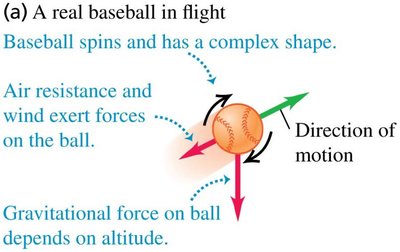
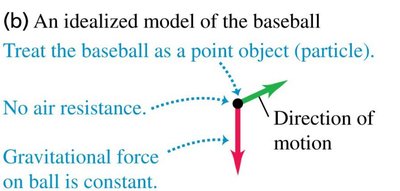
Example: Modeling a baseball in flight can be done in two ways:
Real baseball: Considers spin, air resistance, wind, and altitude-dependent gravity.
Idealized model: Treats the baseball as a point object, ignores air resistance, and assumes constant gravity.
Standards, Units, and Prefixes
Physics relies on fundamental quantities: length, time, and mass. The International System of Units (SI) is the most widely used system, with meters (m) for length, seconds (s) for time, and kilograms (kg) for mass.
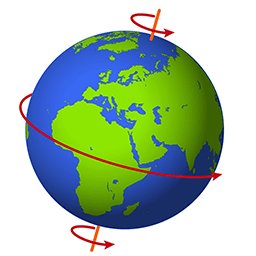
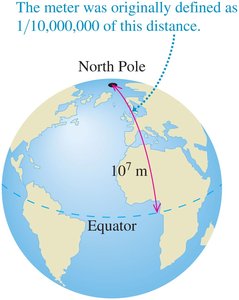
Length: Originally defined by the distance from the North Pole to the Equator; now defined by the distance light travels in vacuum in 1/299,792,458 seconds.
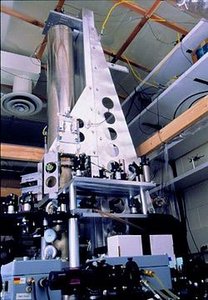
Time: Based on atomic clocks using cesium atom radiation.
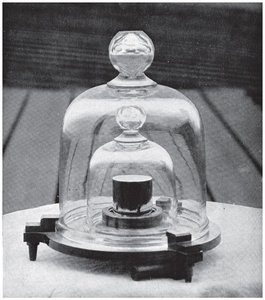
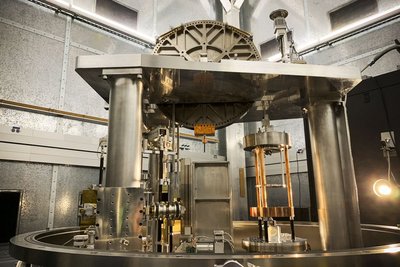
Mass: Historically defined by a physical artifact; now based on Planck's constant.


SI Prefixes
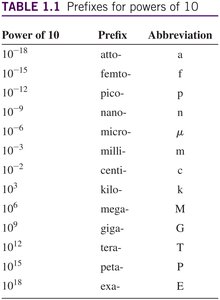
Prefixes are used to express multiples or fractions of units. For example, kilo- (k) means 103, milli- (m) means 10-3, and so on.
Power of 10 | Prefix | Abbreviation |
|---|---|---|
10-18 | atto- | a |
10-15 | femto- | f |
10-12 | pico- | p |
10-9 | nano- | n |
10-6 | micro- | μ |
10-3 | milli- | m |
10-2 | centi- | c |
103 | kilo- | k |
106 | mega- | M |
109 | giga- | G |
1012 | tera- | T |
1015 | peta- | P |
1018 | exa- | E |
Vectors and Scalars
Definitions and Properties
A scalar is a quantity described by a single number (e.g., mass, temperature). A vector has both magnitude and direction (e.g., displacement, velocity, force).
Vector notation: Boldface with an arrow, e.g., .
Magnitude: Written as or .
Vectors are essential in physics because many quantities (such as force and velocity) require both magnitude and direction for complete description.
Displacement Vector
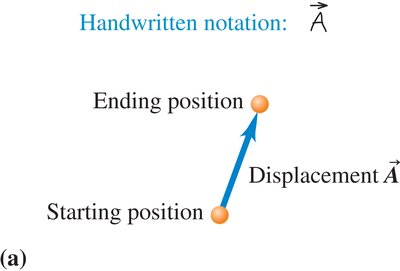
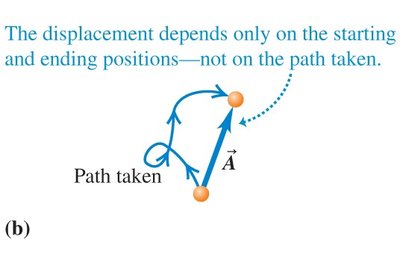
Displacement represents the change in position of an object. It depends only on the starting and ending positions, not the path taken.
Displacement:
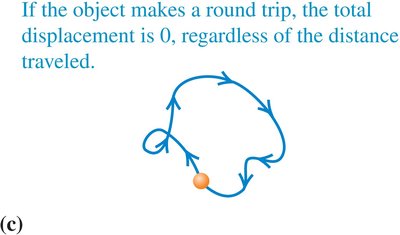
If the object returns to its starting point, total displacement is zero.
Vector Addition and Subtraction
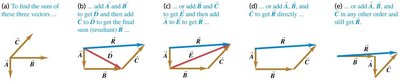
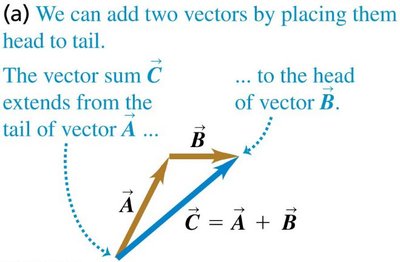
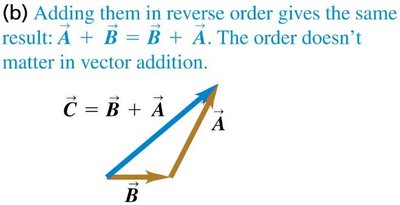
Vectors can be added or subtracted using graphical or analytical methods. The head-to-tail method is commonly used for addition.
Vector Addition:
Order does not matter:
Vectors can be added by constructing a parallelogram.
Subtraction:

Multiplying Vectors by Scalars
Multiplying a vector by a positive scalar changes its magnitude but not its direction. Multiplying by a negative scalar reverses the direction.
is twice as long as .
is three times as long as and points in the opposite direction.

Components of a Vector
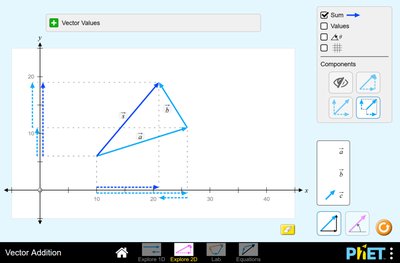
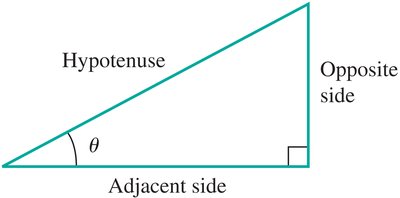
Any vector in a plane can be resolved into components along the x and y axes. This is useful for calculations and understanding physical situations.
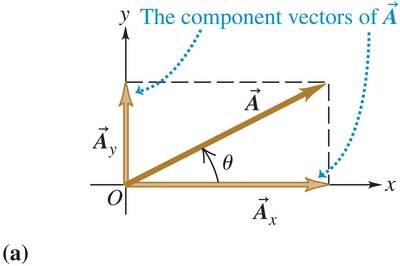
Example: Displacement of a Cross-Country Skier
Suppose a skier travels 1.00 km north and then 2.00 km east. The resultant displacement can be found using vector addition and components:
km (east), km (north)
Resultant magnitude:
Direction:
Application: Vector addition is used in navigation, physics problems, and engineering to determine resultant quantities.
*Additional info: Expanded explanations and formulas were added for completeness and clarity, based on standard introductory physics curriculum.*
