 Back
Physics with Calculus: Motion, Acceleration, and Vectors Study Guidance
Study Guide - Smart Notes
 Tailored notes based on your materials, expanded with key definitions, examples, and context.
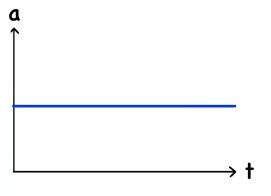
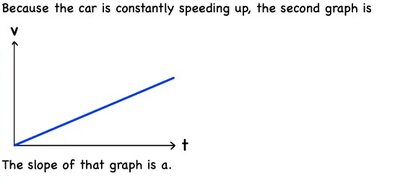
Q1. A car is at rest. The car’s accelerator is suddenly pressed all the way to the floor and held there. Assuming this causes constant acceleration, sketch a graph of acceleration versus time, velocity versus time, and position versus time.
Background
Topic: Kinematics with Constant Acceleration
This question tests your understanding of how acceleration, velocity, and position change over time when an object experiences constant acceleration. It is fundamental to motion analysis in physics.
Key Terms and Formulas:
Acceleration (): Rate of change of velocity,
Velocity (): Rate of change of position,
For constant acceleration:
Step-by-Step Guidance
Start by considering the acceleration graph. Since the car's accelerator is held down, the acceleration remains constant over time. Sketch a horizontal line for vs .
For velocity, recall that constant acceleration means velocity increases linearly. Sketch a straight line with positive slope for vs .
For position, remember that with constant acceleration, position changes quadratically. Sketch a curve that gets steeper as time increases for vs .
Label the axes and indicate the initial conditions: the car starts from rest, so and .
Set up the equations for each graph, but stop before plugging in any values or drawing the final curves.
Try solving on your own before revealing the answer!
Final Answer:
Acceleration vs Time: A horizontal line above the time axis, showing constant positive acceleration.
Velocity vs Time: A straight line starting from zero, increasing linearly with time. The slope is equal to the acceleration.
Position vs Time: A curve starting from zero, increasing quadratically with time (parabola opening upward).
These graphs visually represent the relationships: constant acceleration leads to linear velocity growth and quadratic position change.
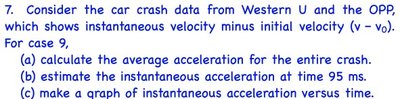
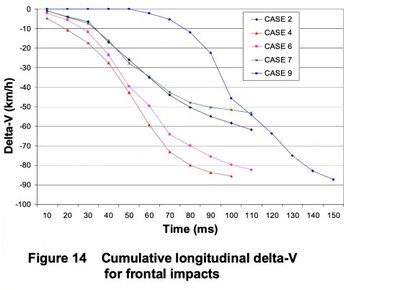
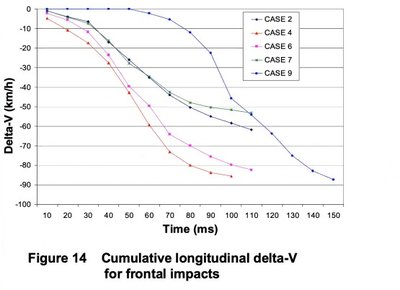
Q2. Consider the car crash data from Western U and the OPP, which shows instantaneous velocity minus initial velocity (v - v0). For case 9:
(a) Calculate the average acceleration for the entire crash.
(b) Estimate the instantaneous acceleration at time 95 ms.
(c) Make a graph of instantaneous acceleration versus time.
Background
Topic: Average and Instantaneous Acceleration
This question tests your ability to calculate average and instantaneous acceleration from velocity-time data, and to interpret and graph acceleration as a function of time.
Key Terms and Formulas:
Average acceleration:
Instantaneous acceleration:
Unit conversion:
Step-by-Step Guidance
For (a), identify the total change in velocity () and the total time interval () from the data.
Convert all units to SI (meters per second and seconds) before calculating.
Apply the formula for average acceleration: , but stop before computing the final value.
For (b), estimate the instantaneous acceleration at 95 ms by finding the slope of the velocity curve near that time. Use for a small interval around 95 ms.
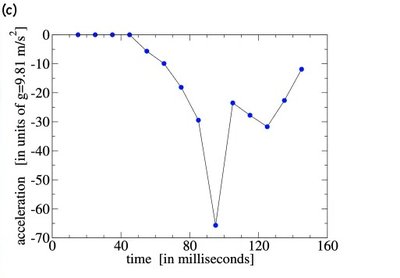
For (c), use the velocity-time data to plot acceleration versus time, showing how acceleration changes throughout the crash.
Try solving on your own before revealing the answer!
Final Answer:
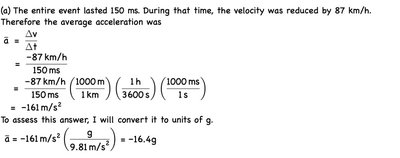
(a) Average acceleration: (or )
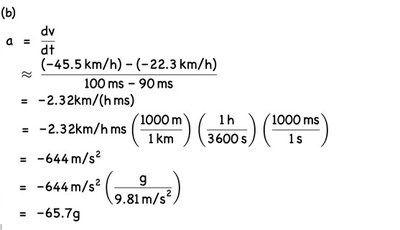
(b) Instantaneous acceleration at 95 ms: (or )
(c) The acceleration vs time graph shows a sharp dip at the moment of impact, then partial recovery.
These calculations demonstrate the extreme forces experienced during a crash and the importance of unit conversion and slope estimation for instantaneous values.
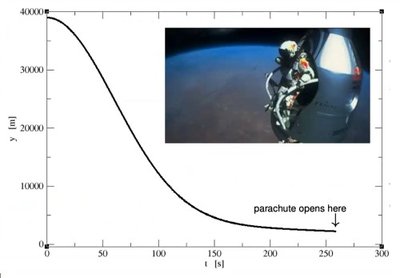
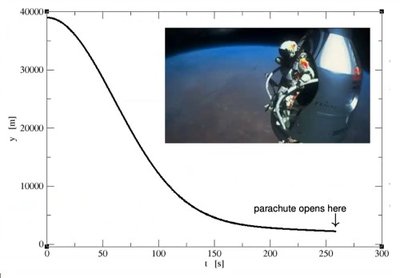
Q3. On 14 October 2012, Felix Baumgartner was in free fall from 39 km to 2.5 km. The graph shows his height during free fall. Sketch a graph of v versus t. Sketch a graph of a versus t.
Background
Topic: Free Fall and Air Resistance
This question tests your understanding of how velocity and acceleration change during a long free fall, especially when air resistance becomes significant and a parachute is deployed.
Key Terms and Formulas:
Velocity (): Rate of change of position,
Acceleration (): Rate of change of velocity,
Terminal velocity: The maximum velocity reached when air resistance balances gravity.
Step-by-Step Guidance
Examine the height vs time graph. Notice the curve steepens, then flattens as the parachute opens.
For vs , velocity increases rapidly at first, then approaches a maximum (terminal velocity) before decreasing when the parachute opens.
For vs , acceleration starts near (gravity), then decreases as air resistance increases, possibly becoming positive when the parachute opens and slows the descent.
Sketch the general shapes of these graphs, but stop before drawing the exact curves or labeling values.
Try solving on your own before revealing the answer!
Final Answer:
Velocity vs Time: Rapid increase at first, then levels off (terminal velocity), then drops sharply when parachute opens.
Acceleration vs Time: Starts at , decreases in magnitude as air resistance increases, may become positive briefly when parachute opens.
These graphs illustrate the effects of gravity, air resistance, and parachute deployment on motion during free fall.
Q4. When I toss a tennis ball, air resistance is negligible. When thrown directly upward, the acceleration...
Background
Topic: Acceleration in Free Fall (Negligible Air Resistance)
This question tests your understanding of the direction and constancy of acceleration for an object thrown upward and then falling back down, assuming air resistance is negligible.
Key Terms and Formulas:
Acceleration due to gravity: (downward, )
At the peak, velocity is zero but acceleration is still .
Step-by-Step Guidance
Recall that gravity always acts downward, regardless of the ball's direction of motion.
At the highest point, velocity is zero, but acceleration remains downward.
Consider each answer choice and use your understanding of gravity to eliminate incorrect options.
Set up the reasoning for which answer is correct, but stop before stating the final choice.
Try solving on your own before revealing the answer!
Final Answer:
(C) Always points down when it is in the air.
Gravity acts downward throughout the ball's flight, regardless of whether it is moving up or down.
