 Back
Physics with Calculus: Motion in One and Two Dimensions & Vectors
Study Guide - Smart Notes
 Tailored notes based on your materials, expanded with key definitions, examples, and context.
Motion in One Dimension
Describing Motion
Motion in one dimension involves tracking the position, velocity, and acceleration of an object along a straight line. The position is specified relative to a coordinate system, and changes in position are called displacement.
Position (x): The location of an object relative to a reference point.
Displacement (Δx): The change in position, a signed quantity:
Time interval (Δt): The elapsed time between two events:
Velocity and Acceleration
Velocity is the rate of change of position, and acceleration is the rate of change of velocity. Both are vector quantities, meaning they have magnitude and direction.
Velocity (v):
Acceleration (a):
Units: Velocity in m/s, acceleration in m/s2
Graphical Representations
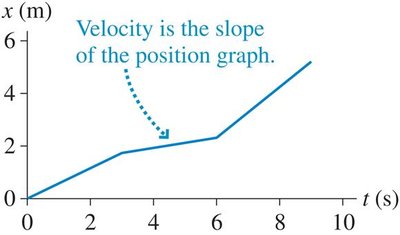
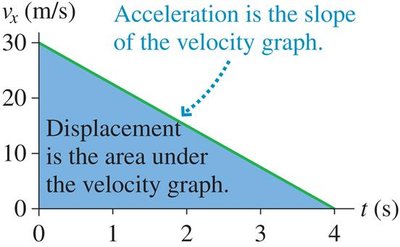
Position-versus-time and velocity-versus-time graphs are essential tools for visualizing motion.
Position vs. Time: The slope of the graph gives velocity.
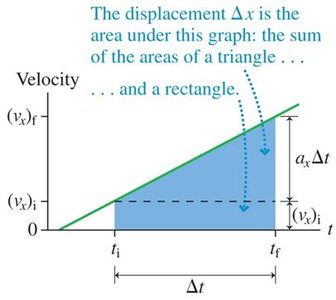
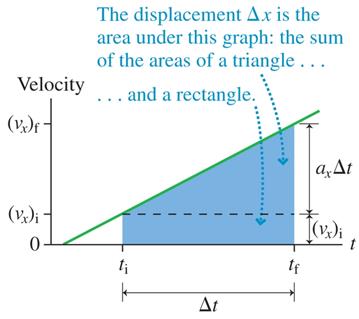
Velocity vs. Time: The slope gives acceleration; the area under the curve gives displacement.
Uniform Motion
Uniform motion occurs when velocity is constant (acceleration is zero). The position changes linearly with time.
Kinematic equation:
Motion with Constant Acceleration
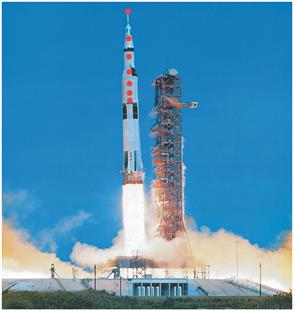
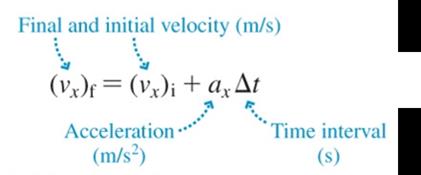
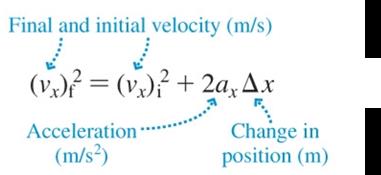
When acceleration is constant, velocity changes linearly and position changes quadratically with time.
Kinematic equations:
Sign of Acceleration
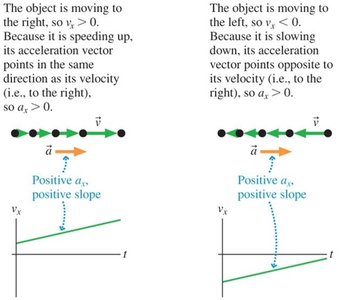
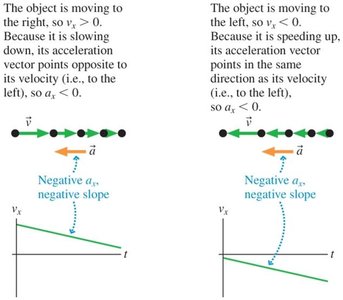
The sign of acceleration depends on the direction of motion and whether the object is speeding up or slowing down.
Speeding up: velocity and acceleration have the same sign.
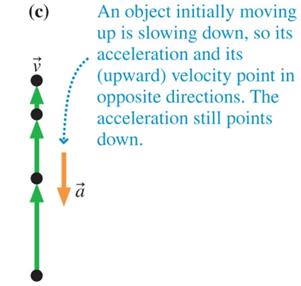
Slowing down: velocity and acceleration have opposite signs.
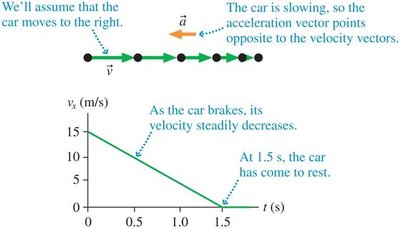
Example: Coming to a Stop in a Car
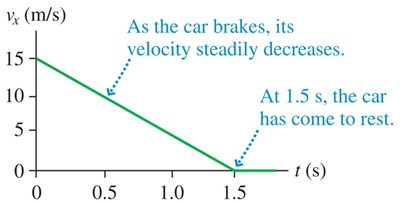
When a car brakes to a stop, its velocity decreases steadily, and the acceleration is negative (opposite to the direction of motion).
Initial velocity: m/s
Final velocity: m/s
Time interval: s
Acceleration:
Displacement:
Quadratic Relationships
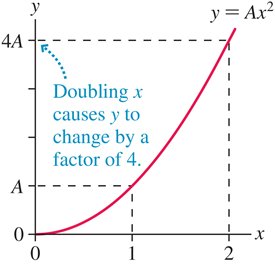
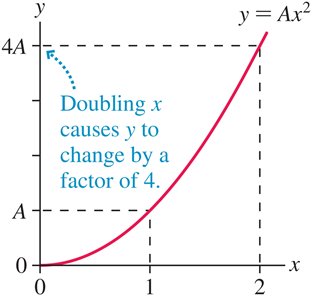
When position changes as the square of time, the graph is a parabola. This is typical for constant acceleration motion.
Doubling x increases y by a factor of 4.
Free Fall
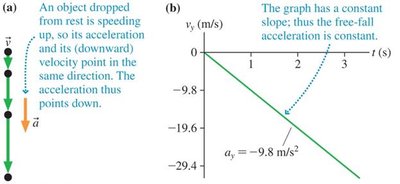
Free fall is motion under the influence of gravity alone. All objects in free fall have the same acceleration, regardless of mass.
Free-fall acceleration: m/s2 (downward)
Use kinematic equations with
Example: Analyzing a Rock’s Fall
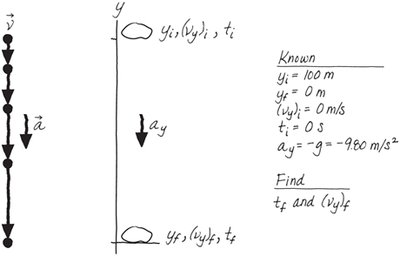
A rock dropped from rest falls 100 m. The time to fall and final velocity can be found using kinematic equations for free fall.
Initial position: m
Initial velocity: m/s
Acceleration:
Use to solve for
Use to find final velocity
Example: Springbok Leap
A springbok accelerates upward and then enters free fall. The speed at takeoff and the height of the leap are found using constant acceleration equations.
Phase 1: Upward acceleration
Phase 2: Free fall
Use for both phases

Vectors and Motion in Two Dimensions
Vectors: Definition and Representation
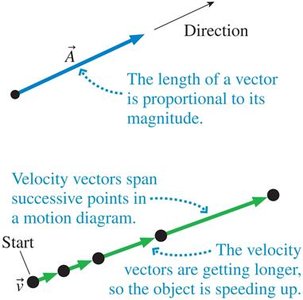
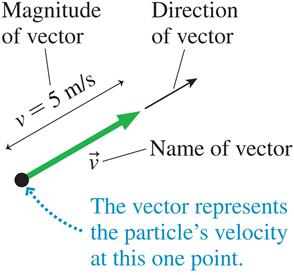
A vector is a quantity with both magnitude and direction. Examples include displacement, velocity, and acceleration.
Vector notation:
Magnitude: (always positive)
Vectors are equal if they have the same magnitude and direction, regardless of their starting point.
Vector Addition and Subtraction
Vectors can be added using the tip-to-tail method or the parallelogram rule. Subtraction is performed by adding the negative of a vector.
Tip-to-tail: Place the tail of one vector at the tip of another.
Parallelogram rule: Draw both vectors from a common origin; the diagonal is the sum.
Multiplication by a Scalar
Multiplying a vector by a positive scalar changes its magnitude but not its direction. Multiplying by a negative scalar reverses its direction.
Zero vector: Multiplying by zero gives a vector of zero length.
Coordinate Systems and Vector Components
Vectors can be decomposed into components along coordinate axes, usually Cartesian (x, y).
Component vectors: and
Finding components: ,
Magnitude from components:
Angle from components:
Working with Components
Vector addition and subtraction can be performed by adding or subtracting corresponding components.
Applications: Projectile and Circular Motion
Projectile motion and circular motion are examples of two-dimensional motion analyzed using vectors and their components.
Projectile motion: Parabolic trajectory, analyzed with horizontal and vertical components.
Circular motion: Constant speed but changing direction, resulting in acceleration.


Summary Table: Kinematic Equations for Constant Acceleration
Equation | Physical Meaning |
|---|---|
Final velocity after time interval | |
Position after time interval | |
Final velocity from displacement |
Additional info: These notes expand on brief points from the slides, providing full academic context, definitions, and examples. Images included are directly relevant to the explanations and reinforce key concepts.
