 Back
Physics with Calculus: Practice Exam 1 – Step-by-Step Study Guidance
Study Guide - Smart Notes
 Tailored notes based on your materials, expanded with key definitions, examples, and context.
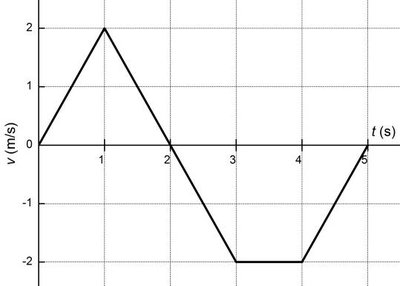
Q5. What is the acceleration of the object at t = 2 s?
Background
Topic: Kinematics – Velocity and Acceleration from Graphs
This question tests your ability to interpret a velocity vs. time graph and determine the acceleration at a specific instant. Acceleration is the rate of change of velocity with respect to time.
Key Terms and Formulas:
Acceleration (a): The rate at which velocity changes with time.
Formula:
Instantaneous acceleration: The slope of the velocity vs. time graph at a given point.
Step-by-Step Guidance
Locate s on the velocity vs. time graph. Observe the shape of the graph at this point (is it a straight line, a corner, or a curve?).
Determine the velocity values just before and just after s to find the change in velocity over a small time interval.
Calculate the slope of the line segment that includes s using two points on that segment: , where and are the velocities at times and .
Set up the calculation for the acceleration using the values you identified, but do not compute the final value yet.
Try solving on your own before revealing the answer!
Final Answer: -2 m/s2
From the graph, between s and s, velocity changes from m/s to m/s. The slope (acceleration) is:
m/s2$
The negative sign indicates the object is decelerating (velocity is decreasing).
Q6. What is the x-coordinate of the object at t = 5 s?
Background
Topic: Kinematics – Displacement from Velocity-Time Graphs
This question tests your ability to determine the position of an object by integrating (finding the area under) a velocity vs. time graph. The area under the curve gives the displacement.
Key Terms and Formulas:
Displacement (): The change in position, found by the area under the velocity-time graph.
Formula:
(for straight segments, use area of geometric shapes)
Initial position: m at s (given in the problem statement).
Step-by-Step Guidance
Break the velocity-time graph into segments between and s (e.g., s, s, s, s).
For each segment, calculate the area under the curve (use triangle or rectangle area formulas as appropriate).
Sum the areas (taking care with positive and negative values) to find the total displacement from to s.
Add the displacement to the initial position to set up the final position calculation, but do not compute the final value yet.
Try solving on your own before revealing the answer!
Final Answer: m
Calculating the area under the graph for each segment and summing them, then adding the initial position m, gives m at s.
This means the object is 2 meters to the left of the origin at s.
