 Back
Physics with Calculus: Step-by-Step Guidance for Exam Questions
Study Guide - Smart Notes
 Tailored notes based on your materials, expanded with key definitions, examples, and context.
Q2. A racing car accelerates uniformly from rest along a straight track. The track has markers spaced at equal distances from the start, as shown in the figure. The car reaches a speed of 140 km/h as it passes marker 2. Where on the track was the car when it was traveling at half this speed, that is at 70 km/h?

Background
Topic: Kinematics with Constant Acceleration
This question tests your understanding of motion with constant acceleration, specifically how velocity and position relate when an object starts from rest and accelerates uniformly.
Key Terms and Formulas
Uniform acceleration: Acceleration is constant.
Initial velocity (): The starting speed, here .
Final velocity (): The speed at a given point.
Displacement (): The distance from the starting point.
Key formulas:
Step-by-Step Guidance
Identify the known values: , km/h at marker 2, and you want to find the position where km/h.
Let at the start, at marker 1, and at marker 2. The distance between markers is equal.
Use the kinematic equation to relate speed and position. For km/h at , and km/h at some .
Set up two equations: one for km/h at , and one for km/h at (the unknown position). Express both in terms of and .
To find where km/h, solve for using the ratio of the squares of the velocities, since acceleration is constant and initial velocity is zero.
Try solving on your own before revealing the answer!
Final Answer: Before marker 1
Using (since ), the position where km/h is at . Since , the car reaches 70 km/h before marker 1.
This shows that with constant acceleration, the speed increases with the square root of the distance traveled from rest.
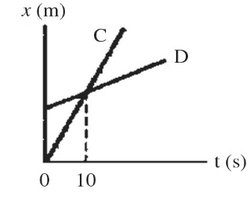
Q4. The figure shows a graph of the position x of two cars, C and D, as a function of time t. According to this graph, which statements about these cars must be true? (There could be more than one correct choice.)
Background
Topic: Motion Graphs and Kinematics
This question tests your ability to interpret position vs. time graphs and deduce information about velocity and acceleration.
Key Terms and Formulas
Position (): The location of an object at a given time.
Velocity (): The slope of the vs. graph.
Acceleration (): The rate of change of velocity; for straight lines, acceleration is zero.
Step-by-Step Guidance
Examine the slopes of the lines for cars C and D. The slope represents velocity.
Check if the lines are straight or curved. Straight lines indicate constant velocity (zero acceleration).
At s, see if the lines cross or are parallel. Crossing means the cars are at the same position at that time.
Compare the slopes at s to see if the velocities are the same.
Determine if the accelerations are the same by checking if both lines are straight and have constant slopes.
Try solving on your own before revealing the answer!
Final Answer: D, E
Both cars have the same acceleration (zero, since both lines are straight), and the cars meet at s (the lines cross at this point).
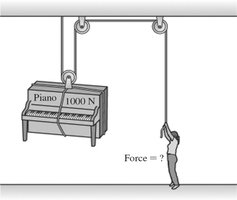
Q14. A piano mover raises a 1000-N piano at a constant speed using a very light rope in a frictionless pulley system, as shown in the figure. With what force is the mover pulling down on the rope?
Background
Topic: Forces and Mechanical Advantage in Pulley Systems
This question tests your understanding of how pulleys distribute force and how to calculate the force required to lift an object at constant speed.
Key Terms and Formulas
Mechanical advantage: The factor by which a machine multiplies the force put into it.
Constant speed: Net force is zero; the upward force equals the weight.
For a frictionless, ideal pulley: , where is the number of supporting rope segments.
Step-by-Step Guidance
Identify the weight of the piano: N.
Count the number of rope segments supporting the piano in the pulley system.
Recall that for an ideal pulley, the force required is divided by the number of supporting segments.
Set up the equation: , where is the number of rope segments supporting the load.
Plug in the values to find the force the mover must exert.
Try solving on your own before revealing the answer!
Final Answer: 500 N
There are two rope segments supporting the piano, so the mover must pull with a force of N to lift the piano at constant speed.
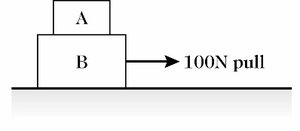
Q13. Two blocks, A and B, are being pulled to the right along a horizontal surface by a horizontal 100-N pull, as shown in the figure. Both are moving together at a constant velocity of 2.0 m/s to the right, and both weigh the same. Which of the figures below shows a correct free-body diagram of the horizontal forces acting on the lower block, B?
Background
Topic: Newton's Laws and Free-Body Diagrams
This question tests your ability to analyze forces acting on objects in contact and to draw correct free-body diagrams.
Key Terms and Formulas
Free-body diagram: A diagram showing all the forces acting on an object.
Constant velocity: Net force is zero (forces are balanced).
Friction: If moving at constant velocity, friction balances the applied force.
Step-by-Step Guidance
Identify all horizontal forces acting on block B: the pull from the rope, friction, and the force from block A.
Since the blocks move at constant velocity, the net force on block B is zero.
Consider the interaction between blocks A and B: block A exerts a force on B, and B exerts an equal and opposite force on A.
Draw the free-body diagram for block B, showing all horizontal forces and their directions.
Compare your diagram to the answer choices to find the correct one.
Try solving on your own before revealing the answer!
Final Answer: B
The correct free-body diagram for block B shows the applied 100 N force to the right and an equal friction force to the left, resulting in zero net force (constant velocity).
