 Back
Physics with Calculus: Step-by-Step Study Guidance
Study Guide - Smart Notes
 Tailored notes based on your materials, expanded with key definitions, examples, and context.
Q1. What is the relationship between the directions of the object's velocity and acceleration vectors for an object moving in a circular path at constant speed?
Background
Topic: Circular Motion
This question tests your understanding of the direction of velocity and acceleration vectors for uniform circular motion.
Key Terms and Formulas:
Velocity vector (): Always tangent to the path of motion.
Centripetal acceleration (): Always points toward the center of the circle.
Step-by-Step Guidance
Recall that in uniform circular motion, the speed is constant but the direction of velocity changes continuously.
The velocity vector is always tangent to the circle at any point.
The acceleration vector (centripetal acceleration) always points toward the center of the circle.
Think about the geometric relationship between a tangent and a radius at a point on a circle.
Try solving on your own before revealing the answer!
Final Answer: The velocity and acceleration vectors are perpendicular.
In uniform circular motion, the velocity is tangent to the path and the acceleration is directed toward the center, making them perpendicular at every point.
Q2. An object hits a wall and bounces back with half of its original speed. What is the ratio of the final kinetic energy to the initial kinetic energy?
Background
Topic: Kinetic Energy and Collisions
This question tests your understanding of how kinetic energy changes when the speed of an object changes.
Key Terms and Formulas:
Kinetic Energy ():
Ratio:
Step-by-Step Guidance
Write the expression for the initial kinetic energy using the initial speed .
Write the expression for the final kinetic energy using the final speed .
Set up the ratio using the two expressions.
Simplify the ratio algebraically before plugging in any numbers.
Try solving on your own before revealing the answer!
Final Answer: 1/4
Since kinetic energy depends on the square of the speed, halving the speed reduces the kinetic energy to one-fourth of its original value.
Q3. What is the net work needed to change the speed of a 1600-kg sport utility vehicle from 15.0 m/s to 40.0 m/s?
Background
Topic: Work-Energy Theorem
This question tests your ability to apply the work-energy theorem to calculate the work required for a change in speed.
Key Terms and Formulas:
Work-Energy Theorem:
Kinetic Energy:
Step-by-Step Guidance
Calculate the initial kinetic energy using kg and m/s.
Calculate the final kinetic energy using m/s.
Find the difference to get the net work done.
Set up the subtraction but do not compute the final value yet.
Try solving on your own before revealing the answer!
Final Answer: J
The net work is the difference in kinetic energy between the final and initial speeds.
Q4. A 1.5-kg block moving on a rough level surface with an initial speed of 4 m/s. The friction force acts on it is constant with the value of 0.50 N. What is the distance it can slide before stopping?
Background
Topic: Work and Energy (Friction)
This question tests your understanding of how friction does work to stop a moving object.
Key Terms and Formulas:
Work done by friction:
Kinetic Energy:
Set (since the block stops, )
Step-by-Step Guidance
Calculate the initial kinetic energy of the block.
Set up the work-energy equation: .
Rearrange to solve for (distance).
Plug in the values for , , and but do not compute the final value yet.
Try solving on your own before revealing the answer!
Final Answer: 24 m
The distance is found by equating the initial kinetic energy to the work done by friction and solving for .
Q5. Neglecting air resistance, when you toss a stone straight up in the air from Earth's surface, which of the following statements is true for the upward motion of the stone?
Background
Topic: Conservation of Energy (Projectile Motion)
This question tests your understanding of how kinetic and potential energy change as an object moves upward under gravity.
Key Terms and Formulas:
Kinetic Energy ():
Gravitational Potential Energy ():
Total Mechanical Energy: (remains constant if no non-conservative forces)
Step-by-Step Guidance
As the stone rises, its speed decreases due to gravity, so decreases.
As the stone rises, its height increases, so increases.
Total energy remains constant (if air resistance is neglected).
Identify which statement matches this energy transformation.
Try solving on your own before revealing the answer!
Final Answer: The stone's kinetic energy decreases while its gravitational potential energy increases.
As the stone rises, kinetic energy is converted into gravitational potential energy.
Q6. An object of mass 4 kg starts at rest from the top of a rough inclined plane of height 10 m. If the speed of the object at the bottom of the inclined plane is 10 m/s, how much work is done by the force of friction? (Use m/s)
Background
Topic: Work-Energy Principle (Friction on Incline)
This question tests your ability to use energy conservation and account for work done by friction.
Key Terms and Formulas:
Potential Energy at top:
Kinetic Energy at bottom:
Work by friction:
Step-by-Step Guidance
Calculate the initial potential energy at the top of the incline.
Calculate the kinetic energy at the bottom using the given speed.
Set up the energy equation including work done by friction.
Rearrange to solve for but do not compute the final value yet.
Try solving on your own before revealing the answer!
Final Answer: -200 J
The negative sign indicates that friction did work against the motion, removing energy from the system.
Q7. Two objects kg and kg moving with the same speed travel in opposite directions in a straight line. If the objects stick together when they collide, what is the speed of the system after collision?
Background
Topic: Conservation of Momentum (Inelastic Collision)
This question tests your ability to apply conservation of momentum to a perfectly inelastic collision.
Key Terms and Formulas:
Momentum:
Conservation of Momentum:
Step-by-Step Guidance
Assign directions: let move in the positive direction and in the negative direction.
Write the initial momentum for both objects, considering their directions.
Set up the conservation of momentum equation for the combined mass after collision.
Solve algebraically for in terms of but do not compute the final value yet.
Try solving on your own before revealing the answer!
Final Answer:
The final speed is determined by the net momentum divided by the total mass.
Q8. A small car meshes with a large truck in a head-on collision. Which of the following statements concerning the magnitude of the average collision force is correct?
Background
Topic: Newton's Third Law (Collisions)
This question tests your understanding of action-reaction forces during a collision.
Key Terms and Formulas:
Newton's Third Law: For every action, there is an equal and opposite reaction.
Collision Force: The force exerted by the car on the truck is equal in magnitude and opposite in direction to the force exerted by the truck on the car.
Step-by-Step Guidance
Recall Newton's Third Law and how it applies to collisions.
Consider whether the masses or velocities affect the magnitude of the force during the collision.
Identify which statement matches the law of equal and opposite forces.
Try solving on your own before revealing the answer!
Final Answer: The small car and the truck experience the same average force.
Newton's Third Law guarantees that the forces are equal in magnitude and opposite in direction.
Q9. A 65-g handball hits the floor with m/s, and bounces back with the speed of 3.95 m/s. What is the magnitude of the impulse received by the ball from the floor?
Background
Topic: Impulse and Momentum
This question tests your ability to calculate impulse as the change in momentum, considering direction.
Key Terms and Formulas:
Impulse ():
Remember to consider the direction of velocities (one is downward, one is upward).
Step-by-Step Guidance
Convert the mass to kilograms ($65= 0.065$ kg).
Assign directions: let downward be negative and upward positive (or vice versa).
Write the initial and final velocities with correct signs.
Set up the impulse formula but do not compute the final value yet.
Try solving on your own before revealing the answer!
Final Answer: 0.55 N·s
The impulse is the total change in momentum, accounting for the reversal in direction.
Q10. A 320-g air track cart traveling at 1.25 m/s suddenly collides elastically with a stationary 270-g cart. What is the speed of the 270-g cart just after the collision?
Background
Topic: Elastic Collisions (Conservation of Momentum and Energy)
This question tests your ability to apply conservation laws to elastic collisions between two objects.
Key Terms and Formulas:
Conservation of Momentum:
Elastic Collision Formula for : (when )
Step-by-Step Guidance
Convert masses to kilograms ($320= 0.320 g kg).
Identify which object is initially at rest and which is moving.
Plug the values into the elastic collision formula for .
Set up the calculation but do not compute the final value yet.
Try solving on your own before revealing the answer!
Final Answer: 1.14 m/s
The formula for elastic collisions gives the final speed of the second cart after the collision.
Q11. In order to simulate weightlessness for astronauts in training, they are flown in a vertical circle. If the passengers are to experience weightlessness, how fast should an airplane be moving at the top of a vertical circle with a radius of 2.5 km?
Background
Topic: Circular Motion (Apparent Weightlessness)
This question tests your understanding of the conditions for apparent weightlessness at the top of a vertical circle.
Key Terms and Formulas:
Centripetal Force:
At the top, weightlessness occurs when the normal force is zero:
Solve for .
Step-by-Step Guidance
Set the gravitational force equal to the required centripetal force at the top of the circle.
Write the equation: .
Solve for in terms of and .
Plug in m/s and km m, but do not compute the final value yet.
Try solving on your own before revealing the answer!
Final Answer: 157 m/s
This is the speed at which the centripetal force equals the gravitational force, resulting in apparent weightlessness.
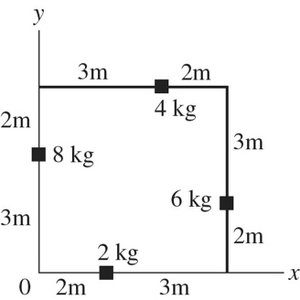
Q12. In the figure, four point masses are placed as shown. What are the x and y coordinates of the center of mass (or center of gravity) of this arrangement?
Background
Topic: Center of Mass Calculation
This question tests your ability to calculate the center of mass for a system of point masses in two dimensions.
Key Terms and Formulas:
Center of Mass (x-coordinate):
Center of Mass (y-coordinate):
Step-by-Step Guidance
List the coordinates and masses for each point mass from the diagram.
Set up the sums and using the given values.
Calculate the total mass .
Write the expressions for and but do not compute the final values yet.
Try solving on your own before revealing the answer!
Final Answer: (2.3 m, 2.7 m)
The center of mass is found by taking the weighted average of the positions of the masses.
Q13. Suppose the pendulum bob in the figure has a mass of 0.5 kg and it starts moving from rest at point A. Neglecting air resistance, what is the speed of the pendulum bob at point B?
Background
Topic: Conservation of Mechanical Energy (Pendulum)
This question tests your ability to use energy conservation to find the speed of a pendulum at a lower point.
Key Terms and Formulas:
Potential Energy at A:
Kinetic Energy at B:
Energy Conservation: (if starting from rest and neglecting friction)
Step-by-Step Guidance
Determine the height difference between points A and B.
Calculate the potential energy at point A using the height difference.
Set the potential energy at A equal to the kinetic energy at B.
Rearrange to solve for but do not compute the final value yet.
Try solving on your own before revealing the answer!
Final Answer:
The speed at point B is found by equating the loss in potential energy to the gain in kinetic energy.
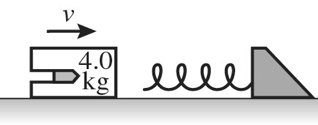
Q14. An 8.0-g bullet is suddenly shot into a 4.0-kg block that is at rest on a frictionless horizontal surface, as shown in the figure. The bullet remains lodged in the block. The block then moves against a spring and compresses it by 3.7 cm. The spring constant of the spring is given. Using conservation of energy and momentum, find the initial speed v of the bullet.
Background
Topic: Conservation of Momentum and Energy (Bullet-Block-Spring)
This question tests your ability to use both conservation of momentum (for the collision) and conservation of energy (for the spring compression).
Key Terms and Formulas:
Conservation of Momentum (collision):
Conservation of Energy (spring):
Spring constant: (given in the problem)
Compression: cm m
Step-by-Step Guidance
Use conservation of energy to relate to the spring compression and spring constant.
Solve for in terms of and .
Use conservation of momentum to relate the initial bullet speed to .
Set up the equation for but do not compute the final value yet.
Try solving on your own before revealing the answer!
Final Answer:
First, find from energy conservation, then use momentum conservation to solve for the bullet's initial speed.
