 Back
Potential Energy & Conservation of Energy: Study Notes for Physics with Calculus
Study Guide - Smart Notes
 Tailored notes based on your materials, expanded with key definitions, examples, and context.
Potential Energy & Conservation of Energy
Introduction to Mechanical Energy Conservation
The principle of conservation of mechanical energy is fundamental in physics, especially when analyzing systems where only conservative forces (such as gravity) are acting. In real-world scenarios, non-conservative forces like friction may also play a role, causing mechanical energy to be transformed into other forms such as heat.
Conservative vs. Non-Conservative Forces
Forces in physics are classified as either conservative or non-conservative. Conservative forces, such as gravity and spring force, store energy that can be fully recovered. Non-conservative forces, like friction, dissipate energy, usually as heat.
Conservative Force: Work done is independent of the path taken (e.g., gravity).
Non-Conservative Force: Work done depends on the path and results in energy loss (e.g., friction).
Potential Energy (U): Energy stored due to position in a conservative force field.
Kinetic Energy (K): Energy due to motion, given by .
Work Done by Non-Conservative Forces: Ramp Example
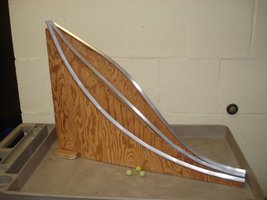
When a marble rolls down a ramp and launches horizontally from a table, the work done by friction (a non-conservative force) can be calculated by comparing the initial mechanical energy to the final mechanical energy.
Given: Marble mass kg, ramp height above table cm, table height above floor cm, horizontal distance traveled cm.
Initial Energy: (potential energy at top of ramp).
Final Energy: (potential energy at table + kinetic energy as it leaves table).
Work by Friction: .
Velocity Calculation: Use projectile motion equations to find from the horizontal distance and table height.
Example: If the marble lands 100 cm from the table, use and to solve for and then calculate the work done by friction.
Vertical Loop: Minimum Speed Calculation
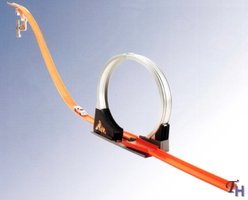
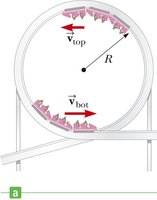
To ensure a roller-coaster car (or marble) completes a vertical loop without falling, it must maintain a minimum speed at the top of the loop. This is determined by the balance of forces and the requirement for centripetal acceleration.
At the top of the loop: The normal force must be zero for minimum speed, so only gravity provides the centripetal force.
Force equation: , where is the loop radius.
Minimum speed: .
Energy consideration: The car must have enough kinetic energy at the top: .
Conservation of energy: Initial energy at the bottom must equal energy at the top plus the energy needed for minimum speed.
Example: For a loop of radius , calculate the minimum speed at the top and relate it to the initial height required.
Conservation of Energy Worksheet & Lab
Students are encouraged to work collaboratively on problems involving energy conservation, discussing each step and ensuring understanding. The worksheet and lab activities reinforce the concepts of mechanical energy, potential energy, kinetic energy, and the effects of non-conservative forces.
Group Work: Discuss and solve problems related to energy conservation.
Lab Activities: Experimentally verify energy conservation and measure the effects of friction.
Summary Table: Energy Types and Conservation
Type of Energy | Formula | Conservative? | Example |
|---|---|---|---|
Potential Energy (Gravity) | Yes | Marble at top of ramp | |
Kinetic Energy | N/A | Marble rolling | |
Work by Friction | No | Energy lost as heat |
Additional info: The notes reference problems from a textbook (e.g., 7.41-42 p. 231) and encourage students to use conservation of energy principles in both theoretical and experimental contexts.
