 Back
BackPotential Energy and Conservation: Study Notes
Study Guide - Smart Notes
 Tailored notes based on your materials, expanded with key definitions, examples, and context.
Potential Energy & Conservation
Overview of Energy Types
Energy exists in various forms and can be transformed from one type to another. In physics, understanding the different types of energy and their transformations is crucial for analyzing physical systems.
Mechanical Energy (M.E.): The sum of kinetic and potential energies in a system.
Kinetic Energy (K): Energy due to motion.
Potential Energy (U): Stored energy due to position or configuration. Common types include gravitational and elastic potential energy.
Thermal Energy: Energy associated with the random motion of particles, often resulting from friction or heat.
Other Types: Electrical, nuclear, light, sound, etc., which are discussed in later chapters.
Energy Transformation: Energy can be converted from one form to another, such as potential energy converting to kinetic energy during free fall.
Conservation of Mechanical Energy
The mechanical energy of a system is the sum of its kinetic and potential energies. If only conservative forces are acting, the total mechanical energy remains constant.
Mechanical Energy Equation:
Conservation Principle: (if no non-conservative work is done)
Example: Dropping a ball from a height—potential energy at the top converts to kinetic energy at the bottom.
Steps for solving conservation of energy problems:
Draw a diagram of the system.
Write the conservation of energy equation.
Expand and eliminate terms as needed.
Solve for the unknown.
Useful equations:
Kinetic Energy:
Gravitational Potential Energy:
Conservation of Total Energy and Isolated Systems
Total energy is conserved in an isolated system, where no external forces do work. A system is defined by the objects chosen for analysis. If all forces are internal, the system is isolated and total energy is conserved.
Internal Forces: Forces between objects within the system.
External Forces: Forces from outside the system.
Example: A spring pushes a box. If the system is defined as the box only, energy is not conserved due to the external force from the spring. If the system is the box and spring together, all forces are internal and energy is conserved.

Conservative vs. Non-Conservative Forces
Mechanical energy is conserved only if the forces doing work are conservative. Conservative forces (like gravity and springs) allow energy to be fully recovered, while non-conservative forces (like friction and applied forces) dissipate energy, usually as heat.
Conservative Forces | Non-Conservative Forces |
|---|---|
Gravity (weight) | Applied Forces |
Spring (Hooke's Law) | Friction |
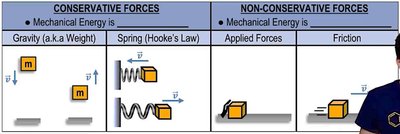
Conservative Forces: Work done is path-independent and reversible.
Non-Conservative Forces: Work done depends on the path and is not fully recoverable.
Example Situations:
Situation | Energy Conserved? | Energy Transfers |
|---|---|---|
Block falls without air resistance | Yes | Potential to kinetic |
Block hits spring and rebounds | Yes | Kinetic to elastic potential and back |
Block pushed by hand | No | Work done by applied force |
Block slows due to friction | No | Kinetic to thermal |
Conservation of Energy with Non-Conservative Forces
If non-conservative forces (e.g., friction, applied forces) do work, mechanical energy is not conserved. However, the total energy is still conserved if all forms are considered. The work done by non-conservative forces () accounts for the energy added or removed from the system.
General Energy Equation:
Work by a Force:
Work by Friction:
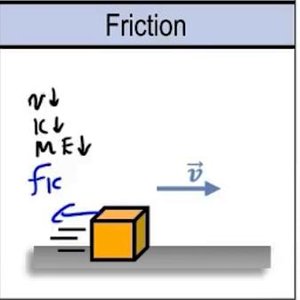
Example: A hockey puck is pushed across ice with a force, or a block slides to a stop due to friction. The work done by friction or applied force is included in the energy equation.
Elastic (Spring) Potential Energy
Springs store energy when compressed or stretched. This energy is called elastic potential energy and is given by Hooke's Law.
Elastic Potential Energy:
Work by Spring:
When solving spring problems:
If objects are stationary, use force equations.
If objects are moving, use energy conservation (since force is not constant).
Example: A block compresses a spring and is released, converting elastic potential energy into kinetic energy.
Potential Energy Graphs
Potential energy graphs plot versus position . The total mechanical energy at any point is the sum of kinetic and potential energies. The kinetic energy at a position is the difference between the total mechanical energy and the potential energy at that position.
Total Mechanical Energy: (constant if )
Kinetic Energy:
Objects remain between turning points (where ) unless energy is added.
Forces and Equilibrium in Potential Energy Graphs
The force at any point on a graph is the negative of the slope of the graph:
If the slope is negative (downhill), force is positive.
If the slope is zero (flat), force is zero (equilibrium point).
If the slope is positive (uphill), force is negative.
There are two types of equilibrium:
Stable Equilibrium: Local minimum of ; objects return if slightly displaced.
Unstable Equilibrium: Local maximum of ; objects do not return if displaced.
Example: Analyzing a ball's motion on a potential energy graph to determine force direction and equilibrium points.
Summary Table: Conservative vs. Non-Conservative Forces
Type of Force | Examples | Energy Conserved? | Work Path Dependence |
|---|---|---|---|
Conservative | Gravity, Spring | Yes | No |
Non-Conservative | Friction, Applied Force | No | Yes |
Additional info: These notes are based on Young & Freedman, University Physics, Chapter 7, and cover all major concepts, equations, and problem-solving strategies for potential energy and conservation in mechanical systems.
