 Back
BackPotential Energy & Conservation – Study Notes (Young & Freedman University Physics, Ch 07)
Study Guide - Smart Notes
 Tailored notes based on your materials, expanded with key definitions, examples, and context.
Potential Energy & Conservation
Overview of Energy Types
Energy exists in various forms and can be transformed from one type to another. Understanding these forms is essential for analyzing physical systems and solving problems in mechanics.
Mechanical Energy (M.E.): The sum of kinetic and potential energies in a system.
Non-Mechanical Energy (N.M.E.): Includes thermal, electrical, nuclear, light, sound, and other forms.
Kinetic Energy (K): Energy due to motion.
Potential Energy (U): "Stored" energy due to position or configuration. Common types include:
Gravitational Potential Energy (Ug): Due to height above a reference point.
Elastic (Spring) Potential Energy (U_{el}): Due to compression or stretching of a spring.
Thermal Energy: Associated with heat and friction.
Example: When a ball is dropped, its gravitational potential energy is converted into kinetic energy as it falls.
Conservation of Mechanical Energy
The mechanical energy of a system is the sum of its kinetic and potential energies. If only conservative forces are present, mechanical energy is conserved.
Mechanical Energy (ME):
Conservation Principle: (if no non-conservative work is done)
Steps to Solve Problems:
Draw a diagram of the system.
Write the conservation of energy equation.
Expand and eliminate terms as needed.
Solve for the unknown.
Example: Dropping a 2 kg ball from a 100 m building: Calculate total mechanical energy at the top and just before hitting the ground.
Conservation of Total Energy and Isolated Systems
Total energy is conserved in an isolated system, where no external forces do work. A system is a collection of objects chosen for analysis. If all forces are internal, the system is isolated and total energy is conserved.
Isolated System: No external work; only internal forces act.
External Forces: Originate outside the system; if present, the system is not isolated.
Internal Forces: Originate within the system; if all forces are internal, the system is isolated.
Example: A spring pushes a box. If the system is defined as only the box, external forces (spring) act. If the system is box + spring, all forces are internal.

Conservative vs. Non-Conservative Forces
Mechanical energy is conserved only if the forces doing work are conservative. Conservative forces (like gravity and springs) can store and recover energy, while non-conservative forces (like friction and applied forces) dissipate energy.
Conservative Forces: Gravity, springs (Hooke's Law). Mechanical energy is conserved.
Non-Conservative Forces: Applied forces, friction. Mechanical energy is not conserved.
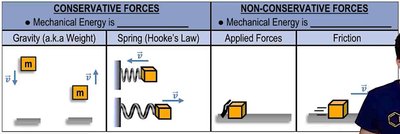
Example Table:
Situation | Energy Conserved? | Energy Transfers |
|---|---|---|
Block falls without air resistance | Yes | Potential → Kinetic |
Block hits spring and rebounds | Yes | Kinetic ↔ Elastic Potential |
Block pushed by hand | No | Work (Applied) → Kinetic |
Block slows due to friction | No | Kinetic → Thermal |
Conservation of Energy with Non-Conservative Forces
If non-conservative forces do work (), mechanical energy is not conserved, but total energy is. The work done by non-conservative forces equals the change in mechanical energy.
General Energy Equation:
Work by Non-Conservative Forces: (work by applied forces + friction)
Example: A hockey puck is pushed with a force over a distance; calculate its final speed using energy conservation.
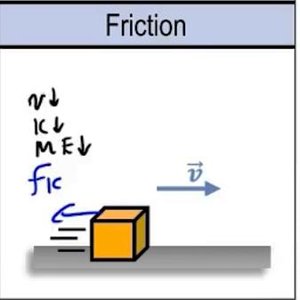
Solving Curved Path and Connected Systems Problems
Energy conservation is especially useful for objects moving along curved paths or for systems of connected objects. For connected objects, consider the energy of each object and remember they share the same acceleration and speed magnitude.
Curved Path: Use energy conservation to relate speeds and heights at different points.
Connected Systems: Include energies of all objects; use the same speed for connected masses.
Projectile Motion and Energy Conservation
Projectile motion problems involving speed or height can often be solved more easily using energy conservation, especially when air resistance is negligible.
Key Equation:
Elastic (Spring) Potential Energy
Springs store energy when compressed or stretched. This energy can be calculated and used in conservation of energy problems.
Elastic Potential Energy:
Work by Spring:
Work by Gravity:
Example: A block compresses a spring and is released; calculate the launch speed using energy conservation.
Potential Energy Graphs
Potential energy graphs plot versus position . The total mechanical energy is constant (if ), and kinetic energy at any point is the difference between total mechanical energy and potential energy.
Total Mechanical Energy: (constant if no non-conservative work)
Kinetic Energy:
Turning Points: Where ; object cannot go beyond these points without added energy.
Example: Given a graph, determine the total mechanical energy, kinetic energy at a point, speed, and whether the object can reach a certain position.
Forces and Equilibrium in Potential Energy Graphs
The force at any point on a graph is the negative of the slope of $U(x)$. Equilibrium points occur where the slope is zero. There are two types of equilibrium:
Stable Equilibrium: Local minimum of ; object returns if slightly displaced.
Unstable Equilibrium: Local maximum of ; object does not return if displaced.
Example: Analyze a graph to determine where force is zero, and identify stable and unstable equilibrium positions.
Summary Table: Conservative vs. Non-Conservative Forces
Type of Force | Examples | Mechanical Energy Conserved? |
|---|---|---|
Conservative | Gravity, Springs | Yes |
Non-Conservative | Friction, Applied Forces | No |
Additional info: These notes are based on Young & Freedman, University Physics, Ch 07, and are suitable for college-level introductory physics courses covering energy, conservation laws, and related problem-solving strategies.
