 Back
BackPotential Energy and Energy Conservation in Physics
Study Guide - Smart Notes
 Tailored notes based on your materials, expanded with key definitions, examples, and context.
Potential Energy and Energy Conservation
Introduction to Potential Energy
Potential energy is a form of energy associated with the configuration or position of objects within a system. It is not a property of individual objects, but rather of the system as a whole, depending on the interactions between its components.
Potential energy is stored energy due to the position or arrangement of objects.
Common examples include gravitational potential energy (due to height) and elastic potential energy (due to deformation of a spring).
Potential energy can be transformed into kinetic energy and vice versa, but the total energy in an isolated system remains constant.
Action-Reaction Pairs and System Definition
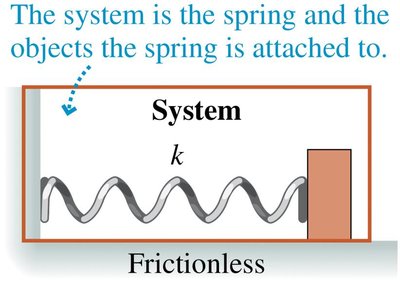
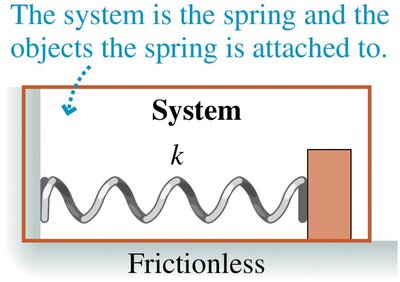
When analyzing energy, it is crucial to define the system boundaries. The way we define the system determines whether forces are considered internal or external, and whether potential energy is included.
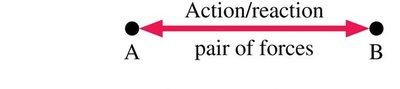
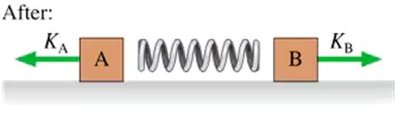
For two boxes connected by a spring, the spring exerts equal and opposite forces on each box (an action/reaction pair).
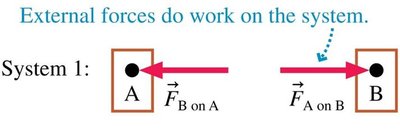
If the spring is outside the system, the forces are external and do work on the system.
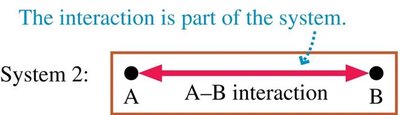
If the spring is inside the system, the forces are internal and energy is transformed within the system.

Applying the Energy Principle
The energy principle states that the change in the total energy of a system equals the work done by external forces. Depending on the system definition, potential energy may or may not be included.
System 1 (spring external):
System 2 (spring internal): (if no external work)
Potential energy is associated with the interaction (e.g., spring or gravity).
Work done by internal forces changes the potential energy:
Key Properties of Potential Energy
Potential energy is associated with interactions, not individual objects.
Changing the system definition can add or remove potential energy from consideration.
Common forces with associated potential energy: gravity, spring force, electric force.
Gravitational Potential Energy
Definition and Calculation
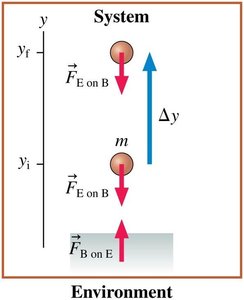
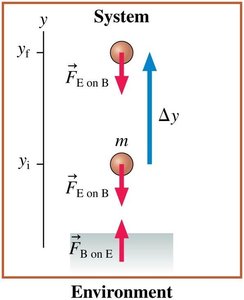
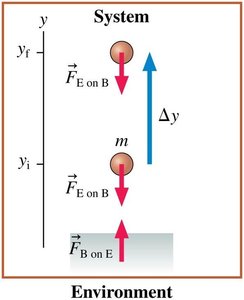
Gravitational potential energy is the energy stored in an object due to its position in a gravitational field. For objects near Earth's surface, it is given by:
The change in gravitational potential energy:
Only changes in potential energy () have physical significance.
Choice of Zero Point
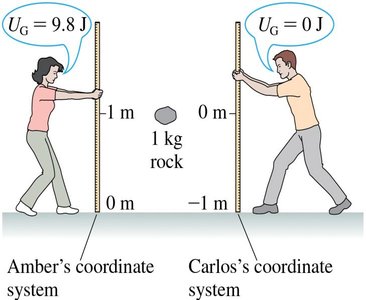
The value of gravitational potential energy depends on the choice of the zero point for height. Only differences in potential energy are physically meaningful.
Different observers may choose different reference points, but remains the same for a given displacement.
Energy Transformation in Free Fall
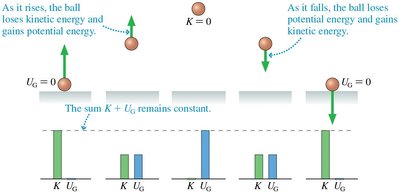
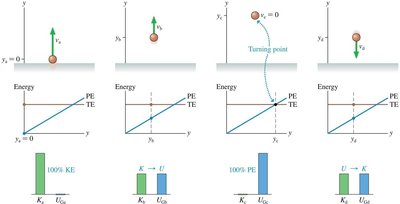
As an object moves under gravity, its kinetic and potential energies transform into each other, but their sum (mechanical energy) remains constant if no external work is done.
Mechanical energy:
As the object rises, decreases and increases; as it falls, $K$ increases and $U_G$ decreases.
Work Done by Gravity and Normal Force
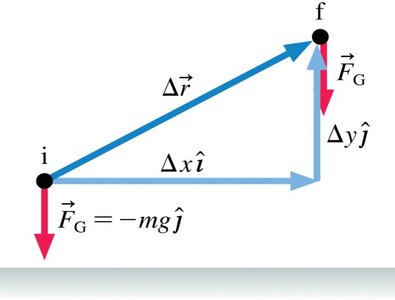
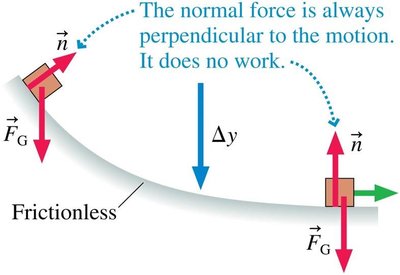
The work done by gravity depends only on the vertical displacement, not the path taken. The normal force does no work if it is always perpendicular to the displacement.
Work by gravity:
Normal force: (if perpendicular to motion)
Mechanical Energy with Friction
When friction is present, mechanical energy is not conserved. Some energy is transformed into thermal energy.
Energy principle with friction:
Friction is a dissipative force; it reduces the mechanical energy of the system.
Elastic Potential Energy
Spring Systems and Elastic Potential Energy
Elastic potential energy is stored in a spring or elastic object when it is compressed or stretched from its equilibrium position.
For a spring with spring constant and displacement :
Change in elastic potential energy:
Combining Energy Forms: Gravity, Spring, and Friction
In systems with multiple interactions (gravity, springs, friction), the total energy principle is:
Total energy is conserved if the system is isolated, but mechanical energy is not conserved if dissipative forces (like friction) are present.
Law of Conservation of Energy
The law of conservation of energy states that the total energy of an isolated system remains constant. Energy can be transformed between kinetic, potential, and thermal forms, but the sum does not change.
For an isolated, non-dissipative system: is conserved.
For a system with friction: is constant.
Problem-Solving Strategy: Energy Conservation Problems
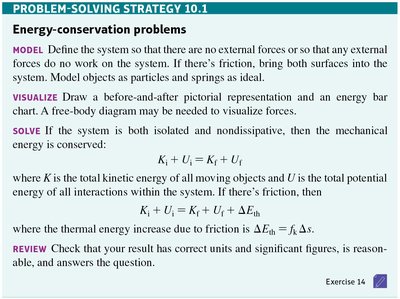
To solve energy conservation problems:
Define the system and identify all forms of energy involved.
Draw diagrams to visualize energy transformations.
Apply the energy conservation equation, including thermal energy if friction is present.
Solve for the unknowns, checking units and significance.
Energy Diagrams
Energy Diagrams: Visualizing Energy as a Function of Position
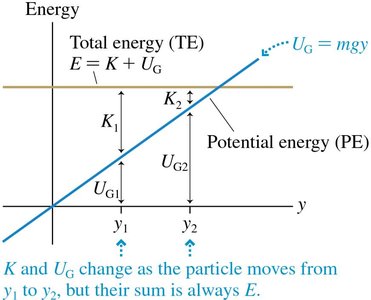
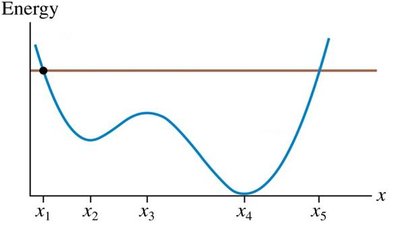
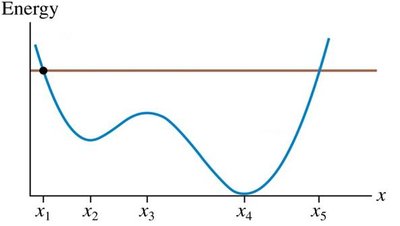
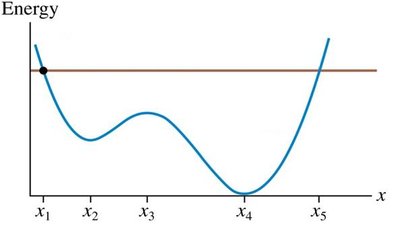
Energy diagrams plot potential energy and total energy as functions of position. They are useful for analyzing the motion and equilibrium of objects in a system.
For gravity: (linear relationship with position)
For a spring: (parabolic relationship)
The total energy line indicates the sum of kinetic and potential energy.
Interpreting Energy Diagrams
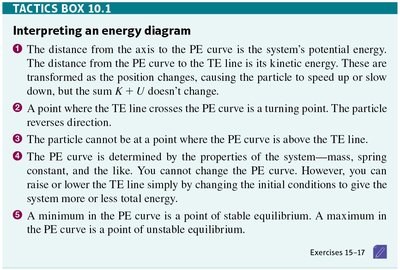
The distance from the potential energy curve to the total energy line is the kinetic energy at that position.
Turning points occur where the total energy line crosses the potential energy curve (kinetic energy is zero).
Minima in the potential energy curve correspond to stable equilibrium points; maxima correspond to unstable equilibrium points.
Force and Potential Energy
Relationship Between Force and Potential Energy
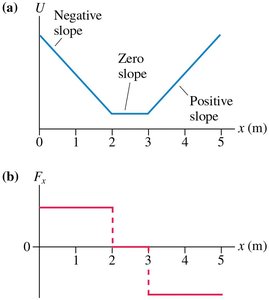
If the potential energy as a function of position is known, the force can be found as the negative derivative of potential energy with respect to position:
For a spring: (Hooke's Law)
Graphically, the force at a point is the negative slope of the potential energy curve at that point.
Conservative and Non-conservative Forces
Definitions and Properties
Conservative forces (e.g., gravity, spring force):
Have an associated potential energy.
Work done is path-independent.
Energy can be fully recovered as kinetic energy.
Non-conservative forces (e.g., friction, drag):
Do not have an associated potential energy.
Work done depends on the path taken.
Transform mechanical energy into thermal energy, which cannot be fully recovered.
Summary Table: Conservative vs. Non-conservative Forces
Type of Force | Potential Energy? | Path Dependence? | Energy Recovery |
|---|---|---|---|
Conservative | Yes | No | Fully recoverable |
Non-conservative | No | Yes | Not fully recoverable (dissipative) |
Key Equations
Gravitational potential energy:
Elastic potential energy:
Energy conservation (no friction):
Energy conservation (with friction):
Force from potential energy:
