 Back
Potential Energy, Work, and Conservation of Energy: Study Notes for Physics with Calculus
Study Guide - Smart Notes
 Tailored notes based on your materials, expanded with key definitions, examples, and context.
Chapter 6 & 7: Work, Kinetic Energy, Potential Energy, and Conservation of Energy
Work and Hooke's Law: Springs
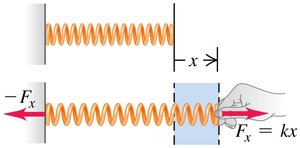
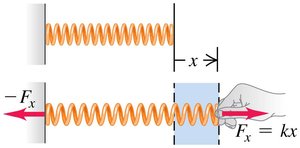
Springs are classic examples of systems where forces and energy can be analyzed using calculus. The force required to stretch or compress a spring is described by Hooke's Law, which states that the force is proportional to the displacement from equilibrium.
Hooke's Law: where k is the spring constant and x is the displacement.
Restoring Force: The spring exerts a force in the opposite direction of displacement: .
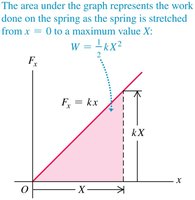
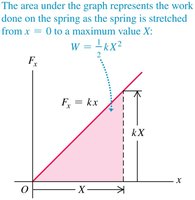
Work Done by Spring: The work required to stretch a spring from to is given by .
Graphical Representation: The area under the force vs. displacement graph represents the work done.
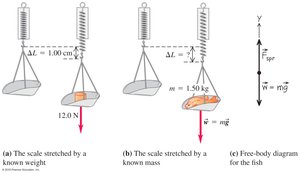
Example: If a spring with is stretched by attaching a mass, the displacement can be found using .
Work and Energy Along a Curved Path
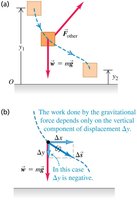
The expression for gravitational potential energy applies regardless of whether the path is straight or curved. The work done by gravity depends only on the change in vertical position.
Work by Gravity:
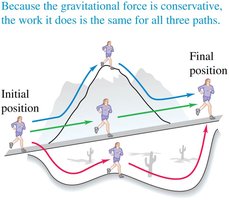
Path Independence: The work done by gravity is independent of the path taken between two points.
Example: Moving a block along a curved path from to yields the same work as moving it straight vertically.
Gravitational Potential Energy
Gravitational potential energy is the energy associated with an object's position in a gravitational field. Changes in this energy are related to the work done by gravity.
Definition:
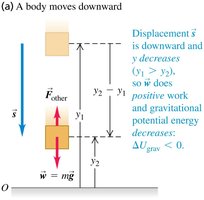
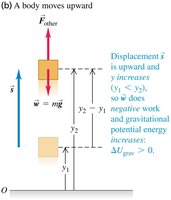
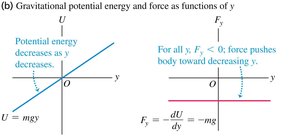
Energy Change: Moving up increases , moving down decreases it.
Work-Energy Relationship: When a body moves upward, gravity does negative work; when it moves downward, gravity does positive work.

Conservation of Mechanical Energy
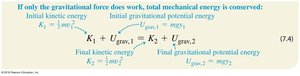
The total mechanical energy of a system is the sum of its kinetic and potential energies. When only conservative forces (like gravity) act, mechanical energy is conserved.
Mechanical Energy:
Conservation Law:
Conserved Quantity: A quantity that remains constant in a closed system.
Example: Two objects with different masses but equal speeds on a frictionless incline will rise to different heights, determined by their initial kinetic energies.
Energy Transformations in Projectile Motion
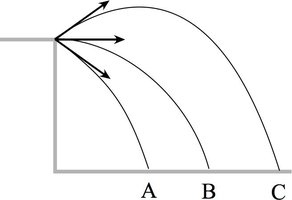
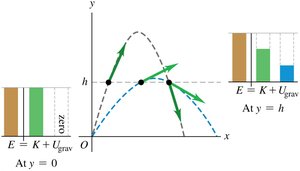
As a projectile moves, its kinetic and potential energies transform, but the total mechanical energy remains constant (in the absence of non-conservative forces).
Energy Shifts: At the highest point, all energy is potential; at the lowest, all is kinetic.
Example: Three balls thrown from a cliff with the same speed but different directions will have the same speed just before hitting the ground, due to energy conservation.
Vertical Loop Example: Conservation of Energy and Forces
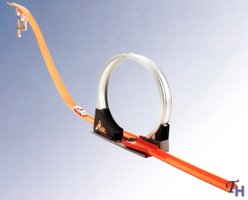
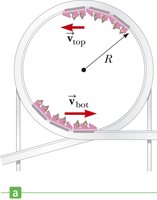
For a roller-coaster car in a vertical loop, both energy conservation and force analysis are required to determine the minimum speed at the top of the loop.
Force at Top: ; minimum speed occurs when .
Centripetal Force: At the top, gravity provides the necessary centripetal force.
Energy Consideration: The kinetic energy at the top must be sufficient to maintain circular motion.
Elastic Potential Energy
Elastic potential energy is stored in objects that can return to their original shape after deformation, such as springs.
Definition:
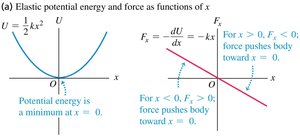
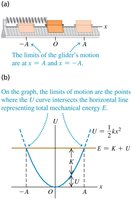
Graph: The elastic potential energy graph for an ideal spring is a parabola.
Properties: Elastic potential energy is never negative.
Work and Energy with Varying Forces
When the force varies with position, the work done is calculated using the integral of the force over the displacement.
Integral Expression:
Graphical Interpretation: The area under the force vs. position curve represents the total work done.

Force and Potential Energy in One Dimension
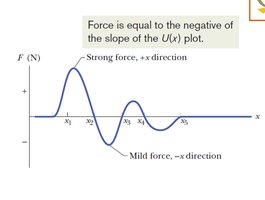
For conservative forces, the force can be derived from the potential energy function as the negative derivative with respect to position.
Force from Potential Energy:
Direction: Conservative forces push the system toward lower potential energy.

Force and Potential Energy in Three Dimensions
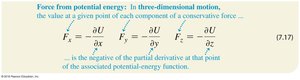
In three dimensions, the components of a conservative force are obtained from the partial derivatives of the potential energy function.
Component Expressions: , ,
Energy Diagrams and Equilibrium Points
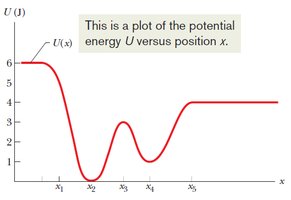
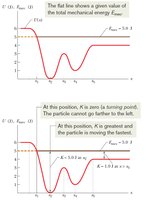
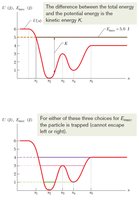
Energy diagrams graphically represent the potential energy function and total mechanical energy. They are useful for visualizing equilibrium points and motion limits.
Stable Equilibrium: At a minimum of U(x), the force acts to restore the object to equilibrium.
Unstable Equilibrium: At a maximum of U(x), the force acts to move the object away from equilibrium.
Neutral Equilibrium: At a flat region, the force is zero and the object remains at rest.
Conservative and Non-Conservative Forces
Conservative forces, such as gravity and spring force, allow energy to be converted between kinetic and potential forms. Non-conservative forces, like friction, dissipate mechanical energy as heat or other forms.
Conservative Force Properties:
Work is path-independent.
Work is reversible.
Work is zero for closed paths.
Non-Conservative Force Properties:
Work depends on the path.
Mechanical energy is not conserved.
Energy is dissipated (e.g., as heat).
Example: Friction in a rolling tire increases internal energy, raising temperature and pressure.

Law of Conservation of Energy
The law of conservation of energy states that energy cannot be created or destroyed, only transformed from one form to another. Non-conservative forces change the internal energy of a system but do not store potential energy.
Expression: (including all forms of energy)
Applications: Roller Coaster and Track Experiments
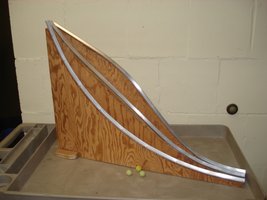
Energy conservation and work-energy principles are applied in problems involving roller coasters and marbles rolling down tracks.
Example: Calculating the speed of a roller coaster at different points, accounting for friction.
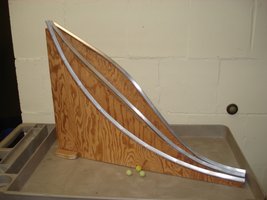
Example: Comparing the time and distance marbles travel along different tracks, using energy conservation.
Summary Table: Conservative vs. Non-Conservative Forces
Property | Conservative Force | Non-Conservative Force |
|---|---|---|
Path Dependence | No | Yes |
Energy Conservation | Mechanical energy conserved | Mechanical energy not conserved |
Potential Energy Function | Exists | Does not exist |
Examples | Gravity, Spring force | Friction, Air resistance |
Additional info: These notes expand on brief lecture points to provide full academic context, including definitions, formulas, and examples suitable for exam preparation in a Physics with Calculus course.
