 Back
BackPractice Exam 2 – Step-by-Step Physics Guidance
Study Guide - Smart Notes
 Tailored notes based on your materials, expanded with key definitions, examples, and context.
Q1a. What is the potential energy of the system of charges?
Background
Topic: Electrostatics – Potential Energy of Point Charges
This question tests your understanding of how to calculate the total electrostatic potential energy for a system of point charges. You need to consider the energy associated with each unique pair of charges.
Key Terms and Formulas
Electrostatic Potential Energy between two point charges:
Total potential energy for a system: Sum the potential energy for each unique pair of charges.
is Coulomb's constant:
are the charges, is the distance between them.
Step-by-Step Guidance
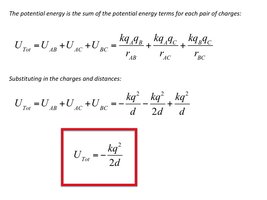
Identify all unique pairs of charges in the system. For three charges, there are three pairs: AB, AC, and BC.
Write the expression for the potential energy for each pair using .
Sum the potential energies for all pairs to get the total potential energy: .
Substitute the given values for the charges and distances into the formula.
Try solving on your own before revealing the answer!
Final Answer:
The total potential energy is found by summing the energy for each pair and simplifying the expression as shown.
Q1b. How much work was done to assemble the system if the charges initially started very far away from each other?
Background
Topic: Work and Potential Energy in Electrostatics
This question tests your understanding of the relationship between work and potential energy in assembling a system of charges from infinity.
Key Terms and Formulas
Work done to assemble the system = Total potential energy of the system
Step-by-Step Guidance
Recall that the work required to assemble a system of charges from infinity is equal to the total electrostatic potential energy calculated in part (a).
Use the result from part (a) as the value for the work done.
Try solving on your own before revealing the answer!
Final Answer:
The work done is numerically equal to the total potential energy found previously.
Q2. If an electron is accelerated from rest through a potential difference of 1500 V, what speed does it reach?
Background
Topic: Conservation of Energy – Electric Potential and Kinetic Energy
This question tests your ability to relate the change in electric potential energy to the kinetic energy gained by a charged particle (electron) accelerated through a potential difference.
Key Terms and Formulas
Change in potential energy:
Kinetic energy:
Conservation of energy:
Electron charge:
Electron mass:
Step-by-Step Guidance
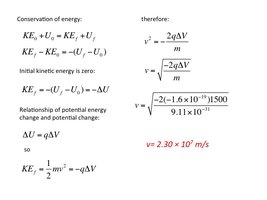
Set the initial kinetic energy to zero (electron starts from rest).
Write the energy conservation equation: .
Solve for : .
Plug in the given values for , , and .
Try solving on your own before revealing the answer!
Final Answer: m/s
The speed is found by substituting the values into the derived formula.
Q3a. Find the electric field at the origin (magnitude and direction) for the given charge configuration.
Background
Topic: Electric Field Due to Point Charges
This question tests your ability to calculate the net electric field at a point due to multiple point charges, including vector addition of field components.
Key Terms and Formulas
Electric field due to a point charge:
Superposition principle: The net field is the vector sum of the fields from all charges.
Decompose each field into x and y components using trigonometry.
Step-by-Step Guidance
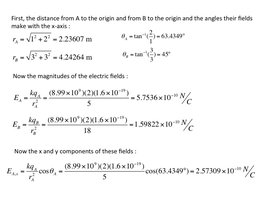
Calculate the distance from each charge to the origin and the angle each field makes with the x-axis.
Find the magnitude of the electric field from each charge at the origin using .
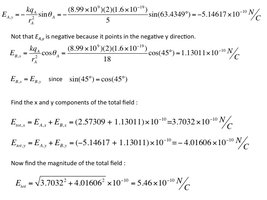
Resolve each field into x and y components using , .
Add the x and y components from all charges to get the total field components at the origin.
Find the magnitude and direction of the total electric field using and .
Try solving on your own before revealing the answer!
Final Answer: N/C, below x-axis
The net electric field is found by vector addition of the components from each charge.
Q3b. What is the potential energy of a proton located at the origin?
Background
Topic: Electric Potential and Potential Energy
This question tests your ability to calculate the electric potential at a point due to multiple charges and then use it to find the potential energy of another charge placed at that point.
Key Terms and Formulas
Electric potential due to a point charge:
Total potential: Sum the potentials from all charges at the origin.
Potential energy:
Step-by-Step Guidance
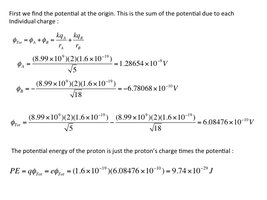
Calculate the potential at the origin due to each charge using .
Add the potentials from all charges to get the total potential at the origin.
Multiply the total potential by the charge of a proton to find the potential energy: .
Try solving on your own before revealing the answer!
Final Answer: J
The potential energy is found by multiplying the total potential at the origin by the proton's charge.
Q4a. What is the resistance of a 178 m long copper wire connected to a 1.20 V potential difference with a current of 2.00 A?
Background
Topic: Ohm's Law and Resistance
This question tests your understanding of how to calculate the resistance of a wire using Ohm's Law and the relationship between voltage, current, and resistance.
Key Terms and Formulas
Ohm's Law:
Resistance:
Step-by-Step Guidance
Identify the given values: V, A.
Use Ohm's Law to solve for resistance: .
Try solving on your own before revealing the answer!
Final Answer:
Plug the values into Ohm's Law to find the resistance.
Q4b. What is the diameter of this wire?
Background
Topic: Resistivity and Geometry of Conductors
This question tests your ability to relate the resistance of a wire to its physical dimensions and resistivity.
Key Terms and Formulas
Resistance of a wire:
Area of a wire:
Resistivity of copper:
Step-by-Step Guidance
Rearrange the resistance formula to solve for area: .
Express area in terms of diameter: .
Solve for by equating the two expressions for area and isolating .
Plug in the known values for , , and to solve for .
Try solving on your own before revealing the answer!
Final Answer: mm
The diameter is found by solving for using the rearranged resistance formula.
Q5a. What is the equivalent resistance of the circuit?
Background
Topic: Series and Parallel Circuits
This question tests your ability to find the equivalent resistance for a circuit with both series and parallel resistors.
Key Terms and Formulas
Series:
Parallel:
Step-by-Step Guidance
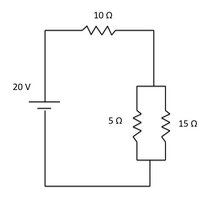
Identify which resistors are in series and which are in parallel.
Calculate the equivalent resistance of the parallel section (5 Ω and 15 Ω): .
Add the series resistor (10 Ω) to the equivalent parallel resistance to get the total equivalent resistance.
Try solving on your own before revealing the answer!
Final Answer:
The equivalent resistance is found by combining the parallel and series resistors as described.
Q5b. What is the total current in the circuit?
Background
Topic: Ohm's Law in Circuits
This question tests your ability to use Ohm's Law to find the total current in a circuit given the total voltage and equivalent resistance.
Key Terms and Formulas
Ohm's Law:
Step-by-Step Guidance
Identify the total voltage supplied by the battery ( V).
Use the equivalent resistance found in part (a).
Apply Ohm's Law: .
Try solving on your own before revealing the answer!
Final Answer: A
The total current is found by dividing the battery voltage by the equivalent resistance.
Q5c. How much current flows through each resistor?
Background
Topic: Current Division in Parallel Circuits
This question tests your understanding of how current divides in parallel branches and how to use Ohm's Law to find the current through each resistor.
Key Terms and Formulas
Ohm's Law:
Voltage across parallel resistors is the same.
Step-by-Step Guidance
Find the voltage drop across the 10 Ω resistor using .
Subtract this voltage from the total battery voltage to find the voltage across the parallel section (5 Ω and 15 Ω).
Use Ohm's Law to find the current through each parallel resistor: , .
Remember, the current through the 10 Ω resistor is the total current from part (b).
Try solving on your own before revealing the answer!
Final Answer:
Current through 10 Ω resistor: 1.45 A
Current through 5 Ω resistor: 1.09 A
Current through 15 Ω resistor: 0.36 A
Current divides in the parallel section according to the resistance values.
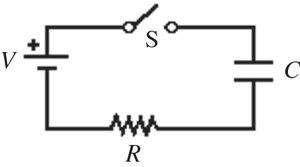
Q6. What is the charge on the capacitor 8.00 s after closing the switch in the RC circuit?
Background
Topic: RC Circuits – Charging a Capacitor
This question tests your understanding of the time-dependent charging of a capacitor in an RC circuit.
Key Terms and Formulas
Charge on a charging capacitor:
Time constant:
Given: V, F, , s
Step-by-Step Guidance
Calculate the time constant: .
Plug the values into the formula for : .
Evaluate the exponential term for s.
Multiply by and to find the charge at s.
Try solving on your own before revealing the answer!
Final Answer: C
The charge is found by substituting the values into the charging formula for capacitors.
Q7a. What is the potential energy held by the capacitor before the dielectric is inserted?
Background
Topic: Energy Stored in a Capacitor
This question tests your understanding of how to calculate the energy stored in a capacitor before any dielectric is inserted.
Key Terms and Formulas
Energy stored:
Given: F, V
Step-by-Step Guidance
Convert the capacitance to Farads: F F.
Plug the values into the energy formula: .
Try solving on your own before revealing the answer!
Final Answer: J
The energy is found by substituting the values into the formula.
Q7b. What is the capacitance of the capacitor after the slab is inserted?
Background
Topic: Capacitance with a Dielectric
This question tests your understanding of how a dielectric increases the capacitance of a capacitor.
Key Terms and Formulas
Capacitance with dielectric:
Dielectric constant:
Original capacitance: F
Step-by-Step Guidance
Multiply the original capacitance by the dielectric constant: .
Try solving on your own before revealing the answer!
Final Answer: F
The new capacitance is found by multiplying the original value by the dielectric constant.
Q7c. What is the potential difference across the capacitor with the dielectric inserted?
Background
Topic: Capacitance, Charge, and Voltage with Dielectrics
This question tests your understanding of how the voltage across a capacitor changes when a dielectric is inserted after the battery is removed (charge remains constant).
Key Terms and Formulas
Capacitance:
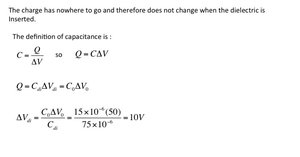
Charge remains constant when battery is disconnected.
Voltage after dielectric:
Step-by-Step Guidance
Recall that the charge does not change when the battery is removed.
Use the relationship to solve for .
Plug in the values for , , and to find the new voltage.
Try solving on your own before revealing the answer!
Final Answer: V
The voltage decreases because the capacitance increases while the charge remains constant.
