 Back
BackPrecession and Static Equilibrium: Concepts, Conditions, and Applications
Study Guide - Smart Notes
 Tailored notes based on your materials, expanded with key definitions, examples, and context.
Precession
Gyroscopes and Precession
Precession is a phenomenon observed in rotating bodies, such as gyroscopes or spinning wheels, where the axis of rotation itself moves in a circular path due to an applied torque. This effect is crucial in understanding the stability of spinning objects and is widely used in navigation and engineering.
Gyroscope: A device consisting of a spinning wheel or disk in which the axis of rotation is free to assume any orientation.
Precession: The slow, conical motion of the axis of a spinning object around another axis due to an external torque.
Torque and Angular Momentum: The direction of precession is determined by the right-hand rule applied to the torque and angular momentum vectors.
Equation: The rate of change of angular momentum is equal to the applied torque:
Uniform Circular Motion Analogy: When torque is perpendicular to angular momentum, the axis of rotation changes direction while the magnitude of angular speed remains constant.
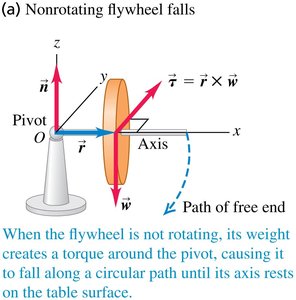
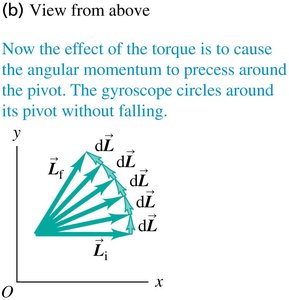
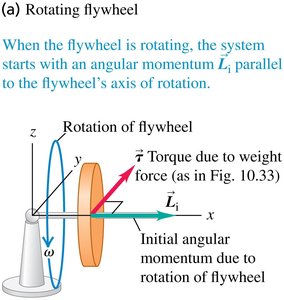
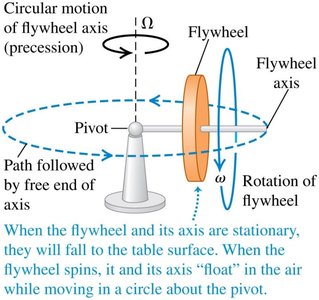
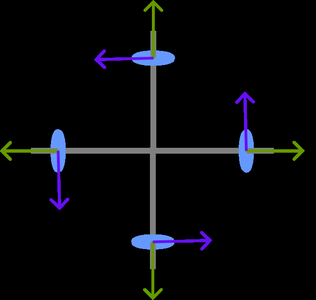
Example: A spinning bicycle wheel suspended from one end will precess horizontally rather than simply falling, due to the torque generated by gravity acting on the wheel's mass.
Static Equilibrium
Introduction to Static Equilibrium
Static equilibrium refers to the condition where an object remains at rest, with no net force or torque acting on it. This concept is fundamental in engineering and physics for analyzing structures and objects that must remain stable.
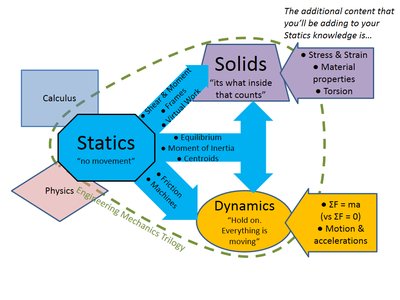
Statics: The branch of mechanics concerned with objects at rest and the forces in balance.
Applications: Used in civil engineering, architecture, and physics to ensure the stability of buildings, bridges, and other structures.
Conditions for Equilibrium
For an object to be in static equilibrium, two main conditions must be satisfied:
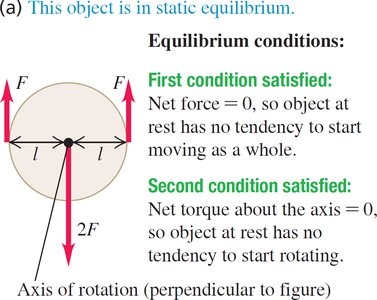
First Condition (Translational Equilibrium): The vector sum of all external forces acting on the object must be zero.
Second Condition (Rotational Equilibrium): The sum of all external torques about any axis must be zero.
Mathematically, these are expressed as:


Examples of Equilibrium Conditions
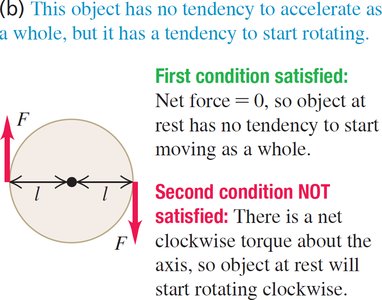
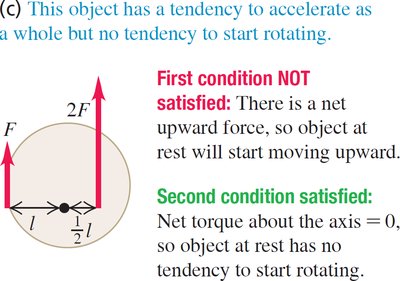
These diagrams illustrate how forces and torques must balance for equilibrium:
If both conditions are satisfied, the object remains at rest and does not rotate.
If only one condition is satisfied, the object may move or rotate.
Center of Gravity
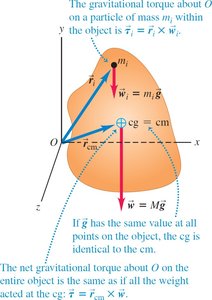
The center of gravity (CG) is the point at which the entire weight of an object can be considered to act. For most practical purposes in introductory physics, the center of gravity coincides with the center of mass.
Definition: The point where the total gravitational torque on the object is zero.
Calculation: For uniform gravity, , where is the position vector of the center of mass and is the weight.
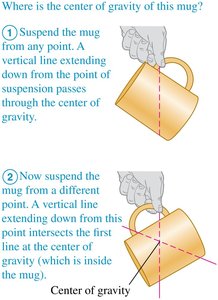
Experimental Location: The center of gravity can be found by suspending the object from different points and tracing vertical lines; their intersection locates the CG.
Equilibrium and Center of Gravity
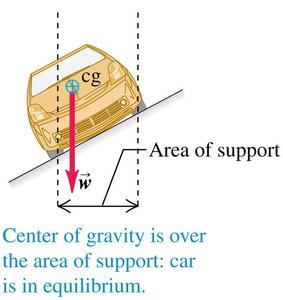
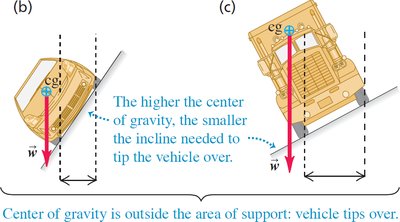
For an object supported at several points, the center of gravity must lie within the area bounded by the supports for equilibrium. If the CG is outside this area, the object will tip over.
Example: Balancing a Meter Stick
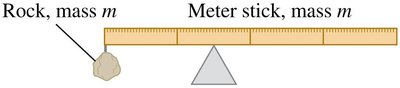
Consider a uniform meter stick with a rock of equal mass attached to one end. To balance the system, the support (pivot) must be placed closer to the heavier end. This is a classic application of torque and equilibrium conditions.
Problem-Solving Strategy for Static Equilibrium
To solve static equilibrium problems, follow these steps:
Sketch the physical situation and identify the object in equilibrium.
Draw a free-body diagram showing all forces and their points of application.
Choose coordinate axes and specify positive directions for forces and torques.
Choose a reference point for calculating torques.
Write equations for , , and .
Solve the equations for the unknowns.
Check your results by considering torques about a different reference point.
Example: Will the Ladder Slip?
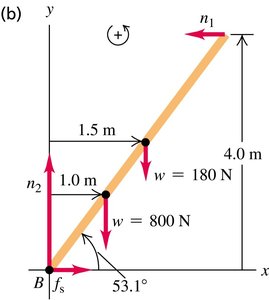
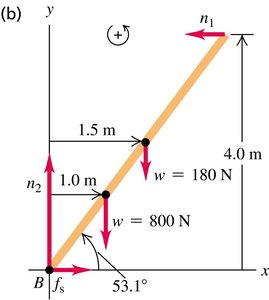
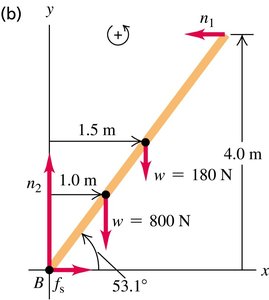
A uniform ladder rests against a frictionless wall, with a person standing on it. To determine the normal and friction forces at the base, apply the equilibrium conditions and solve the resulting equations.
Draw the free-body diagram, showing all forces (weight, normal, friction, and wall reaction).
Apply , , and to solve for the unknown forces.
Section Summary: Static Equilibrium
Two conditions must be met for static equilibrium: zero net force and zero net torque.
These conditions allow us to solve for unknown forces and torques in a variety of physical systems.
The weight of an object can be treated as acting at its center of gravity, which coincides with the center of mass in uniform gravity.
