 Back
Projectile Motion: Analysis and Calculations
Study Guide - Smart Notes
 Tailored notes based on your materials, expanded with key definitions, examples, and context.
Projectile Motion
Introduction to Projectile Motion
Projectile motion describes the two-dimensional motion of an object launched into the air, subject only to gravity (assuming air resistance is negligible). The motion can be analyzed by separating it into horizontal and vertical components.
Initial velocity (v0): The speed and direction at which the object is launched.
Angle of projection: The angle at which the object is launched with respect to the horizontal.
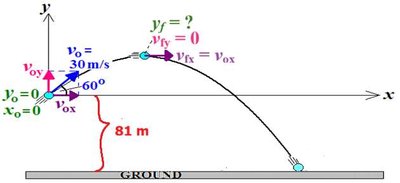
Horizontal and vertical components: The initial velocity can be resolved into horizontal (v0x) and vertical (v0y) components.
Resolving Initial Velocity
The initial velocity vector is split into horizontal and vertical components using trigonometric functions:
Horizontal component: $v_{0x} = v_0 \cos \theta$
Vertical component: $v_{0y} = v_0 \sin \theta$
For example, if $v_0 = 30\ \mathrm{m/s}$ and $\theta = 60^\circ$:
$v_{0x} = 30 \cos 60^\circ = 15\ \mathrm{m/s}$
$v_{0y} = 30 \sin 60^\circ \approx 25.98\ \mathrm{m/s}$
Equations of Motion
The position and velocity of the projectile at any time t can be found using the following equations:
Horizontal position: $x = x_0 + v_{0x} t$
Vertical position: $y = y_0 + v_{0y} t - \frac{1}{2} g t^2$
Horizontal velocity: $v_x = v_{0x}$ (constant)
Vertical velocity: $v_y = v_{0y} - g t$
Where $g$ is the acceleration due to gravity ($9.8\ \mathrm{m/s^2}$).
Key Features of Projectile Motion
Maximum height: The highest point reached by the projectile, where $v_y = 0$.
Time of flight: The total time the projectile is in the air.
Range: The horizontal distance traveled by the projectile before landing.
Example Problem: Projectile Launched from a Height
Consider a projectile launched from the edge of a cliff 81 m above the ground with an initial velocity of 30 m/s at an angle of 60° above the horizontal. The diagrams show the trajectory and the velocity components at various points.
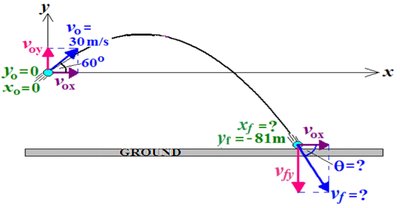
Initial position: $x_0 = 0$, $y_0 = 0$
Final vertical position: $y_f = -81\ \mathrm{m}$ (below the starting point)
Find: The final velocity magnitude and direction upon impact with the ground.
Calculating Final Velocity
The final velocity vector can be found by combining the horizontal and vertical components at the moment the projectile hits the ground:
Horizontal velocity: $v_{fx} = v_{0x}$ (remains constant)
Vertical velocity: $v_{fy} = v_{0y} - g t$ (must solve for $t$ using the vertical position equation)
Magnitude of final velocity: $v_f = \sqrt{v_{fx}^2 + v_{fy}^2}$
For example, if $v_{fx} = 15\ \mathrm{m/s}$ and $v_{fy} = -47.57\ \mathrm{m/s}$:
$v_f = \sqrt{15^2 + 47.57^2}$

Summary Table: Key Quantities in Projectile Motion
Quantity | Symbol | Equation |
|---|---|---|
Horizontal velocity | $v_{0x}$ | $v_0 \cos \theta$ |
Vertical velocity | $v_{0y}$ | $v_0 \sin \theta$ |
Horizontal position | $x$ | $x_0 + v_{0x} t$ |
Vertical position | $y$ | $y_0 + v_{0y} t - \frac{1}{2} g t^2$ |
Final velocity magnitude | $v_f$ | $\sqrt{v_{fx}^2 + v_{fy}^2}$ |
Additional info: In real-world scenarios, air resistance may affect the trajectory, but it is neglected in introductory physics problems unless otherwise specified.
