 Back
BackProjectile Motion and 2D Kinematics: Study Notes
Study Guide - Smart Notes
 Tailored notes based on your materials, expanded with key definitions, examples, and context.
Projectile Motion and 2D Kinematics
1-D Kinematics Equations
One-dimensional kinematics describes the motion of objects along a straight line, using position, velocity, and acceleration. For constant acceleration, the following equations are fundamental:
Average velocity:
Instantaneous velocity:
Average acceleration:
Instantaneous acceleration:
Kinematic equations for constant acceleration:
Example: If a car accelerates from rest at for , its final velocity is .
2-D Kinematics: Definitions and Vector Components
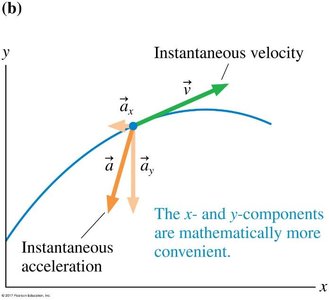
Two-dimensional kinematics extends motion analysis to the plane, using vectors for position, velocity, and acceleration. Each vector can be decomposed into x and y components:
Position vector:
Displacement:
Velocity:
Acceleration:
Magnitude and direction: ,
Example: A ball moving diagonally has and , so .
Vector Form of Constant Acceleration Kinematic Equations
For constant acceleration in two dimensions, the kinematic equations can be written in vector form and then separated into components:
Component forms:
Example: If and , the x-motion is uniform, and the y-motion is constant acceleration.
Acceleration in 2D: Effects on Motion
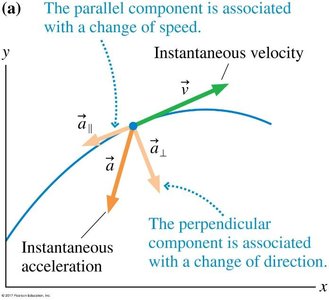
Acceleration in two dimensions can change both the speed and direction of an object. The vector nature of acceleration means it can be decomposed into components parallel and perpendicular to velocity:
Parallel component (): Changes the speed.
Perpendicular component (): Changes the direction.
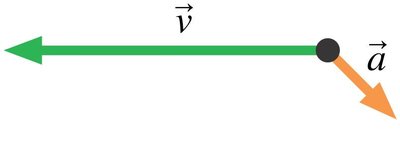
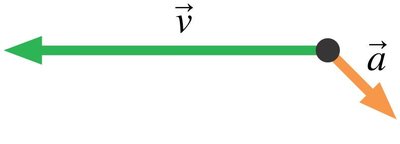
Example: A particle with velocity to the left and acceleration downward will slow down and curve downward.
Projectile Motion: Definitions and Assumptions
Projectile motion is a classic example of 2D constant-acceleration motion, where an object moves under the influence of gravity alone (neglecting air resistance). The acceleration is purely vertical:
Acceleration vector: , where
Motion in x: Uniform (constant velocity)
Motion in y: Constant acceleration (gravity)
Assumptions:
Air resistance is negligible
Gravity is constant and directed downward
Earth's rotation and curvature are ignored
Example: A ball thrown horizontally from a cliff follows a parabolic trajectory.
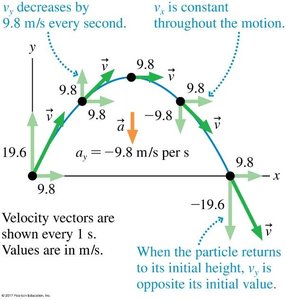
Projectile Motion: Equations for General Launch Angle
When a projectile is launched at an angle above or below the horizontal, its initial velocity can be decomposed:
(above horizontal), (below horizontal)
The position and velocity at any time are:
Example: A ball launched at above the horizontal with has and .
Solving 2D Kinematics Problems
To solve projectile motion problems:
Break vectors into x and y components
Treat x and y motion independently, but use the same time variable
Identify key events (e.g., landing, maximum height)
Use tables to organize known and unknown values
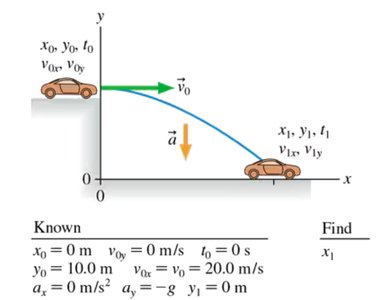
Example: A car drives off a 10.0-m-high cliff at 20 m/s. Find how far it lands from the base:
Vertical motion:
Time to fall:
Horizontal distance:
Summary Table: Projectile Motion Variables
The following table summarizes the key variables and their typical values in projectile motion problems:
Variable | Symbol | Typical Value/Expression |
|---|---|---|
Initial position (horizontal) | Given or 0 | |
Initial position (vertical) | Given (e.g., height of cliff) | |
Initial velocity (horizontal) | ||
Initial velocity (vertical) | ||
Acceleration (horizontal) | 0 | |
Acceleration (vertical) | ||
Time of flight | ||
Horizontal distance |
