 Back
Projectile Motion and Circular Motion: Range, Trajectories, and Applications
Study Guide - Smart Notes
 Tailored notes based on your materials, expanded with key definitions, examples, and context.
Projectile Motion
Maximum Height of a Projectile
When a projectile is launched, its maximum height (ymax) is reached when its vertical velocity becomes zero. The following equations describe this process:
Equation for Maximum Height: Where v0y is the initial vertical velocity and g is the acceleration due to gravity.
Key Points:
Maximum height depends only on the initial vertical velocity and gravity.
Horizontal velocity does not affect maximum height.
Height increases quadratically with v0y and decreases with stronger gravity.
Example: If a soccer ball is kicked upward with v0y = 11.47 m/s, then m.
Time to Reach Maximum Height
The time to reach the top of the trajectory is when the vertical velocity becomes zero:
Equation for Time to Top:
Key Points:
Time to top depends only on initial vertical velocity and gravity.
It increases linearly with v0y and decreases with stronger gravity.
Example: For v0y = 11.47 m/s, s.
Characteristics of Projectile Motion
Constant Acceleration: The acceleration is always downward and constant (gravity).
Horizontal Velocity: Remains constant throughout the flight.
Vertical Velocity: Is zero at the highest point.
Symmetry: Time spent rising equals time spent falling (to the same altitude).
Return Speed: Returns to the original altitude at the same speed (but downward).
Range of a Projectile
The range (R) is the horizontal distance traveled by a projectile. For launch and landing at the same altitude:
Equation for Range: Where v0 is the initial speed and θ is the launch angle.
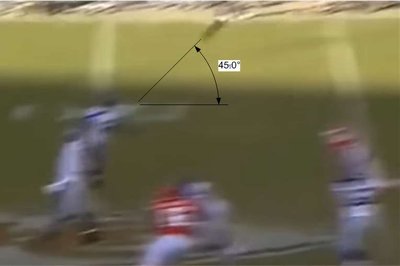
Maximum Range: Occurs at a launch angle of 45°.
Example: A quarterback throws a football at 22.3 m/s at 45°: m (about 55.5 yards)
Launch Angle for a Given Range
To achieve a specific range with a given speed, the launch angle can be calculated:
Equation for Launch Angle:
Key Points:
Two angles can produce the same range: a low arc and a high arc.
For example, to throw 35 m with 20 m/s, or .
Circular Motion
Acceleration in Circular Motion
When an object moves in a circle, its acceleration is always directed toward the center (centripetal acceleration):
Centripetal Acceleration: Where v is the tangential speed and R is the radius of the circle.
Angular Velocity: Where ω is angular velocity (rad/s) and T is the period (time for one revolution).
Key Points:
Acceleration is always perpendicular to velocity in uniform circular motion.
Results in a circular trajectory.
Example: Maximum Speed in Circular Motion
If a car can accelerate up to 8 m/s2 before sliding, and the radius of the circle is 6 m, the maximum speed is:
Equation:
Calculation: m/s (about 16 mph)
Summary Table: Projectile Motion Equations
Quantity | Equation | Variables |
|---|---|---|
Maximum Height | Initial vertical velocity, gravity | |
Time to Top | Initial vertical velocity, gravity | |
Range | Initial speed, launch angle, gravity | |
Centripetal Acceleration | Tangential speed, radius |
