 Back
BackProjectile Motion and Two-Dimensional Kinematics
Study Guide - Smart Notes
 Tailored notes based on your materials, expanded with key definitions, examples, and context.
Motion in Two or Three Dimensions
Projectile Motion: Fundamentals
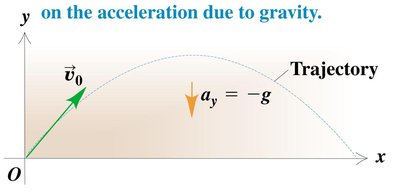
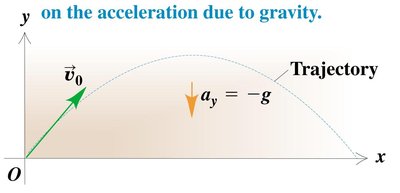
Projectile motion describes the path of an object launched into the air, subject only to gravity. The motion occurs in a vertical plane and is determined by the initial velocity vector and the constant acceleration due to gravity. The trajectory is parabolic and can be analyzed by decomposing the motion into horizontal and vertical components.
Projectile: An object moving in a vertical plane under the influence of gravity alone.
Initial velocity vector (\(\vec{v}_0\)): The velocity at which the projectile is launched.
Acceleration due to gravity (\(a_y = -g\)): Gravity acts downward with a constant acceleration of \(9.81\, \text{m/s}^2\).
Trajectory: The path followed is a parabola.
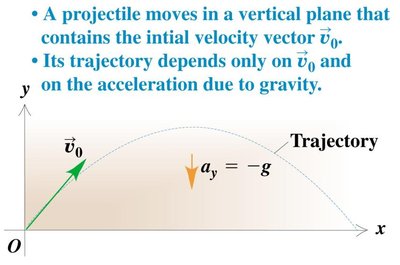
Example: Footballs, baseballs, and basketballs all follow parabolic paths when thrown or kicked.
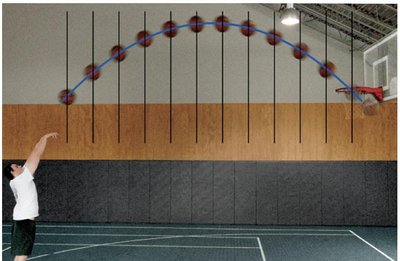
Independence of Horizontal and Vertical Motion
The horizontal (x) and vertical (y) motions of a projectile are independent. The horizontal motion occurs at constant velocity, while the vertical motion is a free fall under gravity.
Horizontal motion: Constant velocity (\(a_x = 0\)).
Vertical motion: Constant acceleration (\(a_y = -g\)).
Independence: The time to reach the ground depends only on the vertical motion.
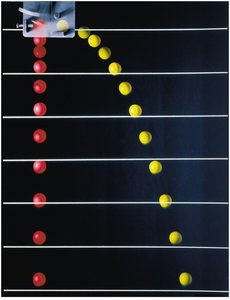
Example: If two balls are released simultaneously, one dropped vertically and one projected horizontally, both reach the ground at the same time.
Kinematic Equations for Projectile Motion
Projectile motion can be analyzed using kinematic equations, with the initial velocity decomposed into x and y components:
\(v_{0x} = v_0 \cos \alpha_0\)
\(v_{0y} = v_0 \sin \alpha_0\)
Horizontal position:
Vertical position:
Vertical velocity:
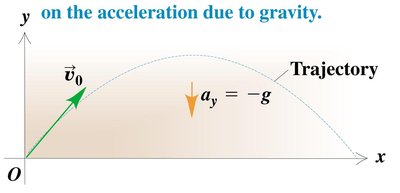
Additional info: The trajectory is symmetric; the time to reach maximum height equals the time to descend from maximum height to the launch level.
Maximum Height of a Projectile
The maximum height is reached when the vertical velocity becomes zero. The time to reach maximum height and the height itself can be calculated as follows:
Time to maximum height:
Maximum height:
For a given initial speed, maximum height is greatest at a launch angle of 90°.
Maximum Range of a Projectile
The range is the horizontal distance traveled when the projectile returns to its original elevation. The maximum range occurs at a launch angle of 45°.
Total time of flight:
Range:
Maximum range at \(\alpha_0 = 45°\) when launch and landing heights are equal.
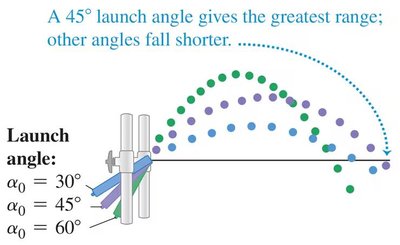
Additional info: If the launch and landing heights are not equal, the angle for maximum range will differ.
Applications and Conceptual Questions
Projectile motion principles are used in sports, engineering, and physics demonstrations. Conceptual questions often test understanding of the independence of x and y motion, and the effects of gravity.
Example: A zookeeper must aim directly at a falling monkey to hit it, as both the dart and monkey experience the same vertical acceleration.
Practice: Objects dropped from moving vehicles retain their horizontal velocity and remain directly below the vehicle (in the absence of air resistance).
